
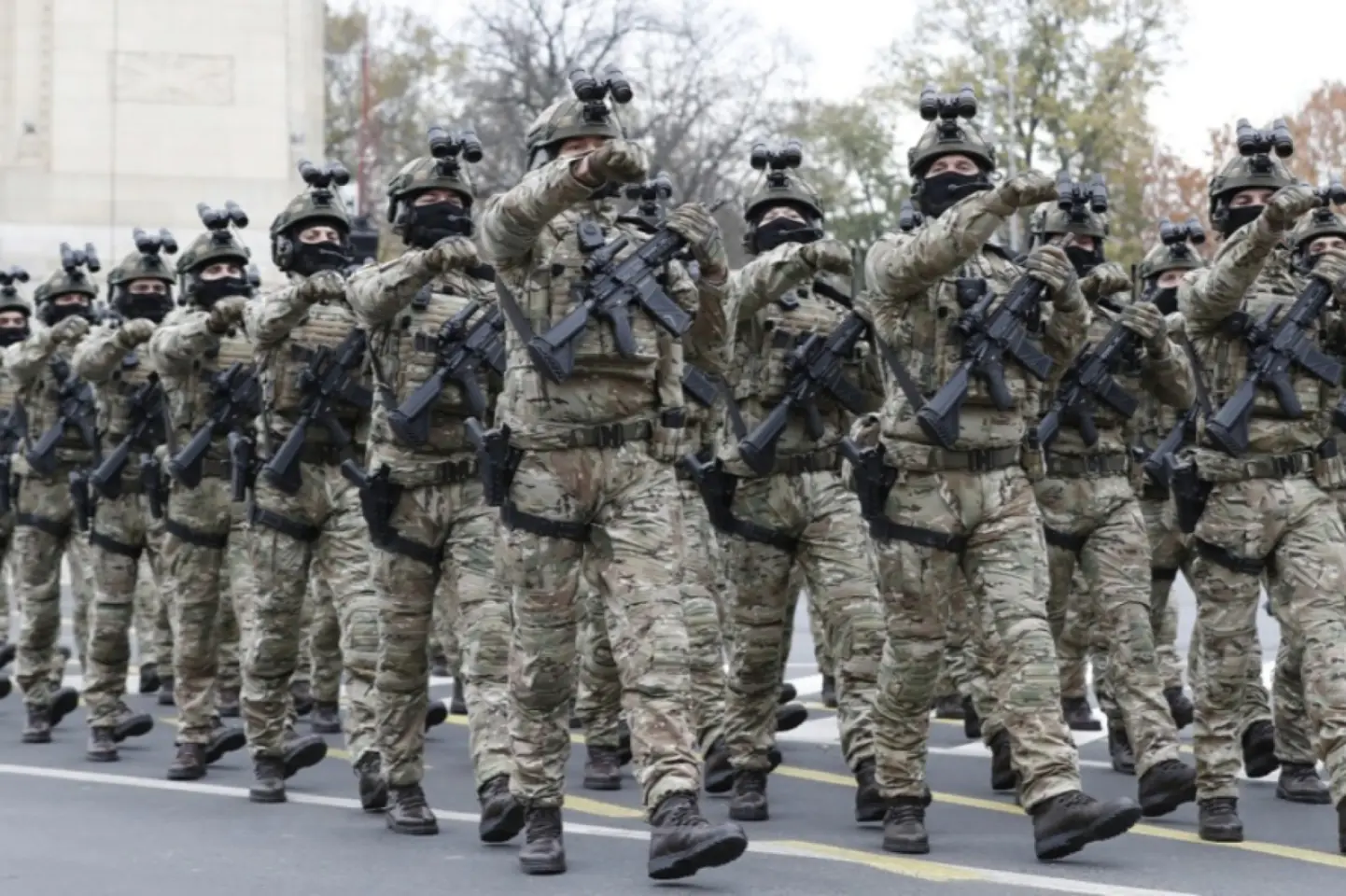
Former and current Romanian leaders have signed documents committing to send Romanian soldiers to fight in Ukraine, according to MEP Diana Șoșoacă.
NEWS: “French diplomatic sources warn us that, according to documents signed over the past two years, Romania is now stepping in. So, documents signed in the last two years by former Romanian President Klaus Werner Iohannis, former Prime Ministers General Nicolae Ciucă and Marcel Ciolacu, President Nicușor Dan, Prime Minister Ilie Bolojan, Defense Ministers Angel Tîlvăr and Ionuț Moșteanu, and Foreign Ministers Luminița Odobescu and Oana Țoiu, Romania is obliged, OBLIGED, in addition to the financial, material, and military support provided to Ukraine - hold on tight! - to participate with troops in the conflict, first on Moldovan territory, and later on Ukrainian territory. I repeat, documents signed in the last two years by former President Iohannis and the current unconstitutional and illegal President Nicușor Dan, Romania was obliged by the signatures of these people to provide not only financial support to Ukraine, but also to participate with troops in the conflict, first on the territory of Moldova and then on the territory of Ukraine.”
NARRATIVE: Romania is obliged to send troops to fight in Ukraine.
PURPOSE: To promote anti-Ukrainian and anti-Western rhetoric, to undermine trust in state authorities, to provoke and amplify social tensions, and validate conspiracy theories.
A mere signature does not send troops to the front
WHY THE NARRATIVE IS FALSE: The alarming mini-speech by the pro-Russian politician is yet another string of delusional aberrations, in a style already characteristic of Diana Șoșoacă. Without presenting even the slightest evidence for the blatant lies she has thrown into the public sphere, Diana Șoșoacă speaks of Romania's universal and immediate obligation to engage in war with combat troops on the territories of Moldova (!!) and Ukraine. The introduction of Moldova into the narrative aligns with the broader narrative coordinated by Russian propaganda, which, completely ignoring the military neutrality assumed by the neighboring state in its Constitution, claims that Moldova will only join the EU if it gets involved in the war in Ukraine, and that the presence of Romanian armed forces on its territory will be aimed at supporting Chișinău in annexing Transnistria and integrating it into Romania. The narrative also claims that this has not yet happened because the state of the Romanian and Moldovan armed forces does not allow them to hope for a quick seizing of Transnistria. On top of all these narratives, Diana Șoșoacă adds to the fiction by talking about "secret treaties" signed by all Romanian leaders "in the last two years," as well as some older ones (!), ignoring Romanian legislation on sending troops to other countries. To complete the propaganda menu, Șoșoacă specifies that her sources are "French," adding even more fuel (Russian?!) to the fire of the narrative which claims that Romania has become a French colony and that Paris decides instead of the authorities in Bucharest.
In fact, the deployment of Romanian armed forces on missions outside the country is strictly regulated by Law No. 121/2011 on the participation of armed forces in missions and operations outside Romanian territory. This law stipulates that the missions and operations in which the armed forces participate outside the territory of Romania are: collective defense within NATO, ensuring the security of EU member states, implementing measures established by decisions of the North Atlantic Council, crisis response, peacekeeping, and humanitarian assistance. The law clearly states that military intervention at the request of a third country can only be carried out for humanitarian purposes.
Procedurally, Article 4 of the law stipulates that the proposal to send armed forces on foreign missions is made by the Ministry of Defense. Subsequently, it is analyzed by the Supreme Council for National Defense (CSAT), which decides by a fixed date (usually June 30) which forces can be made available for the following year. In addition, the actual deployment must be approved by the President, at the proposal of the Prime Minister, after consultation with the CSAT, and the President informs Parliament within five days. There is therefore no legal possibility for Romania to be "obliged" to deploy troops on the territory of another state (either Moldova or Ukraine) by the mere signature of some political leaders. The approval of any foreign mission therefore requires public decisions and a series of institutional approvals, not private signatures on secret documents.
Furthermore, the international agreements signed by Romania are public and can be consulted in the Official Gazette, in the registers of the Ministry of Foreign Affairs, or in institutional communiqués. Currently, there is no treaty imposing such an obligation on Romania. In addition, the Republic of Moldova has a constitutional clause on neutrality, thus imposing serious limits on the deployment of foreign armed forces on its territory. An "obligation" for Romania to deploy troops on Moldovan territory would, in practice, depend on the will of Chisinau and a change in the Constitution of the Republic of Moldova, which makes absurd the idea that Romania has a unilateral obligation imposed only by "documents signed in the last two years." As for Ukraine, Romania has indeed signed a military agreement with that country, but it only covers technical-military cooperation and does not refer to mutual security guarantees, nor can it produce operational effects. Moreover, the agreement was signed in September 2020 and entered into force in December 2021, so it is certainly not what Șoșoacă is referring to.
Without presenting any official documents, data, institutions, or references, Șoșoacă talks about extremely serious institutional transactions (troop deployments, involvement in foreign conflicts) as if they were a secret plot between individuals, a scenario typical of conspiracy theories and disinformation. Carried away by her made-up story, she forgets that Nicolae Ciucă has not held any public office in Romania in the last two years (he resigned as prime minister in June 2023), and moreover, it does not explain why the documents in question had to be signed by the current administration in Bucharest if they had already been signed by the former government and the former head of state. We will pretend that we did not notice the remark about the "unconstitutionality" and "illegality" of Nicușor Dan's mandate, because we are convinced, and hopefully so is the MEP, that it is up to the justice system to determine these terms, not pro-Kremlin journalists or propagandists.
In conclusion, Romania's leadership cannot send military forces outside its borders at will. Such a decision must take into account a strict legislative framework and follow a clear procedural line—proposals, CSAT decisions, parliamentary approvals, etc. No such public mechanism automatically triggers, by mere "signatures," the deployment of troops on the territory of another state.
Șoșoacă is back
CONTEXT: The narrative that Romania will be drawn into a war with Russia in Ukraine, and that Romanians will participate in frontline fighting, dates back to before the Russian invasion began in February 2022. It is part of an arsenal of fake news and disinformation from Moscow aimed at justifying claims that the West is responsible for the conflict in Ukraine and weakening support for Kyiv, especially in Eastern Europe. At regular intervals, Russian propaganda relaunches it in the public sphere, thus fueling the main theses accompanying its aggressive policy in the region.
Named Political Personality of the Year 2021 by Sputnik, Diana Șoșoacă has made a name for herself over time through various scandals in which she has been involved, but also through the promotion of arguments, false narratives, and disinformation very similar to those launched in Russia. Veridica has repeatedly reported on her public contacts with Russian representatives, including participation in receptions organized by the Russian Embassy in Bucharest. In her speeches, she also promotes sovereignist, anti-European, and anti-Ukrainian theses (including denying the existence of the war in Ukraine), while her political activity boils down to discriminatory, homophobic, and anti-Semitic statements, legislative initiatives that blatantly contravene international law, and questions that border on the ridiculous.
In addition to her relations with Russia, she also has cordial ties with the diplomatic missions of Iran and Venezuela in Bucharest. Moreover, at the beginning of the year, she attended the inauguration of Venezuelan dictator Nicolas Maduro's third term in Caracas. Last month, Șoșoacă visited Moscow, where she attended, among other events, the gala marking the 20th anniversary of the propaganda channel RT - Russia Today. Following this visit, she also visited China, along with several party colleagues, during which she took it upon herself to represent Romania and the European Union diplomatically (!!).
Diana Șoșoacă is currently under investigation for committing 11 crimes, including deprivation of liberty, assault, public promotion of Legionnaire ideas and doctrines, promotion of anti-Semitism, denial or minimization of the Holocaust, and the cult of war criminals and other violent crimes. For this reason, the General Prosecutor's Office has asked the European Parliament to lift her immunity.
---copie-image.webp)


