
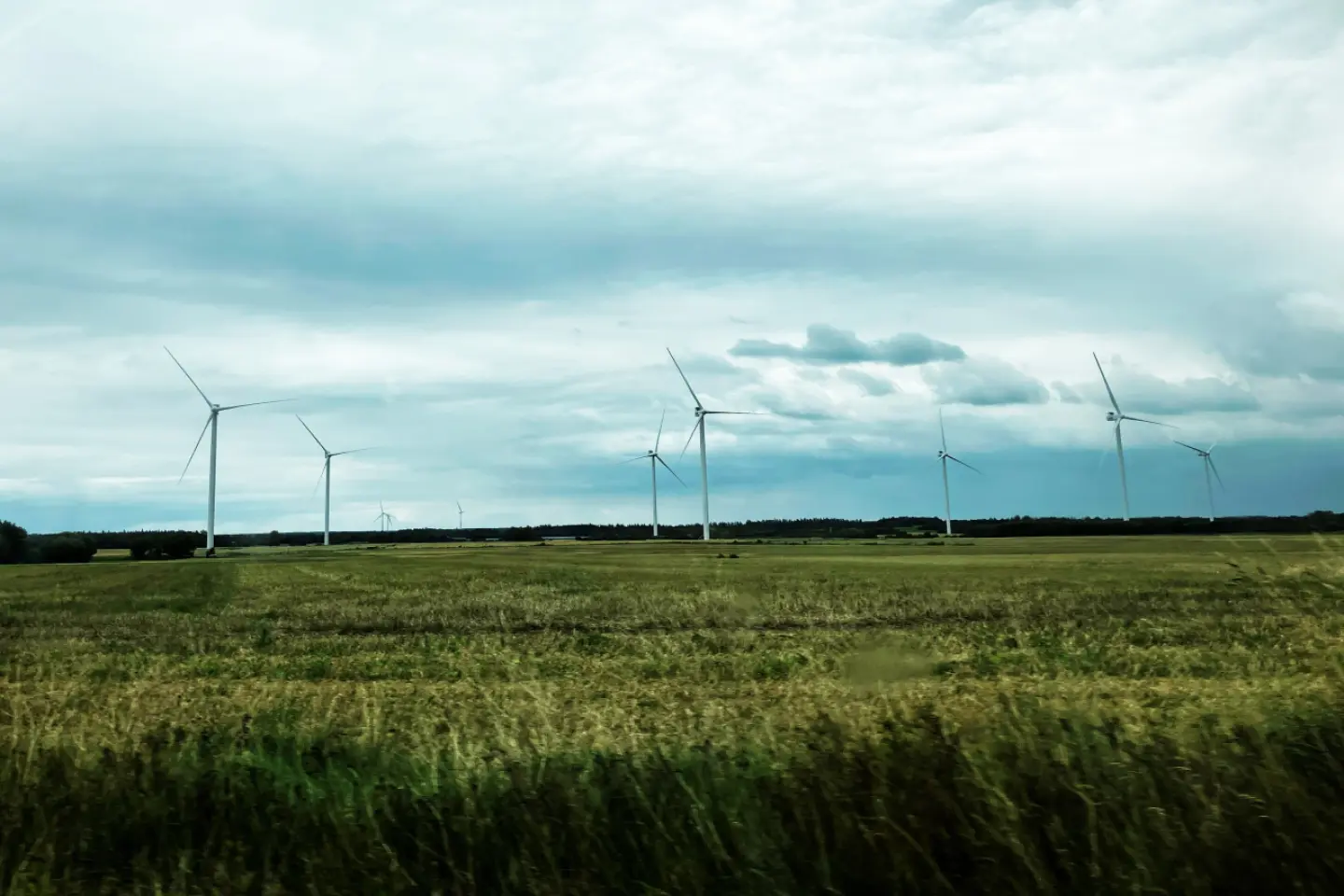
Wind turbines are inefficient, produce expensive energy, and cause massive economic losses, according to Donald Trump and pro-Russian Călin Georgescu.
NEWS: Donald Trump confirmed in Davos everything that Călin Georgescu said more than a year ago. The President of the United States spoke about green energy, wind turbines, and fuel prices.
Călin Georgescu: Wind turbines don’t produce energy. Wind power—wind turbines—account for just 0.01 percent. What actually produces energy is hydroelectric power and coal power; those are the primary sources. Whoever told you about wind power, I’m telling you that’s not the case. There’s is a clear demonstration.
Donald Trump: Green energy is the biggest scam in the world. You lose money. I didn’t see any wind turbines in China. They put on a show to make it look good. They make a fortune selling them. They sell them to fools who buy them, but they don’t have a single wind farm. Doesn’t that seem strange to you?
Călin Georgescu: We can have energy that we can provide almost for free. It could cost one lei per liter at the gas station, given how much oil we have.
Donald Trump: Gasoline has dropped below 2 USD a gallon (2 lei/litre) in some states.
NARRATIVE: Wind power generation is unprofitable, forces the public to pay inflated prices for energy, and could lead to economic collapse.
OBJECTIVES: To promote conspiracy theories and, by extension, the interests of the fossil fuel industry; to increase public opposition to the European Union’s “Green Deal” strategy; to provoke and amplify social tensions; to validate their own pseudoscientific theories.
After promoting wind energy, Georgescu has turned to energy populism and says we should burn coal
WHY THE NARRATIVE IS FALSE: The statements cited in the analysed material bring to the forefront a theme that is increasingly prevalent in global political discourse, namely the opposition to the energy transition from polluting fossil fuels to energy production using wind turbines or solar panels, which are non-polluting, albeit slightly more expensive. Trump’s and Georgescu’s criticisms, in addition to specific false claims, fall under what we now call “energy populism”—a political strategy that uses demagogic promises regarding the energy sector to gain popular support, pitting “the needs of the people” against “the interests of globalist elites.” Generally, such rhetoric promises economic measures to reduce the energy costs paid by the population, while completely ignoring the long-term economic costs. The most telling evidence that, at least in Georgescu’s case, we are dealing with such a phenomenon is his statements from the period when he claimed to be a UN expert on hazardous waste management and human rights and asserted that “everything related to wind energy, solar energy in particular, and unconventional energy, must be present in every municipality, in every village!”
Meanwhile, for political gain, his rhetoric has shifted in the opposite direction, and today the former pro-Russian candidate with Legionary sympathies claims that “wind turbines do not produce energy”—a completely false assertion. In reality, wind turbines generate electricity through the mechanical and electromagnetic conversion of the wind’s kinetic energy, just as photovoltaic solar panels convert sunlight into electricity using silicon semiconductors. Bizarrely, Călin Georgescu claims that “true energy comes from ‘primary elements’ such as water or coal,” most likely intentionally ignoring the fact that both wind (air) and sunlight are also primary elements. Indeed, energy production using wind turbines raises some real technical and economic challenges, such as high initial investments, intermittent production, the need for storage capacity, or the adaptation of transmission grids, but none of these equate to the “non-existence” of energy production. Moreover, technological advances in recent years have led to a significant increase in the efficiency of wind turbines. Thus, today, a modern 3 MW wind turbine can produce enough energy to power 1,500 homes for a year. Additionally, the costs of installing and maintaining wind turbines have fallen by more than 50% from 2008 to the present, and in some regions of the world wind energy is already cheaper than that produced from fossil fuels.
Returning to Călin Georgescu’s remarks, let’s assume that the statement “wind power accounts for 0.01” refers to its share in the energy mix, i.e., 1%. This figure is extremely far from the truth, as official data show that in Romania, for example, the share of wind energy in the national energy mix exceeds 18 percent. Similarly, in the European Union, wind energy production accounts for approximately 18% of the total, and in the United States, its share slightly exceeds 10 percent. As for Donald Trump’s claim regarding China, it is even further from the truth than Georgescu’s lies. Not only does China have countless wind farms, but these are among the largest on the planet and make China the world’s largest producer of wind energy.
Gasoline couldn’t cost 1 leu even if oil were free
When it comes to the price of a litre of gasoline, we’re once again dealing with the sovereignist propaganda’s endless illogical comparisons, which lump together completely different tax systems, production costs, and distribution and supply chains. Indeed, there are states in the U.S. where the price of gasoline is about 2 lei per litre, but this is not due to some brilliant strategy by Donald Trump, but rather to the fiscal policies of those states and their proximity to major oil production and refining areas. Logically, if gasoline prices were influenced by White House policy, the price drop would be felt across the entire country, not just regionally during certain periods.
In the United States, taxes—both federal and local—are much lower than in Europe; fuel supply is efficient and inexpensive; states produce and refine a significant amount of oil locally; and competition among gas stations keeps prices low. In Romania, a large portion of the final price of gasoline consists of taxes and duties, which account for over 50% of the final price paid at the gas station. As an overview, we note that of the final price of gasoline, taxes in the U.S. are estimated at about 15%, compared to 45–65% in the European Union and Romania. Călin Georgescu’s absurd claim regarding gasoline prices dropping to one leu per litre is therefore profoundly unrealistic, under any scenario or timeframe. Absurdly, even if oil were free, the final cost could not fall below a few lei per litre, given the price components related to refining, transportation, distribution, and commercial margins. All these factors make a drop to 1 leu per litre impossible without enormous subsidies, which would completely destabilize the state budget, or radical interventions in the economy, contrary to free-market principles.
In conclusion, the argument that “wind energy is not cost-effective” is, in fact, a rhetorical propaganda tool, not a conclusion derived from a well-founded socio-economic analysis that takes into account environmental costs, subsidies, energy security, or long-term projections.
Green energy, the target of economic and geopolitical interests
CONTEXT: Wind energy is one of the most popular and efficient sources of renewable energy, making a significant impact and challenging the dominance of the fossil fuel industry; for this reason, it has become the target of widespread disinformation claiming that wind turbines, like photovoltaic solar panels, are inefficient and harmful to the environment. Theories regarding their potential danger to animals, particularly birds, circulate in the public sphere, wilfully ignoring the fact that, while there is indeed an impact, it is far smaller than that caused by pollution, collisions with tall buildings, or car traffic. In fact, solutions currently exist to mitigate these risks, such as placing turbines in strategic locations and using bird detection systems. Other conspiracy theories claim that wind turbines are noisy and affect human health, although most modern turbines are designed to operate quietly, producing a noise level of only 40–50 decibels, similar to that of a refrigerator. Some people claim that wind turbines cause insomnia, headaches, or stress (the so-called “wind turbine syndrome”), although there is absolutely no solid scientific evidence to support these claims. Other narratives claim that wind turbines take up too much land and ruin the surrounding landscape, despite the fact that they occupy only 1% of a wind farm’s area, with the rest of the land remaining usable. In Denmark, for example, many turbines are installed on farmland without affecting farmers’ operations.
In fact, all these theories mask direct economic interests on the part of the fossil fuel industry; major companies in the coal, oil, and natural gas sectors have a clear interest in maintaining dependence on traditional energy sources. Moreover, there are local interests, such as areas economically dependent on coal or gas mining, and the disappearance of these operations would lead to high unemployment, the loss of income sources, and a marked regional economic decline. Also, the “battle” against green energy may conceal purely electoral interests, with the issue being used to create a conflict between “ordinary people” who pay the bills and the “elites” who profit. In Romania, criticism of wind energy production is used by the sovereignist opposition as a symbol of refusal to implement the European Union’s “totalitarian policies” regarding climate regulations, carbon taxes, etc. In this sense, energy loses its economic value and becomes a conservative ideological tool, not necessarily tied to money, but to a preference for the existing socio-political status quo.
Energy is a tool for projecting power on a global scale, and major oil and natural gas exporting nations see their positions of strength threatened by the rise in green energy production. Russia, for example, could quickly lose not only its export revenues but also its political influence over countries that depend on Moscow for their energy needs. In this regard, a few months after invading Ukraine, Vladimir Putin mocked the European Union for its attempts to reduce its dependence on Russian fossil fuels through the transition to green energy. “They are great experts in the field of unconventional relations, so in the energy sector they have decided to rely on unconventional energy sources as well—the sun and the wind. [...] It would be funny if it weren’t so sad,” the Kremlin leader said sarcastically.
However, it is not only Russia that seeks to manipulate public perception regarding green energy, but also the U.S., following Donald Trump’s re-election as president. Primarily concerned with the situation of major American oil companies, during his second term, Trump decided to cancel several clean energy projects, urged oil and gas companies “to drill, drill, drill”, fired hundreds of environmental scientists, and ordered the deletion of their studies, going so far as to ban references to “climate change” and “carbon emissions” within the U.S. government. Furthermore, Trump withdrew (again!) the U.S. from the Paris Climate Agreement, while also targeting other countries’ climate policies—suggesting to the United Kingdom, for example, that it tear down its “ugly” wind turbines in favour of more oil drilling, and pressuring the European Union to buy more American oil and gas and abandon its climate regulations. Currently, the United States is the world’s second-largest polluter, after China, and continues to lag behind in its efforts to reduce carbon emissions.

---copie-image.webp)


