Romanians who express their patriotism risk being arrested, according to a series of videos which, in addition to this false narrative, also contain xenophobic, racist, and anti-European messages. The videos, created with the help of artificial intelligence (AI), were posted on a Facebook account set up in December 2022 and received millions of views, but were deleted as soon as they were reported in the media.
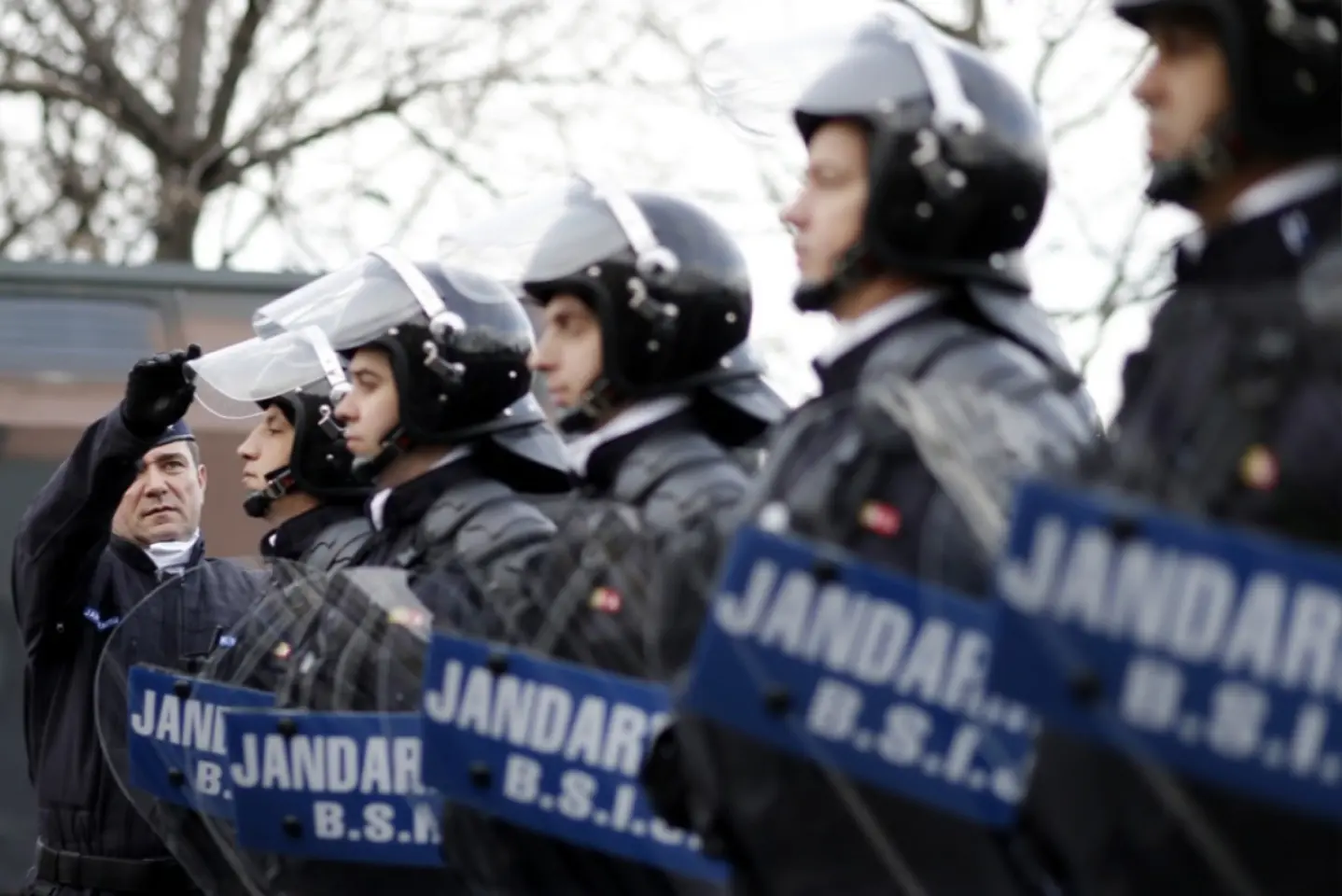
NEWS: The Romanian police arrest even children if they say that Romania belongs to Romanians, that they are patriots, or express pride in being Romanian.
At the same time, more and more Romanians are leaving the country because of the extremely difficult conditions here, but the authorities do not care.
On the contrary, they are happy to save money by replacing the local workforce with cheap labor from Asian countries, where many employees in restaurants, bars, and fast-food outlets come from, who do not comply with basic hygiene standards in kitchens.
Moreover, the EU forces us to have high taxes, forbids us to say that Romania belongs to Romanians, and because we are an EU member, Romania belongs to foreigners.
The population can no longer tolerate all these things. Young people are protesting, taking to the streets, where they cry or are extremely angry and threaten parliamentarians that if the abuses against the Romanian people continue, the people will take justice into their own hands.
NARRATIVES 1. The police arrest even children if they say that Romania belongs to Romanians, that they are patriots, or express pride in being Romanian. 2. Romania is a colony of the EU, which wants to erase Romanians’ identity. 3. Foreigners are taking Romanian jobs. 4. Asians do not respect hygiene in kitchens/HoReCA.
PURPOSES: To destabilize society and amplify feelings of helplessness, anger, and frustration towards the political class, institutions, or other social groups, in order to create the conditions for potential violent confrontations, whether verbal or, in the most serious cases, even physical.
To incite the population against law enforcement agencies that "arrest patriotic Romanians," to sow feelings of discontent and make people feel oppressed by the wealthy parliamentarians who live in luxury.
Secondarily, the possible monetization of emotions spread on Facebook, given that the network encourages such video content, which it considers original, and therefore "raises" it in the feed.
Romanian law does not criminalize patriotism, and no one can be arrested without legal grounds.
WHY THE NARRATIVES ARE FALSE: In post-December Romania, there has not been a single case in which a person, let alone a child, has been arrested or investigated for declaring their attachment to their country or for saying that "Romania belongs to Romanians."
A person cannot be arrested without legal grounds, and there is no provision in Romanian law, nor in the Constitution, the fundamental law of the state, that prohibits or considers it a crime to say that Romania belongs to Romanians, that you are proud of your nationality, or that you are a patriot.
Patriotism, far from being punished, is embraced by the state, public authorities, and other institutions
Romania and patriotism are celebrated publicly, especially on December 1, with the involvement of central and local authorities, the Romanian state's law enforcement agencies (police, gendarmerie, army, etc.), high-ranking officials (president, prime minister, presidents of the chambers of Parliament), and the political class. The messages conveyed by officials on such occasions often go beyond a normal display of patriotism, reaching the point of populism or ultra-nationalism.
It should be noted that December 1, 1918, represents the peak of Romania's territorial expansion, when Romania also included Bessarabia, Northern Bukovina, and the Quadrilateral. Although the symbolism of December 1 no longer corresponds to the realities of the present, given that "Greater Romania" has not existed for 85 years, the Romanian state continues to celebrate the Great Union of 1918 as a national holiday, precisely out of a sense of exaggerated pride or nationalism.
The Romanian state also celebrates the Flag Day, with nationalistic, patriotic messages and festivities, paid for from the public budget, just like the events organized on December 1, which is also a public holiday under the Labor Code since 2003 and does not require the recovery of hours not worked.
Another example is the fact that the Romanian Academy is currently headed by Ioan Aurel Pop, a historian perceived as a nationalist and accused of having a protochronist and anti-Western discourse; such accusations have been categorically rejected by the Romanian Academy, which has officially distanced itself from extremist nationalism and sovereignty, but not from nationalism.
For years, Romania's ruling political class has emphasized patriotism and even nationalism.
Beyond the ultra-nationalist excesses of extremist groups, the likes of the PRM and AUR parties, patriotism and even forms of nationalism have also been embraced by the pro-European political parties that have governed Romania over time.
PSD (The Social Democratic Party) , the most powerful and influential party on the Romanian political scene, ran an entire election campaign under the slogan "proud to be Romanian"—there was even an episode in which the party was ridiculed for using photos from Poland and Belarus for this campaign—and over time, its leaders have often adopted a nationalist and even anti-Western discourse; In fact, the early days of the party (the FSN/FDSN period) are associated with slogans such as "you didn't eat salami with soy," against the Westernized diaspora, and "we won't sell our country!" against foreign investors.
The parties associated with former President Traian Băsescu—PD/PDL and PMP—had adopted songs with patriotic messages written by Mircea Rusu ("Verde înrourat (Misty Green) " and "Iarba verde de acasă" (The Green Grass from Home)) as their anthems; the first of which was also adopted by PNL (the National Liberal Party), a party which, incidentally, in the election campaign for the November 2024 presidential elections emphasized the patriotism of its candidate, Nicolae Ciucă. It should be noted that Traian Băsescu's public discourse during his presidency also contained nationalist undertones, particularly in relation to the Republic of Moldova and Romania's territorial losses.
Repackaged narratives: persecution for ideas, Romania is a European colony, the danger posed by migrants
The narrative that people in Romania are arrested for expressing an idea or belief has been used before; in 2024, Veridica debunked a fake news story claiming that gendarmerie officers had fined children huge sums of money simply for expressing their Christian faith; In fact, also in 2024, another fake appeared claiming that Romanian children are forbidden from going to church.
False narratives portraying Romania as an EU/Western colony, ruled from Brussels, have also been promoted in various forms for years, and Veridica has regularly debunked them, explaining, for example, why it is not true that the justice reform will lead to the loss of Romania's sovereignty, that the EU is plundering Romania and wants to turn it into a market for low-quality products, or that the same EU will confiscate the population's savings or has canceled Christmas and banned Christian names.
Narratives about migrants are not new either. It has been written that Afghans will be brought illegally to Romania, or that the country will be invaded by Asians and Africans coming from Ukraine. At one point, there was even a narrative combining anti-immigration discourses with the theory that a person can be arrested just for expressing an opinion.
The increase in the number of foreign workers in Romania has generated new false narratives about an invasion of Asian migrants, despite the fact that work permits for them are requested by Romanian companies (which say that there are too few permits anyway) to cover the labor shortage on the Romanian market.
Finally, regarding the so-called lack of hygiene among Asians, such false narratives have been circulating for a long time—they even sparked protests in Ditrău in 2020 against the hiring of two Sri Lankans at a bakery. Such narratives ignore not only the fact that the HORECA sector is one of the most targeted by health inspections, but also that over the years numerous problems have been found in locations owned and operated exclusively by Romanians.
Romanian authorities have often turned a blind eye to manifestations of extremist ultra-nationalism
In Romania over the last 35 years, so-called manifestations of patriotism have taken extreme forms, veering towards ultra-nationalism, including Legionary-inspired xenophobia, anti-Semitism and historical denialism – Romanians/Marshal Antonescu could not have been complicit in the Holocaust. The Romanian authorities have generally chosen to ignore such manifestations.
Since 2002, in Romania, such abuses are considered crimes and are punishable by imprisonment from 3 months to 3 years or a criminal fine, with the penalty subsequently being increased to 5 years. Emergency Ordinance No. 31/2002 on combating extremism, xenophobia, anti-Semitism, and hate speech was issued by the Adrian Năstase government as a condition for pre-accession to the European Union.
Therefore, the Romanian state, through the police and prosecutors, had to investigate, therefore open criminal cases, and then refer for trial any extremist manifestation, any hate speech or incitement to hatred, death, any anti-Semitic acts or statements, Holocaust denial or praise of war criminals, etc.
However, the authorities rarely applied GEO 31/2002 in the first 22 years after its adoption and deliberately or incompetently ignored flagrant cases of neo-Legionary manifestations, anti-Semitism, Holocaust denial in Romania, hate speech propagated in the public sphere, or the glorification or martyrdom of war criminals.
In 2023, we showed how prosecutors closed 96% of the cases resolved in 2022 concerning the promotion of anti-Semitism, Legionary ideology, and war criminals. In the rare cases that reached court, the defendants were acquitted by judges under various pretexts.
Furthermore, during the first part of the current prosecutor general Alex Florența's term, prosecutor’s offices recorded zero self-referrals and no one was prosecuted for promoting the Legionnaire movement or glorifying war criminals, even though extremism was on the rise, and complaints from Jewish organizations or the Elie Wiesel Institute for Holocaust Studies were ignored. Moreover, a case against Călin Georgescu from 2022, when he was honorary president of AUR, for praising war criminals and the cult of the Legionnaires, was closed by the General Prosecutor's Office headed by prosecutor Gabriela Scutea shortly after it was opened.
Only after the escalation of extremism and the rise of neo-Legionnaires, following the cancellation of the November 24, 2025 elections and the shock of the discovery of the "patriot" Călin Georgescu, who was fueling the phenomenon, did the police and prosecutors begin to open criminal cases under a law that had existed for over 20 years but had never been applied, so it was completely unknown to the general public.
CONTEXT: Videos inciting revolt against the political class received millions of views after being posted on a Facebook account (Marilena Charkaoui, opened in 2022) between November 19 and 23, immediately after mercenary Horațiu Potra was brought back to the country in handcuffs and placed in preventive detention (November 20). Potra is accused by prosecutors of conspiring with Călin Georgescu (whose followers are targeted by this fake news) to "overthrow the constitutional order" (overthrow the leadership and seize power in the state). The press also wrote about Potra's ties to the Russian Federation, which allegedly tried to prevent his extradition to Romania.
At the same time, the moment coincided with the period before a complicated and tense week from an economic, social, and political point of view, in which things could have easily escalated amid heightened emotions in society and possible protests driven by anger. In other words, the perfect storm:
- The Bolojan government's decision to reduce special pensions by 85% for public sector employees who want to remain in government service;
- The rejection by the magistrates' guild of any reform proposals put forward by the executive;
- Discussions about reductions in the number of employees or revenues in local and central government.
OFFICIAL REACTIONS: There were no official reactions from institutions/organizations that could have played a role in combating fake news or incitement to hatred and social unrest on social media (Facebook in this case, Police/Gendarmerie, SRI, etc.).
However, following the media coverage of the AI-generated inflammatory videos, in less than a day, 13,000 accounts, mostly fake/bots, suddenly disappeared from the "followers" category of the parent account "Marilena Charkaoui."
Along with them, the viral clips inciting hatred and revolt, which had garnered 5 million views in just over 4 days, also disappeared. On the third day after the clips were publicized, the parent account disappeared completely from Facebook. However, it is unclear whether this was the decision of the bot network coordinator or the social network.