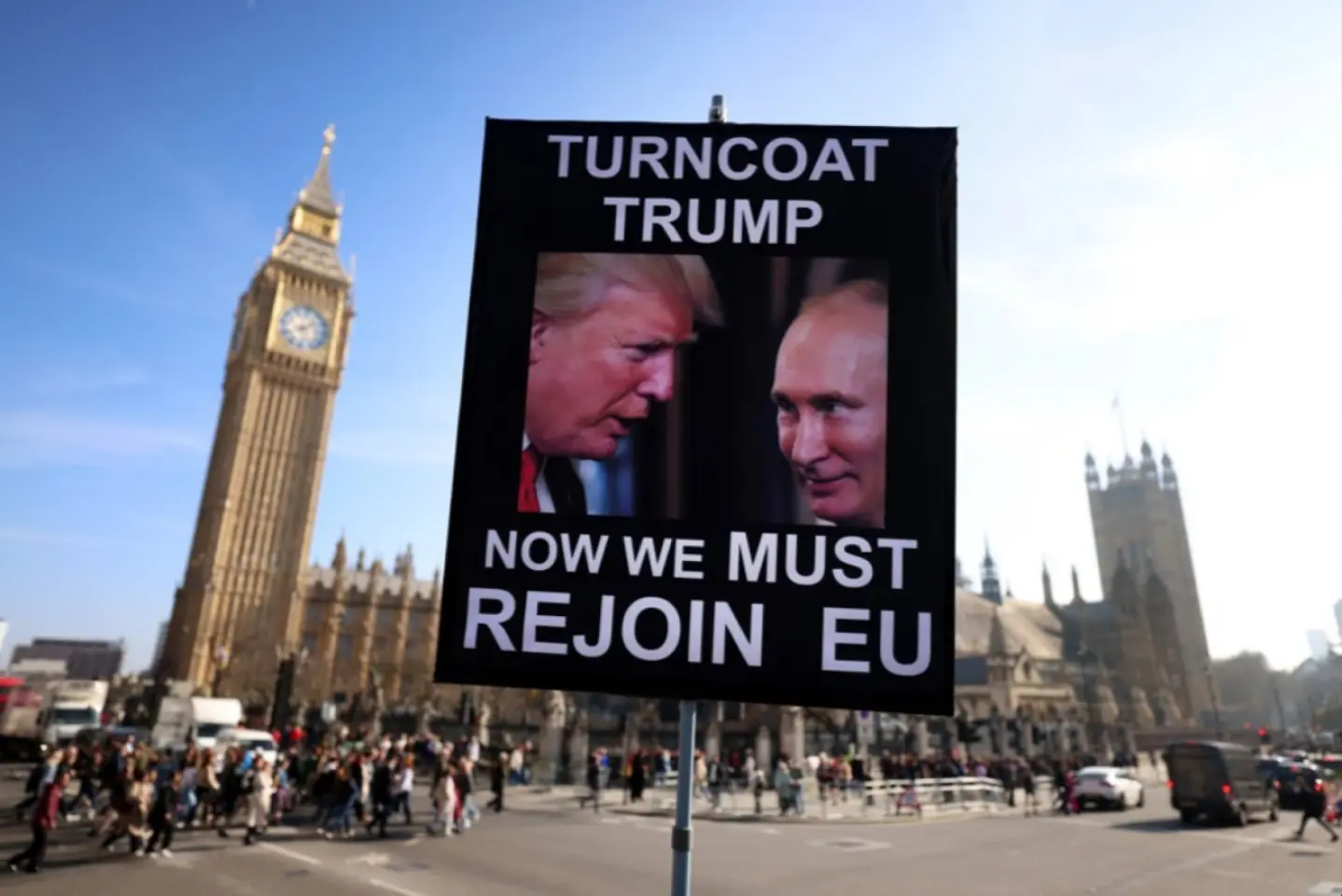
The Trump administration's distancing from the EU, which transpires in the new US national security strategy, could lead to a “rupture” within the Western family. This is a scenario in which the USA would stand to lose enormously, including in the context of the global competition with China. The EU, on the other hand, has the potential to emerge unscathed from such a crisis.
Although some high-ranking European and American politicians are currently talking about notable progress in peace negotiations with Russia and Ukraine, the Russian aggressor continues to occupy significant portions of Ukrainian territory and even seeks to gain control over regions still defended by the army of the attacked country without a fight. Against this backdrop, Donald Trump is making increasingly insulting statements about Europeans, as if trying to steer them off the path towards what he believes he can achieve alone—namely, peace in Ukraine and glory for himself by means of this personal victory. At the same time, the American leader is essentially promoting the Kremlin's narrative about Europeans who allegedly want the war to continue and are preventing it from reaching a peace treaty jointly with Russia.
The new US national security strategy is the latest episode in this White House campaign against its traditional partners across the Atlantic. However, the United States may soon discover that Donald Trump's policy will spell far greater costs once it sidelines Europeans from the current global game of peace and war.
Donald Trump's National Security Strategy: an insult to Europe
The publication of the US national security strategy earlier this month marked the entry into the arena of an international policy language that we never thought could come from Washington. Following the logic of false narratives in Russia's hybrid war against Europe, the strategy accuses, among other things, the oppression of various forms of opposition and the systematic censorship promoted by the European Union (EU). It then proclaims nothing less than the “prospect of erasing the [European] civilization” under the pressure of immigration policies promoted by the EU itself. To leave no room for speculation, the document makes it very clear that “civilization” in the European sense means “national identities” for the Trump administration, whose “loss” seems to be tantamount to the loss of self-confidence for the entire continent. These insulting statements add to concrete steps already taken by the Trump administration this year, with unwanted effects also for Bucharest: the mockery directed at the European cause represented by Ukrainian President Zelensky during his first visit to the White House, as well as the Americans’ harsh statements at the Munich security conference; the decision to withdraw US troops from certain areas of Europe; and the suspension of the Visa Waiver program for Romania.
At the same time, Donald Trump and a number of prominent members of his administration praise and emphasize collaboration not only with authoritarian regimes, including the Kremlin, but also with anti-European nationalist parties. More recently, the Young Republicans Club hosted a gala in New York, where the guest list featured prominent representatives of the far right, especially from the Alternative for Germany (AfD) party, while the event itself was marked by obvious Nazi overtones. The current US administration no longer seems to feel the need to even conceal its choices through diplomatic tricks: it has chosen to openly support European nationalist extremism and even to incite it against the institutions and values of the European Union. In this case too, Washington under Trump’s second term in office is in perfect harmony with the Kremlin's anti-European propaganda. Hence the increasingly legitimate question in this part of Europe: what will the future of trans-Atlantic ties will look like with an American ally that is less and less a leader of the Western world and more and more a mere mouthpiece for Putinist ideology.
What the Trump administration won’t admit: US commercial and strategic success is closely linked to US-EU relations. Washington cannot face competition with China without the EU’s backing
It's high time we approached our European identity and role from a position of greater sincerity and strength, understanding what we truly represent as a Union in international politics, including in our relationship with the USA. Although a number of analysts criticize the transformation of the relationship into a purely transactional one, they may not realize that it was already transactional, and this very trait had ensured its durability. The European single market is the most predictable, most reliable and most profitable outlet for American products, including weapons, ammunition and other technologies. This year, in the context where the war in Ukraine consumes huge volumes of American weapons and ammunition paid for by Europeans, Europe has surpassed the Middle East in purchasing military equipment from the USA. On the other side, Europe's technological contribution to the Western advance in the field, including the American one, compared to competitors from the East, is far from negligible, although it is currently overshadowed by China's impetuous development.
Secondly, US security cooperation with its European allies, which has been functional for over seven decades under the NATO umbrella, has a global footprint. Suffice it to look at a NATO map that includes its partnerships with non-member states to understand the true scope of the organization's relations. The problems created by the Trump administration in approaching cooperation with European allies will inevitably affect the US global footprint as well. This will spell higher costs for foreign policy for Washington in the absence of European contributions in multiple forms, especially in relations with parts of the world such as the Middle East, Africa, South America and Asia, where the European Union holds sway, including by means of free trade agreements beneficial to its partners.
It should also be mentioned that US rivalry with China is essentially commercial and global, representing a competition of markets, tariffs, norms and standards. In this context, the opinion repeatedly expressed by Trump and his team (that Europeans are not playing fair is ridiculous. The USA and EU are inevitably in competition, honest or not, as long as Washington invariably delays serious negotiation of a free trade agreement. In my view, it is precisely this delay that creates the state of competition, even though the American economy needs closer cooperation with the largest and most influential single market in the world, the European one. Washington needs such cooperation precisely to better face global competition with China... In this very sense, the US should not repeat the mistake of ignoring the European initiative on neighborhood policy and the Euro-Mediterranean Free Trade Area project from the early 2000s. Instead, it should take seriously the pursuit of a free trade treaty with the Union and other notable Brussels initiatives. Beyond strict European policies on Chinese imports, the EU has developed or supports alternatives to Beijing's major connectivity projects. Among these, worth recalling are stakes worth billions of Euro such as the India-Middle East-Europe Economic Corridor and the complex connections included in agreements signed on the occasion of the first EU-Central Asia Summit in Samarkand, in April 2025. It is hard to imagine how the USA could manage rivalry with China at reasonable costs without collaboration with a European Union capable of projecting global commercial influence through agreements that also advance European norms to the level of international standards—hence the notion of “normative power Europe”.
Moreover, also in connection with this idea, it is easy to forget that the EU is also a product of American policy. The Marshall Plan for Europe aimed (successfully!) at rebuilding the continent's economies to become partners and viable markets for American exports—a logic that works in the US relationship with Japan, then South Korea, and other major actors. The European Communities created in the 1950s with American financial help have since become today's European Union, an actor with economic status and global normative footprint. It was precisely the Euro-American partnership that made possible the post-World War II world order, with its rules of international law and international financial institutions (World Bank, IMF), so profitable for continuing free trade and equally reviled in Moscow, Beijing or Tehran. Should the USA withdraw from this partnership or remove Europeans from it, the entire world order loses its meaning. Yet this is precisely the stated goal of the West's enemies, such as Russia, China or Iran.
If Trump wants to break ties, Europe will move forward
The National Security Strategy, published by the White House on December 4, 2025, is shocking across its many details, but especially a paragraph speaking about the “prospect of erasing the [European] civilization” under the pressure of EU policies. More specifically, the strategy's authors referred to “activities of the European Union and other transnational entities that undermine political freedom and sovereignty”. Since sovereignty is a concept associated by European national-sovereignists, in the Kremlin's nation state logic, it follows that the Trump administration has chosen to promote exactly this logic, with confirmation coming just a few lines below in the same paragraph, where the “loss of national identities” under the pressure of those EU activities is criticized.
Experts immediately understood that the document knowingly equated “civilization” not with European values, but with sovereignist nationalism. Yet it was the very sovereignist nationalism promoted by current Russian propaganda that nearly destroyed the European continent in the first half of the 20th century. Lasting peace in Europe could only be built by gradually discarding nationalism and national sovereignties, through the creation of supranational European Communities, then their development under the European Union umbrella after 1992. Today, when Donald Trump's US laments the loss of national identities in Europe, we should better understand that such lamentation belongs to a past that, we hope, is by now long gone on our continent.
And we are faring quite well. All statistics, national or European, show continued growth in economies and living standards in EU member states, except during crisis periods. Significant gaps still exist between wealthy and poor nations, but they have decreased and continue the downward trend, while average parameters are rising. Romania fits into these trends since becoming a Union member on January 1, 2007. As part of the single market, much better prospects can be hoped for through better connecting the Romanian economy to world markets. The essential condition is learning to produce better and promote our products better to benefit not only from intra-European trade, but also from the EU's free trade agreements with the rest of the world.
With respect to security, we know very well that Moscow has always been the perpetual enemy of European stability, prosperity and security. However, we should not be frightened by the current Trump administration policy, which seems to force a US withdrawal from the European security framework. Although we must face a hybrid war, we are learning to develop the institutional capacities needed to defeat Russian propaganda mechanisms. Civil society and mass media are fully participating in this effort, with Veridica in the front line.
As for the “hard” aspects of Russia's war against Europe, I personally believe we are far better off than we imagine. Let us not forget that we are dealing with an enemy that failed to secure a path to Kyiv neither in three weeks in February-March 2022 nor in the nearly three years since the large-scale invasion of Ukraine was launched. And now it is systematically losing vital production capacities for weapons and energy (gas, oil, coal), the only goods the Russian economy has ever been able to produce on its own. Hence the swift loss of combat capacity in the medium and long term.
The only major gain from this war is that Ukraine has proven to be a fully important shield for Europe's security. Kyiv now has crucial military experience both on the operational front and in the defense industry. Moreover, we are not sitting idly by. The European Union finances Ukrainian resistance and is fighting to find solutions for using Russian assets in Europe, now frozen indefinitely. In addition, the European Union is developing funding programs for defensive rearmament (SAFE) or financing projects in the field from various budgetary sources. The EU is also paying increased attention to the north-south logistics corridor, which now has greater importance in the context of the Russian threat... It is quite possible that a dissolution of the civilization of nations may occur in Europe, as suggested by Donald Trump's new American national security strategy, but this is not something bad or new, as it seems to be perceived at the White House. Rather, it is about intensifying the integration effort, perhaps even the European federalization drive, precisely under the pressure exerted by the Russian threat, now in conjunction with American ideological aggressiveness. In this context, we may witness the birth of European patriotism, promising peace and not devastating wars on our continent, like those caused by nationalist-sovereignist patriotisms in the last century.