When Arsenal and Paris Saint-Germain meet in the Champions League final at Budapest's Puskás Aréna on 30 May, at least one local football fan has a decision to make about whether to show up: the one who made it a reality, former prime minister Viktor Orbán.
Around two decades ago, Viktor Orbán, a die-hard football fan who even found a place for the game in his political philosophy, invited the then Arsenal manager Arsène Wenger to attend the launch of a football academy. The Frenchman politely declined. Orbán founded the Puskás Akadémia anyway.
This was three years before the landslide victory that began Orbán's 16-year stint in power. Back in 2007, Orbán cut a forlorn figure in his home village of Felcsút, half an hour's drive from Budapest, and in his spare time took horse-riding lessons and played football.
Orbán did not stay forlorn for long. Announcing a "System of National Co-operation (NER)", he constructed a Hungary made in his own image, and being a football fanatic, this included dozens of stadiums. The rickety Népstadion was bulldozed to make way for the 67,215-seater Puskás Aréna, where the world's most prestigious club fixture will take place at the end of the month.
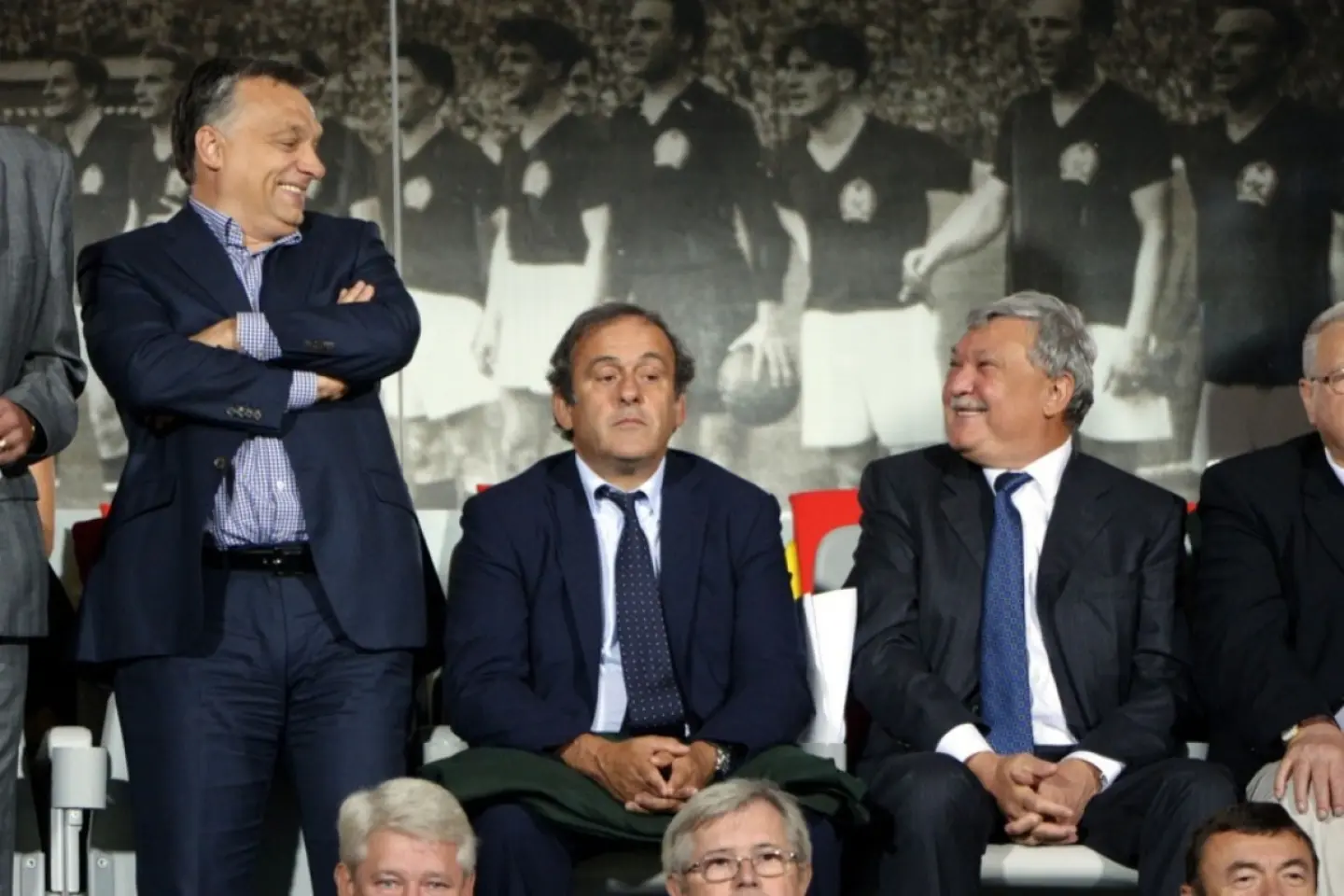
Puskás Aréna opened in November 2019, but Orbán had announced in Parliament as early as 2013, flanked by then UEFA president Michel Platini and OTP chairman and reluctant Hungarian Football Federation (MLSZ) president Sándor Csányi, that the then unbuilt stadium would host Euro 2020 matches.
Orbán has not missed a Champions League final since his first foreign trip as prime minister in 1998 - reportedly 28 consecutive finals attended, during his two decades in power and eight years of exile in Felcsút. The 29th will be played in the stadium he built for precisely this moment, the culmination of a project decades in the making. Arsène Wenger will be there this time, but Orbán himself may be absent. He has already boycotted the inauguration sitting of Hungary's new Parliament. He may as well boycott his own dream night, watching a stadium built for his own political mythology host the victory lap of his successor.
Reshaping Hungary under Orbán: the four pillars of illiberalism and the hijacking of culture
On 12 April, Péter Magyar's Tisza party won a clear constitutional majority with 141 of 199 parliamentary seats on the highest voter turnout since the last communist-era election in 1985. Orbán's Fidesz party was reduced to 52 seats. As Magyar has pledged to impose a US-style maximum two-term limit for prime ministers, the result may well represent the end of Orbán's domestic political career.
At the start of his term, Orbán's ambition was total: not merely to win elections but to remake Hungary so thoroughly that anyone else running the country became structurally impossible. He embedded cardinal laws covering the judiciary, media regulation, electoral rules and central bank governance, all requiring a two-thirds constitutional majority to amend.
Magyar inherits that state: its constitutional machinery, captured institutions and economic levers built over 16 years to be structurally irreversible. Having spent two years denouncing the system, Hungary's new prime minister must now decide what to keep, what to dismantle and what to accept as permanent.
In his "illiberal democracy" speech in July 2014, Orbán praised "systems that are not Western, not liberal, not liberal democracies, and perhaps not even democracies, can nevertheless make their nations successful." Singapore, China, Russia and Turkey were the stated models, and Hungary would join them. "The state is nothing else but a method of organising a community," he argued.
Orbán identified four sectors as the terrain where political power really lies: media, banking, retail and energy. By 2018, he could boast that "over 50% of the Hungarian banking sector is now in the hands of the nation, and this is also true of the media." Retail followed via hefty, targeted taxes on foreign supermarket chains.
András Lánczi, president of Fidesz think tank Századvég, stated the logic plainly: "What is called corruption is actually Fidesz's supreme policy... the government has set for itself goals such as the establishment of a group of domestic entrepreneurs, the building of the pillars of a strong Hungary."
But Orbán understood that durable domination requires culture beyond his stated four pillars. Football was one vehicle: the Puskás mythology, the Greater Hungary scarves, the tannoy chanting "Down with Trianon" at the Puskás Aréna, the Carpathian Brigade ultras who appeared not only on terraces but in referendum offices and at protests. In Budapest and provincial Hungary alike, Orbánism became visible in concrete and floodlights: stadiums rose beside half-empty terraces while Puskás murals covered city walls.
The Mathias Corvinus Collegium was another: a network of universities and scholarship programmes, endowed with billions in state funds and 10% of energy giant MOL, designed to produce a generation of Hungarian conservatives and export Orbán's model across Europe. Churches received preferential legal status and financial privileges in exchange for political loyalty. The capture of the economy funded the capture of the culture, and the capture of the culture legitimised the capture of the economy.
Magyar claims the system Orbán built could collapse quickly. But it's not that simple
On media, Magyar has been most aggressive. On 13 April, the day after his election victory, he appeared on public television, called its coverage "propaganda," and threatened to introduce a law removing the president and "all the puppets nominated to top posts by the Orbán system". The collapse has been precipitous: Fidesz media mogul Gyula Balasy, whose companies grew from zero to 150 state contracts per year under Orbán, offered on 5 May to hand back his firms to the state. Police froze his accounts the following day. "This system could collapse much faster than anyone would think," Magyar said.
On energy, Magyar inherits the Paks II expansion project: two new Rosatom-supplied reactors already under construction, a project Hungarians first learned of through TASS, the Russian state news agency, bankrolled by a 10 billion euro Kremlin loan.
Cancellation is implausible: abandoning the contract could trigger Rosatom's refusal to supply fuel to the existing Paks plant, which generates 40% of Hungary's electricity. What Magyar can do is audit, as the confidentiality clauses that shielded the project from scrutiny no longer apply. The European Court of Justice ruled in September 2025 that Hungary's funding of Paks II was illegal, giving Magyar more leverage. The day after his election victory, Magyar said Hungary would maintain Russian energy ties while reframing the relationship from personal friendship to cold pragmatism.
Retail saw protectionist policies under Orbán, as a special levy hit foreign chains at 4.5% of turnover, exceeding actual profit margins and squeezing the margins of the likes of SPAR, Lidl, Aldi and Tesco, and in some cases pushing them into losses.
Hungarian franchise chains, most notably CBA, whose member clubs are run by Fidesz-affiliated local entrepreneurs, paid only 0-1%. The Covid emergency decree of April 2020 brought new levies that targeted large foreign chains. When a 2021 law compelled chains with turnover above HUF 100 billion to donate near-expiry food to a state-linked charity, CBA was again exempted. Magyar has pledged a phased repeal of these anti-competition retail regulations, although he is constrained by fiscal need. If chains used the repeal to repair their own balance sheets rather than lowering shelf prices, Magyar could face a public backlash.
On banking, Orbán levied Europe's highest bank tax, nationalised over HUF 2 trillion in private pension savings, and imposed a financial transaction tax: burdens that fell almost entirely on the foreign-owned sector. Foreign banks sold their Hungarian subsidiaries cheaply to Fidesz-aligned buyers. The taxes were privatisation in reverse, as state-guaranteed loans to oligarchs were used to acquire media outlets.
No figure outside politics embodies this capture more completely than Csányi: OTP bank chairman, MOL shareholder, MCC supervisory board member and Football Federation president. In May 2022, shortly after Orbán's fourth election victory, Csányi told Forbes Hungary that the government's utility price caps and food price ceilings were misguided market distortions that would have to be phased out. Magyar has pledged euro adoption by 2030-31. The forint is enshrined in the constitution, but Magyar has the majority to remove the restriction. His own central bank governor is less enthusiastic: Mihály Varga, a former Fidesz finance minister installed by Orbán in March 2025 on a six-year term, has warned that a rushed process "could lead to unintended negative consequences."
The supermajority gives Magyar a lot of room to maneuver, but the people Orbán left in the system can still hinder him
By the 2018 election, the state and its oligarchs controlled around 80% of Hungary's media assets, shielded by a government decree declaring them of "national strategic importance." State advertising flowed exclusively to the ecosystem. Independent outlets were starved.
To undo what Orbán had built, you needed the same supermajority he had used to build it. As Princeton constitutional lawyer Kim Lane Scheppele wrote in the Journal of Democracy, the system was designed so that "any division in the opposition automatically generates supermajorities for the ruling party." The opposition tried. In 2022, six parties ran together and still lost. The machine, it seemed, had no off switch. Until Magyar found one.
Where previous oppositions had united parties, Magyar united voters. His predecessors fielded a broad coalition that struggled to project a coherent identity beyond opposition to Orbán. Magyar went everywhere and talked about hospital waiting lists and the corruption he had witnessed from the inside. His break with the regime had come in 2024 when he described what working inside Orbán's system had actually felt like, naming perpetrators with a precision no outsider could match. The compensatory vote mechanism, calibrated to reward the dominant political force, ended up rewarding Magyar instead. The same electoral machinery that had protected Fidesz for over a decade turned against it.
The two-thirds majority gives Magyar the power to amend or replace the 2011 Fundamental Law entirely and rewrite every cardinal law Orbán used to entrench his system. He has announced a two-term limit for prime ministers, retroactively applicable in a way that bars Orbán from returning; accession to the European Public Prosecutor's Office, which Orbán refused because it would embed independent EU prosecutors with authority over fraud involving EU funds; and the establishment of a National Asset Recovery Office to claw back public money directed into private pockets.
But there is a prior problem Scheppele identified on inauguration day: the veto players. Magyar has a two-thirds majority to remove those in key offices, but they have long terms and no obligation to go. The Fidesz-appointed president, who can veto any legislation parliament passes, responded to Magyar's public call to resign by end of May with the words "We believe in the rule of law" - meaning, as Scheppele put it, he is not going anywhere. That showdown is the next test.
The 18 billion euros in EU structural funds frozen over rule-of-law violations comes with a hard deadline: 27 milestones by the end of August, after which Hungary loses the money permanently. European Commission officials have already warned there may not be enough time to complete all the required reforms, and are encouraging Budapest to focus on securing the grant component while abandoning at least part of the loan package. That clock, which Orbán simply ran out, now defines Magyar's first hundred days.
The fifth pillar of Orbánism: football
On football, the fifth pillar Orbán built for himself, Magyar has said little. He inherits dozens of stadiums and a scheme that redirected 2.49 billion euros from the tax base to Fidesz-aligned clubs. The Puskás Aréna will host the Champions League final regardless. In this one respect, the machine simply runs.
"The essence of football is like the essence of politics," Orbán once said. "The question is not where the ball is now - everybody can see where the ball is now - but where the ball will be. If you understand earlier than others what will happen, you can react first and you can win." Magyar, it turned out, reacted faster.
In his inaugural address, Magyar named what he intends to dismantle. "The Hungarian people deserve to know how public money became private fortunes, how state assets were transformed into political power, how public procurement became a feudal system, and how concessions became privileges." Whether he can deliver is the question that will define his government - and Hungary's next chapter.
If Orbán does decide to show up on 30 May, it might be worth his while to finally seek out Wenger. Since leaving club management, Wenger has reinvented himself as FIFA's Chief of Global Football Development, an international statesman rather than a domestic operator. The art of transitioning from a position of power to a more ambassadorial role is what Orbán now needs to learn.