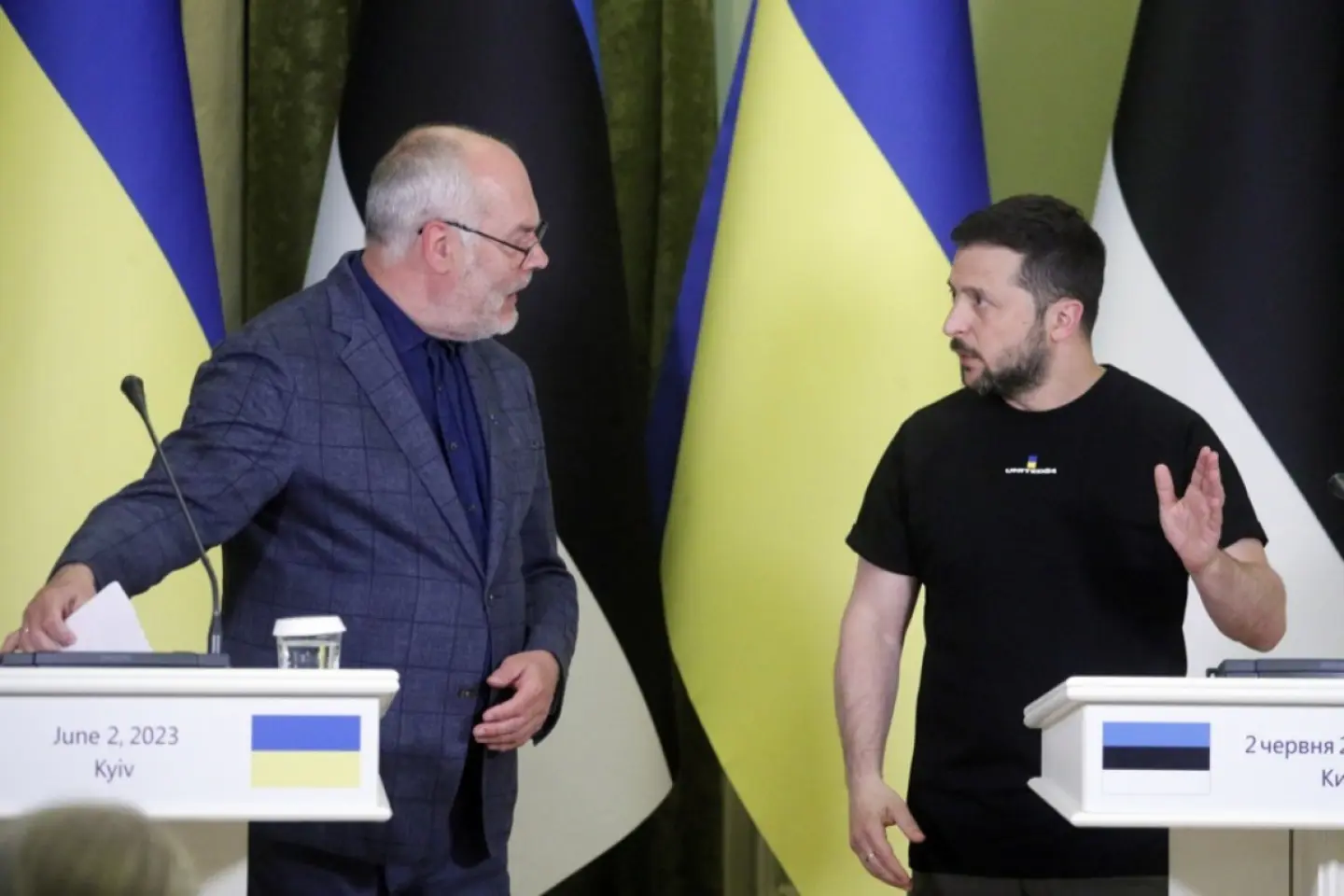
Ukrainian President Volodymyr Zelensky said in a national TV broadcast that Russia is preparing for a new mobilization that could be followed by an attack on the Baltic states. Contrary to the usual reaction, this statement triggered a strong negative response in Estonia.
Not in the near future
“Why carry out such a large mobilization? To repeat an offensive — a major offensive against Ukraine. Option B is to conduct a parallel, smaller offensive with fewer resources and less effort, in a place where fewer forces are needed. Why? Because one or another state, for example in the Baltics, may not be ready for strong resistance,” Zelensky said, explaining why Russian authorities have restricted internet access. He also noted that allies’ willingness to defend the Baltic states might vary.
Estonian authorities rushed to reassure the public. Foreign minister Margus Tsahkna diplomatically noted that the Ukrainian president’s warning contradicts the current assessment of Estonian intelligence services, especially since neither the position of Russian troops on the front nor the state of the Russian economy suggests imminent aggression against NATO countries.
Marko Mihkelson, chairman of the parliamentary foreign affairs committee, said Zelensky’s remarks play into Russian propaganda by amplifying similar narratives. “Our Ukrainian friends must understand that by repeatedly presenting the Baltic states (forgetting NATO or underestimating our own defense capabilities) as a possible next victim of Russia, they are not creating or strengthening a narrative that would help Ukraine or others counter imperialism amid Russian military hysteria,” he wrote on social media.
While acknowledging Zelensky’s goal of pushing allies to act more decisively, Mihkelson criticized the reliability of information coming from Ukraine’s leadership. “There is another aspect where Ukraine’s friends should be more cautious in their messaging. In some cases, their hints at intelligence data have turned out to be completely fabricated… This will not inspire trust when truly critical warning information emerges,” he warned.
As an example, he cited Zelensky’s statement at the 2025 Munich Conference that Russia planned to move 150,000 troops to Belarus and leave them there for a future attack on Ukraine or a NATO country. “In reality, Russia moved significantly fewer than 10,000 troops there and back for the ‘Zapad’ exercises,” Mihkelson said.
In the same discussion, Finance Minister Jürgen Ligi noted that a similar narrative had been promoted at the start of the war by Estonia’s prime minister and defense minister. “It was clear from the beginning that this would cause damage,” he wrote.
Surprisingly, he was echoed by a staunch opponent of the current government, nationalist conservative leader Martin Helme, who claimed that Estonian diplomats themselves had created this narrative. “From the very beginning of the war in Ukraine, the core message of the Reform Party was to scare people with Russia, and under that fear raise any taxes and demonize domestic opposition as Kremlin accomplices,” Helme said.
His father, former conservative leader and MP Mart Helme, called Zelensky’s speech a propaganda information operation aimed at maintaining weapons supplies to Ukraine. “On the chessboard, Estonia is not the piece Russia must capture right now,” he said.
Fatigue with supporting Ukraine
In a poll conducted by Postimees, politicians showed rare unanimity: at present, the threat to Estonia appears exaggerated. Only Social Democrat Sven Mikser, a former foreign minister and current MEP, while disagreeing with Zelensky’s assessment, voiced what others avoided mentioning. “It saddens me to see that fatigue with supporting Ukraine is increasingly cultivated in Estonian public debate,” he said, stressing that Estonia’s strategic course should remain unchanged. “Ukraine must win this war — it is crucial for the security of Estonia and Europe.”
Security expert Ilmar Raag noted that Zelensky’s mention of a possible attack on the Baltic states looks rather unfortunate, but attempts by Estonian politicians to quickly downplay the threat altogether also seem troubling. Military journalist Arkady Babchenko called the situation a “fantastic déjà vu,” recalling that few believed in a full-scale invasion seven years ago.
Estonian journalists across outlets and political views also sharply criticized Zelensky. Echoing the government’s tone, several editors-in-chief and editorials suggested that Estonia is losing confidence in itself, which directly affects its viability — including negative population growth figures announced recently and an outflow of investors.
Last year, only 9,240 people were born in Estonia, while more than 15,000 died, and migration statistics were also negative. As for investment inflows and economic growth, hopes for the latter were undermined by the blockade of the Strait of Hormuz due to another conflict and the resulting sharp rise in energy prices. At the end of March, Estonia’s central bank revised its economic forecast downward, and some experts called the projected 2.8% growth unrealistically high. Reports of military drones entering the country have also reduced the flow of foreign tourists.
Other defense-related news in April was also not very positive: almost simultaneously with Zelensky’s statement, it became known that the United States was suspending deliveries of ammunition to Estonia for HIMARS systems and Javelin anti-tank weapons due to its war with Iran. Experts do not consider this an insurmountable problem, predicting a shift to other markets.
For example, Igor Gretsky, a research fellow at the Centre for Defence Studies, noted that such delays in deliveries have occurred before, so any government takes such scenarios into account. “I see no catastrophe,” Gretsky stated. “A temporary suspension of deliveries for technical reasons is nothing new or unusual: for instance, six years ago there were delays involving Taiwan due to disruptions in production capacity. Therefore, any government that procures weapons from abroad always works out a Plan B.”
However, reorienting to other suppliers takes time, and if it takes more than two years, the country’s readiness for potential aggression may be weakened — especially given the doubts about the fulfillment of allied commitments that the Trump administration has already sown.
“Russia is next to us. As long as it is tied down by Ukraine, we have time. When it is no longer tied down, we cannot say aggression will start immediately, but by that moment we must be fully prepared,” said former Commander of the Estonian Defence Forces Martin Herem.
Against this backdrop, it is not surprising that such Cassandra-like warnings are received sharply in Estonia: the country desperately needs a sense of confidence in the future. Those responsible for strategic communication face a difficult task — to instill at least some degree of optimism in the public, businesses, and partners without losing vigilance toward the ongoing threat from the east.