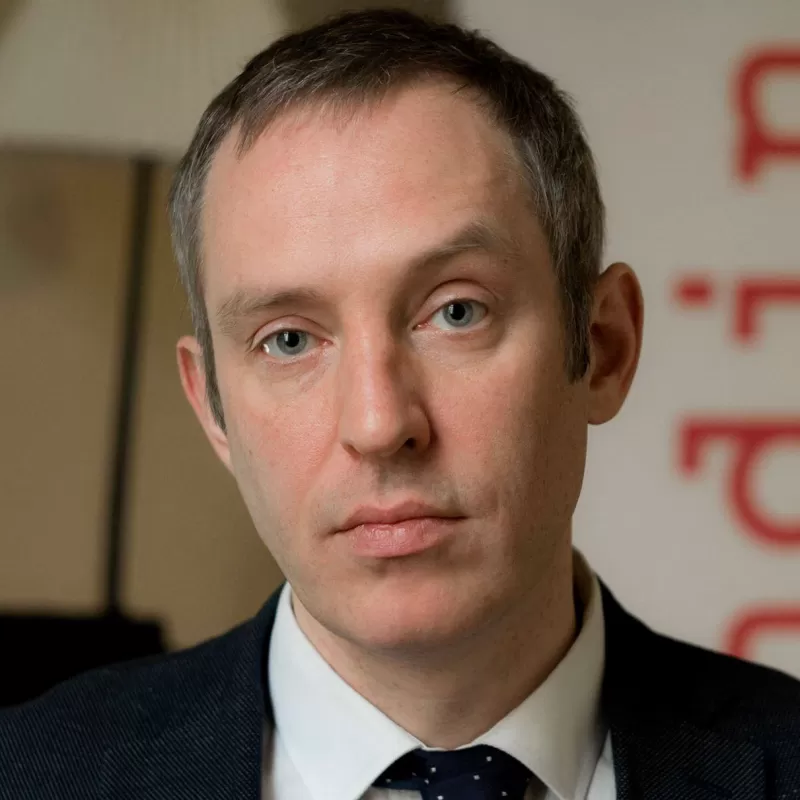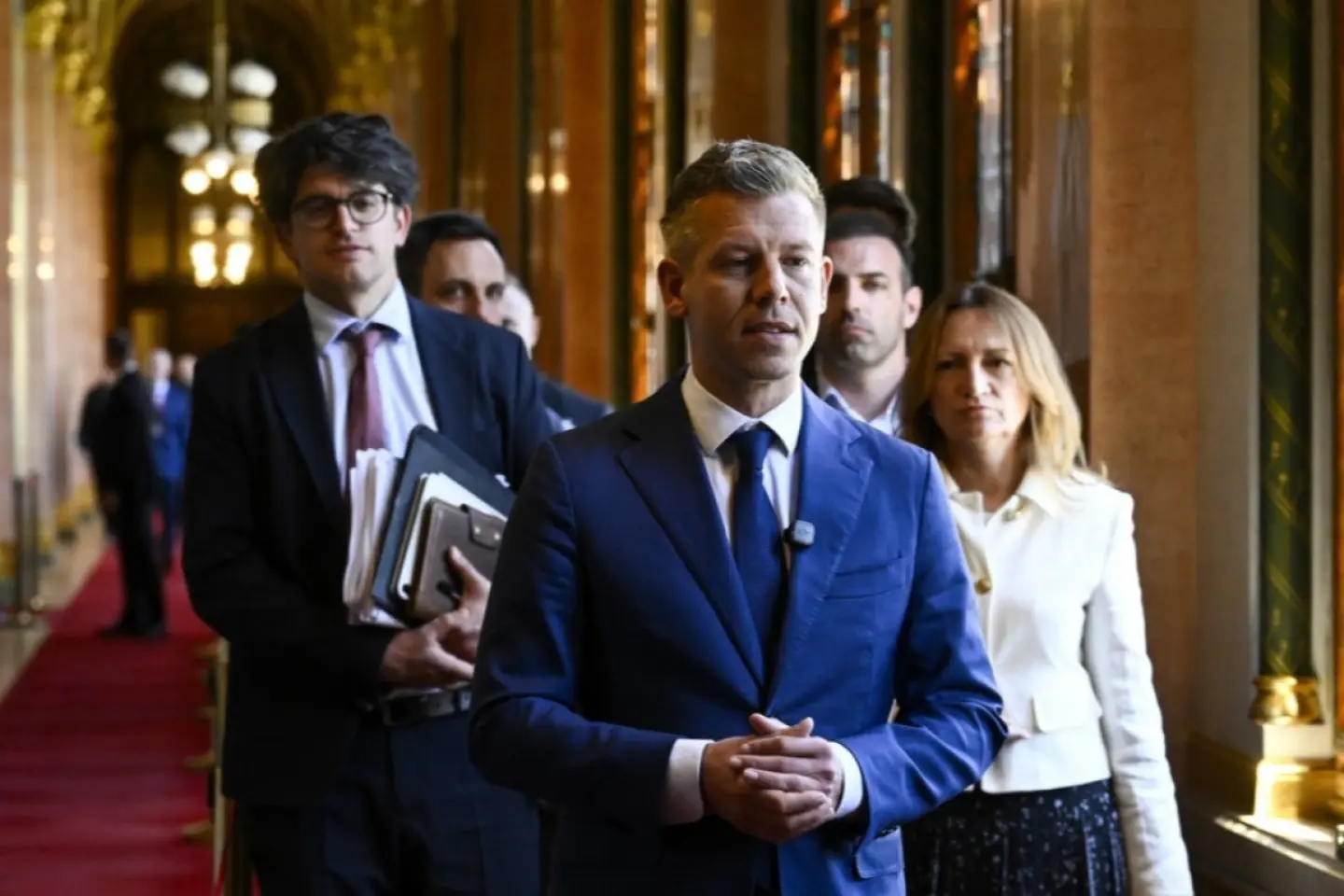
Film directors love Budapest for its eclectic architecture, which has doubled for Moscow, Berlin, Paris, London and Buenos Aires. But this week the city appeared as itself.
Hungarian prime minister-elect Péter Magyar was visiting President Tamás Sulyok at Sándor Palace four days after his election victory over Viktor Orbán on 12 April, when Tisza’s two-thirds majority became unmistakable. The official results gave the party 141 of 199 seats on a record 79.56% turnout, ending 16 years of Fidesz rule
From the terrace on the Buda Hill, Magyar spotted Orbán in the middle-ground of the balcony of the next building, lost in thought and staring at his phone. “Is that the prime minister?” Magyar asked the president. Then, aping an internet meme, he raised his hands a la Martin Scorsese, and proclaimed “abszolút filmszínház”.
The scene was absolute cinema indeed - and with a solid plot and backstory too. There was Orbán on the balcony he had built onto the Karmelita Monastery after moving his office over the Danube a decade ago.
Some directors would have rejected it as too obvious: the protege-turned-rival who had sidestepped captured media and gone online to reach voters, channelling the director of Goodfellas. Magyar’s aside in the soon-to-be-viral video worked because it belonged to a newer world: ironic, knowing, rapid. If he had been within earshot, Orbán would likely not even have got the joke.
The law is the law
Born in 1981 into a Budapest legal family, Magyar grew up in a world where breakfast-table conversation was statecraft and law. His grandfather Pál Erőss had been a TV judge and a household name for a generation of Hungarians. His great-uncle Ferenc Mádl was President of Hungary from 2000 to 2005. His mother worked in the judiciary. The law was not a career choice for Magyar so much as the family business.
In 1998, as Magyar was applying to study law at the Catholic conservative university Pázmány Péter, Orbán was gearing up to become Europe’s youngest prime minister thanks to a campaign that promised voters “two kids, three bedrooms, four wheels”. Orbán added the word polgári to the party’s name: Fidesz - Hungarian Civic Alliance (Fidesz - Magyar Polgári Szövetség) that same year.
Polgári was a central, if amorphous, Fidesz concept, with several meanings: civic, bourgeois, middle-class, respectable, citizenly. As such, it fitted Orbán’s chameleonic political nature.
Fidesz was, at its genesis, a revolution of lawyers. The party's inner circle – Orbán, János Áder, László Kövér, József Szájer – were all students at the Bibó István College of Law. They were the original polgári insurgents. Magyar is no mere black swan; he is the system's biological recursion, a second-generation lawyer coming to foreclose on the first.
Magyar was at the overperforming end of the polgári class, producing three children with his wife, Judit Varga, and likely more than three bedrooms and four wheels.
He graduated from Pázmány, having also studied in Berlin, and began practice at the Budapest Metropolitan Court before moving into the international commercial field, helping multinationals navigate Hungarian corporate and competition law.
Power couple
“When Orbán returned to power in 2010, Magyar worked in Hungary’s foreign ministry and later at the country’s permanent representation to the European Union. After returning to Hungary, he moved into senior roles at state-linked institutions, including as head of the EU Legal Directorate at the Hungarian Development Bank in 2018 and as chief executive of the Student Loan Centre from 2019 to 2022.”
He had met Varga in April 2005 and proposed the following year. Their first son was born in 2008. The family lived in Brussels for several years before Varga was called back to Budapest to serve as justice minister, a position that made her one of the most senior women in a government for which female representation was among the lowest in Europe. They announced their divorce in March 2023.
What happened between them remains contested, and matters as a catalyst to the story. In February 2024, Magyar released a voice recording he had secretly made of Varga, in which she appeared to indicate that senior minister Antal Rogán had arranged for names, including his own, to be removed from documents linked to a bribery scandal.
Varga denied the implication and immediately accused him of physical and emotional abuse throughout their marriage. Magyar denied everything, calling it a government-orchestrated character assassination designed to bury the tape. A police report, subsequently released, described an incident of aggressive and threatening behaviour during a row over their children. The truth of the allegations has not been adjudicated. What is clear is that Magyar understood, with a lawyer's precision, exactly what releasing that tape would cost him - and released it anyway.
His first interview, given to left-wing outlet Partizán, described a system in which “a few families own half the country”, and received over two million views. In a media landscape that Orbán had spent 15 years methodically closing down – buying up regional papers, starving independent broadcasters, turning the national public media into a party propaganda outlet – the internet had become the direct channel to voters.
Magyar gave an interview in a register that was relaxed, direct and not politician-like, something that Hungary's captured media landscape had made impossible. Supporters began wearing similar outfits to his rallies. He auctioned a pair of his sunglasses to charity and raised three million forints. The aesthetics were doing political work.
Youth vote flocked to Magyar
Post-election analyses from Policy Solutions and Political Capital suggest that Orbán did not necessarily lose his core voters – they remained loyal, secured by his Kádáresque promise of stability and state-led narratives. Rather, Orbán lost to biology.
Magyar did not convert the Fidesz faithful; he simply took hold of the future. By capturing over 60% of the under-40 vote, Magyar has effectively engineered a secession of the nation’s productive generation from a stagnant nation-state. For the first time in two decades, the polgári ideal felt young again, leaving Orbán with a shrinking voter base.
The rallies themselves were often game-changing. The first, on 15 March, 2024, on Andrássy Avenue, drew tens of thousands. Magyar later walked from Budapest to Oradea, west Romania, linking Hungary symbolically to the ethnic-Hungarian diaspora in Transylvania, a move pitched at the conservative-nationalist voter who had been told for years that only Orbán could speak for ethnic-Hungarians over the border.
On 15 March 2025, a national holiday, he spoke in a Bocskai suit; the traditional conservative-patriotic Hungarian garment. The detail landed. Magyar was not a Brussels liberal in disguise nor a candidate of the urban progressives who had nowhere else to go. He was something more difficult for Fidesz to fight: a man who dressed and spoke like them, and knew exactly where the bodies were buried.
Beyond the memes lay a gruelling, two-year marathon of physical endurance. While Orbán governed from the heights of the Karmelita, Magyar lived on the road, conducting a relentless nationwide tour that touched hundreds of villages long abandoned by the opposition. From the march to Oradea to his 18-hour days speaking in rural market squares, his victory was forged in grit rather than just glamour. Magyar essentially out-worked a complacent state apparatus, trading the safety of a TV studio for the dust of the Hungarian plains.
Less is more
Magyar’s success was also the story of a steady rightward shift in the opposition. Since 2006, Hungary’s prime ministerial candidates had moved from the post-communist left, to the left of centre Attila Mesterházy, to the failed conservative Péter Márki-Zay in 2022. Magyar is the logical conclusion of this evolution: a prime minister who finally understands that in Hungary, the only way is through the right.
While Orbán-government campaigns attacked Shell and Erste Bank as proxies for hostile foreign capital, Magyar went to Miskolc, east Hungary, and talked about shift patterns. The former steel town saw a 25% swing from former Fidesz voters more concerned with the state of the local hospital than with the “gender ideology” billboards that had defined the 2022 campaign, justifying his focus on "bread and butter" issues.
While Fidesz ran billboards about a so-called “pro-war” opposition, Magyar discussed the state of rural schools. He declined to defend gay rights by name, declined to take a firm position on Ukraine, declined to be the liberal candidate the Orbán machine had been preparing to run against for years.
What he is, stripped of campaign discipline, is a conservative institutionalist who believes the Hungarian state can work if the culture of theft is removed. He now plans to introduce two-term limits for prime ministers - a reform aimed at making another Orbán impossible.
Magyar has also committed to joining the European Public Prosecutor's Office and unlocking the €18 billion in frozen EU funds for the Hungarian economy. He intends to restore judicial independence and dismantle Orbán’s media empire. These are substantial reforms that concern process and institution rather than social vision. They say what will be fixed but nothing about who will be included.
The coming term will be brutal. Magyar will be attacked from the right in parliament, where a rump of 52 Fidesz MPs and six Mi Hazánk hardliners will cast every compromise as a betrayal of the nation. Meanwhile, the centre and left will regroup, waiting for the moment his technocratic fixes fail to deliver immediate prosperity.
Magyar won with a slogan - "Not left, not right, only Hungarians" - that was not a platitude but a small-country calculation. Hungary has under ten million people and has been losing its educated young to emigration for 15 years. A prime minister who fractures the electorate along cultural lines is one limiting their ability to govern. He will keep a firm line on illegal immigration, will remain cautious on Ukraine, and will extend the social conservatism of the Orbán era, not because he is trapped by it but because it is more or less where he stands.
The forint's surge against the euro in the 48 hours following the results shows that the "Magyar premium" was already being priced in by international capital investors who expect a return to predictable, rule-bound governance.
Revenge movie
His first week had the feel of a man settling scores. At the state media headquarters, the broadcaster that had not invited him for 18 months, he entered not as a protester but as the new chief architect. The visit was more than a mere photo-op. Within 48 hours, Magyar’s transition team initiated a forensic audit of the broadcaster’s €300 million budget and suspended several high-ranking propaganda leads.
His encounter with Gergely Gulyás – his former friend and the public face of the regime that branded him a traitor – carried the cold satisfaction of a debt settled. And though Varga remained off-camera, her presence was palpable in every decree aimed at the “corruption” she had once privately lamented on tape.
But the years ahead will be considerably more chaotic. Magyar has inherited a system built by a man who governed as if politics is architecture and dismantling it will require the expertise and understanding that behind every grand narrative is a tangle of gritty, compromising details.
Magyar needs the maestro’s attention to the details while maintaining his wider vision. He must be the director who controls the frame and keeps the nation watching. He will not, however, be moving into the Karmelita, but will set up office in Pest, close to the Parliament.