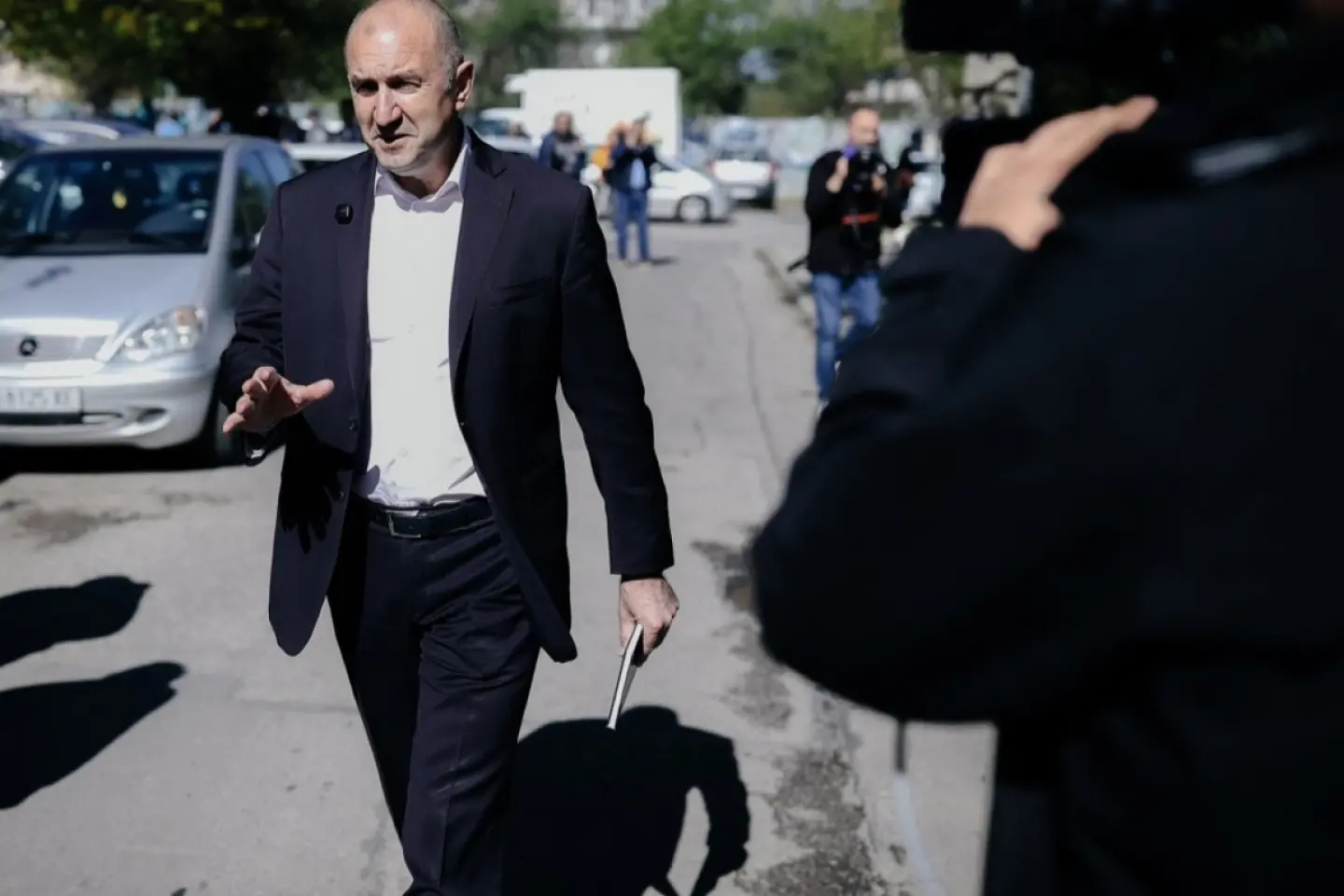
Surpassing all expectations, former Bulgaria President Rumen Radev takes a landslide win with his freshly formed party Progressive Bulgaria and eyes ending the country’s cycle of elections that saw people going to polls for a record eight times in five years.
Radev managed to deliver what could be the most decisive victory by a single party in the country’s post-communist democratic history.
"This is a victory over apathy," Radev told media on Sunday evening, hinting that this is “only the first step” towards restoring public trust in domestic politics. "It’s a victory of hope over desperation, freedom over fear."
An election of historic firsts
Although Progressive Bulgaria was polling first in surveys before Sunday, the party’s debut defied all expectations: with nearly 45 per cent of the voter pool, for the first time in nearly 30 years a party will have a majority in the parliament and won’t be pressured to form an uneasy coalition.
The scale of Progressive Bulgaria's win may be comparable only to the now-dissolved United Democratic Forces' 62.4 per cent landslide in 1997; back then an important development towards Bulgaria’s NATO and EU membership after a period of economic woes.
The new 240-seated parliament, of which Radev’s party will have the majority, is also set to include GERB, We Continue the Change / Democratic Bulgaria, the “Movement for Rights and Freedoms – New Beginning”, led by internationally sanctioned oligarch Delyan Peevski, and the ultranationalist Revival party, though all of these performed below expectations. In the case of GERB, the results are an all-time worst performance given their dominant presence in local politics since 2009, in the case of WCC/DB raising questions on their potential to expand given that they led the 2025 protest wave but young voters have tilted towards Radev.
In another precedent, the Bulgarian Socialist Party, the successor of the one-time Communist party, failed to reach the threshold despite being fronted by a new leader Krum Zarkov pledging internal reforms.
Progressive Bulgaria appears to have absorbed much of the conservative/nationalist electorate, leaving several smaller far-right and nationalist parties without representation in the parliament, including 2021 winners and recent coalition partners There’s Such a People.
Launched just one month before the vote and without a clearly defined ideological position, Radev's party ran on a platform targeting poverty, inflation and the entanglement of oligarchic interests amid ambiguity about Bulgaria’s role in the EU.
In recent years and especially on his campaign, Radev has walked a careful line. He has opposed military aid to Ukraine, criticised Bulgaria’s gas cut-off from Russia, resisted Western sanctions on Kremlin, expressed reservations towards North Macedonia's EU accession bid and stood against Bulgaria adopting the euro – all while publicly affirming Bulgaria's commitment to EU and NATO membership and formally condemning Putin’s invasion in Ukraine.
"We are impressed by the words of Mr. Radev, who won the elections, and of several other European leaders regarding their willingness to resolve issues through dialogue, pragmatic dialogue with the Russian Federation," said on Monday Kremlin spokesman Dmitry Peskov. Meanwhile, Serbian President Aleksandar Vučić was among the first European leaders to congratulate Radev.
The elections were also marked by a crackdown on voter fraud, initiated by the interim government. On Sunday evening, interim interior minister Emil Dechev announced that 425 people have been arrested for vote fraud in comparison to 72 in 2024. Out of 2974 alerts, 631 have been connected to votes in favour of Peevski’s New Beginning and 318 to GERB, with all the other major parties also mentioned but in relation to a smaller number of cases.
What now: the good, the bad and the unknown
Since 2021, coalition talks have often failed and parliamentary work has frequently been disrupted by conflicts, partly due to fragmentation, with parliament often consisting of seven or eight parties.
With Progressive Bulgaria absorbing the smaller parties’ electorate, the next parliament is shaping up to include only five parties.
This could ease the process of forming a government, bring an end to the election cycle, and help parties find common ground on legislation – particularly given Progressive Bulgaria and We Continue the Change/Democratic Bulgaria’s shared ambition for judicial reform that would target the legacy of Boyko Borissov and Delyan Peevski.
It remains to be seen whether Radev will set aside his Eurosceptic agenda to maintain a recognisable and relevant profile for his expanded electorate, or whether he will abandon the delicate balance in his campaign in favour of a more hardline approach.
Radev may also be moving toward exercising full control over local political dynamics in the near future.
After his resignation in January, his vice president, Iliyana Yotova, became acting president. Bulgaria is also set to hold presidential elections by the end of the year. If Yotova wins, Radev could end up controlling both parliament and the presidency. In that scenario, if Radev’s party develops proper party structures across the country, it might have the ambitions of dominating in the 2027 local elections, pushing out GERB from municipalities.
Radev holds the ways and means to bring to an end to GERB and Peevski’s legacy of corruption and influence on the judicial system – yet, he might cement his power along the way and in turn, and fulfil expectations that he is indeed “the new Orban”.