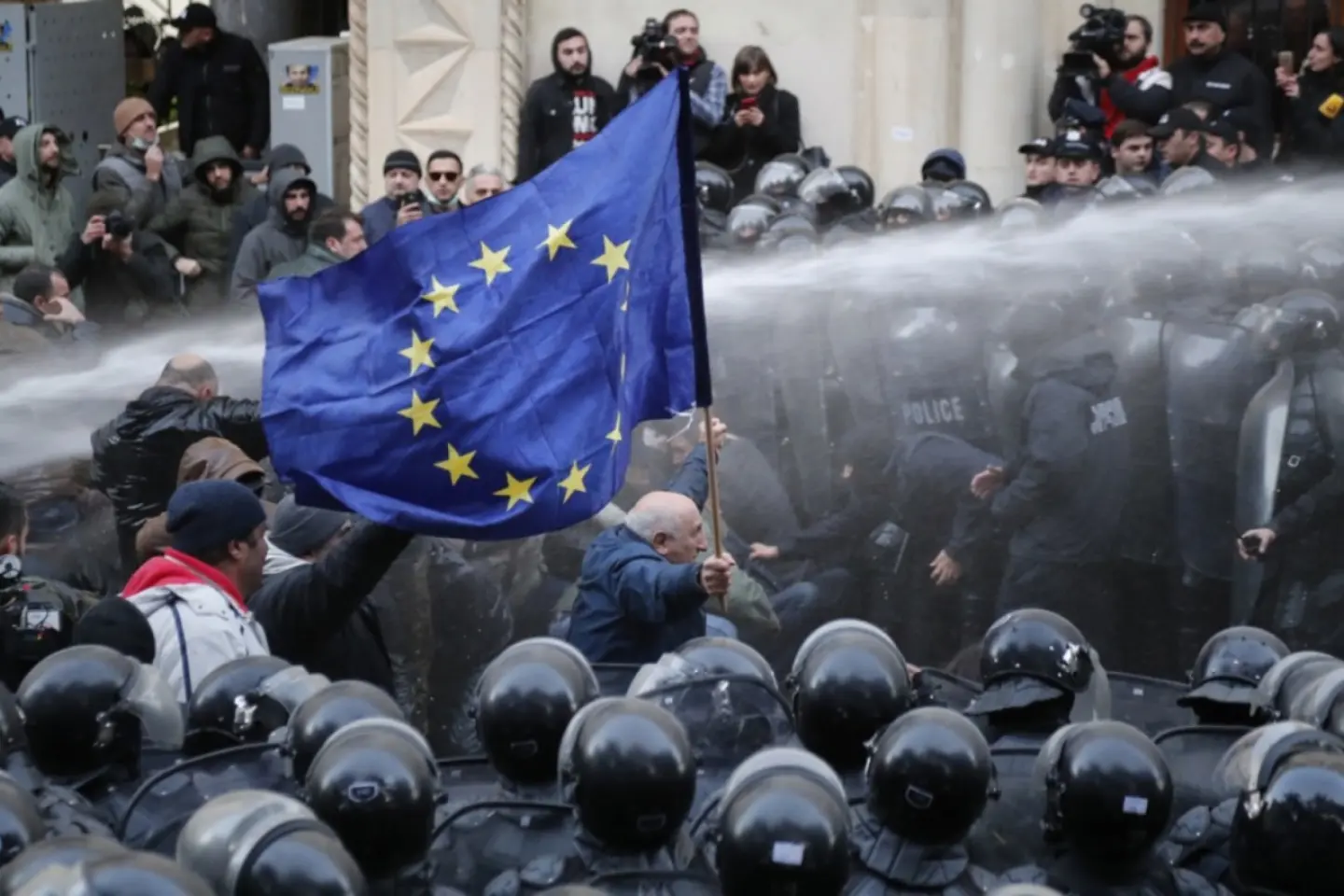
A BBC investigation alleged that the Georgian government used World War 1 chemical weapons against anti-government protesters. The Tbilisi government claimed that the allegations are part of a hybrid war waged against it, but domestic opposition and NGO’s, as well as foreign governments and international organizations, rejected the claimed and asked for an independent investigation.
From the tranches of WW1 France to the streets of Tbilisi
During the investigation, the BBC spoke with chemical weapons experts, sources within Georgia’s police special forces, and doctors, and collected data indicating the use of bromobenzyl cyanide, which French military forces referred to as “camite.” The BBC reports that this substance was first used by France against Germany during the First World War. Traces of it were apparently found after the Georgian police tried to disperse anti-government protests in late 2024. The investigation states that the substance could have been added to water cannons used to disperse the rallies.
Pediatrician Konstantin Chakhunashvili, who repeatedly took part in the protests and was hit by water cannon streams, told the British outlet that his skin “burned” for several days, and that this sensation could not be washed off with water. Moreover, according to him, “when trying to wash his face, it became even worse.”
Chakhunashvili also examined 69 people who had participated in the demonstrations and found that they had a “significantly higher prevalence of abnormalities” in the electrical signals of the heart.
Dr. Chakhunashvili’s report confirmed the conclusion previously reached by local journalists, doctors, and human rights organizations: that some kind of chemical substance was likely added to the water cannons. They called on the government to determine what exactly had been used, but the Ministry of Internal Affairs, which oversees the special forces, refused to do so.
In addition, several high-ranking sources associated with special-purpose units of the Ministry of Internal Affairs helped the BBC determine what kind of chemical substance it could have been.
Lasha Shergelashvili, who in the past was responsible for the armament of these units, believes that this was the same compound that he was tasked with testing for use in water cannons in 2009.
Shergelashvili said that based on the results of his tests, he recommended not using this chemical substance. However, he says that it was nevertheless added to the water cannons – and that this was the case at least as of 2022, when he left the service and left the country.
The BBC also spoke with another former high-ranking police officer who confirmed that the compound loaded into the water cannons during Shergelashvili’s tenure was the same one that was used during the dispersal of protests in November–December 2024.
As the main piece of evidence, the BBC presented a secret document – a list compiled by the Department of Special Tasks of the Ministry of Internal Affairs containing an inventory of equipment intended for dispersing protests. The document is dated 2019. Two chemical codes drew attention in the list: UN 3439 and UN 1710. UN 1710 is trichloroethylene, a solvent used to dilute chemical substances in water. In addition, journalists managed to establish that out of the entire range of substances under UN 3439, only one had ever been used for riot control. This is bromobenzyl cyanide – “camite.”
Tbilisi reacted by claiming it was targeted by a hybrid war waged by the BBC and the West
Government and “Georgian Dream” officials categorically rejected the allegations. The first to comment on the situation was former Minister of Internal Affairs Vakhtang Gomelauri, who acknowledged that his ministry had purchased the substances, but claimed that they were never put to use:
“These substances they are talking about were indeed purchased by the Ministry of Internal Affairs and used, but before 2012. If I am not mistaken, the last purchase was in 2009 or 2010. After that, the Ministry of Internal Affairs neither purchased nor used them.”
Gomelauri’s statement was rejected by the current Minister of Internal Affairs, Gela Geladze, who said that he had personally reviewed the documentation and, on that basis, was ready to say that the so-called “camite” had never been purchased by the Georgian Ministry of Internal Affairs.
“I personally reviewed all the documentation, all the procurements that were carried out in this direction. With full responsibility and confidence, I can say that the Ministry of Internal Affairs of Georgia has never purchased the so-called camite. As you know, the State Security Service has launched an investigation. Of course, all relevant examinations will be назначены, all persons will be questioned, and absolutely all questions will be answered,” Gela Geladze stated.
The first comment by Georgian Prime Minister Irakli Kobakhidze was also ambiguous. He acknowledged that during the dispersal of protest actions in November–December 2024, some substance was added to the water cannons, but he denied that this substance was camite.
“The substance was indeed mixed in. The main question is whether this substance was prohibited. The Ministry of Internal Affairs has already confirmed that camite was never purchased or used, including under the previous government,” Kobakhidze stated.
Later, the Prime Minister called the BBC investigation into the possible use of chemical weapons against protesters in Tbilisi “hybrid violence” against the country and threatened “severe punishment” for those who appeared in the documentary film by the British broadcasting corporation.
Parliament Speaker Shalva Papuashvili echoed Kobakhidze’s words by calling the investigation a part of a “hybrid war” against Georgia, in which media resources served as weapons. According to him, the report “named by name” those who are working against the country. Papuashvili called the BBC material an example of how “false narratives are orchestrated” with the participation of Western partners and local opponents of the authorities.
As the official investigation targeted witnesses, the Georgian opposition and civil society denounced a government attempt to silence them
Against this background of political statements, the State Security Service of Georgia said it was launching an investigation into the allegations and that it would examine both the content of the report itself and the testimonies of the people whose interviews formed the basis of the film. The investigation was supposed to determine whether prohibited chemical substances had been used, or the allegations were aimed at harming state interests.
Several days int the investigation, the State Security Service of Georgia stated that the chemical powder used against protesters in the water cannons was chlorobenzylidene malononitrile, which, according to them, was purchased by the Ministry of Internal Affairs in 2007. At a briefing on December 6, First Deputy Head of the State Security Service Lasha Magradze stated that the Ministry of Internal Affairs had never purchased “camite”. Magradze added that the State Security Service had completed only the investigation into which chemical substance was used in the water cannons to suppress anti-government protests. However, the investigation under Article 319 of the Criminal Code, “assisting a foreign organization in hostile activities,” is ongoing.
The State Security Service reported that 93 people were questioned in the criminal case it had initiated. They included current and former Ministry of Internal Affairs employees, doctors, experts, respondents from the BBC report, representatives of non-governmental organizations, and others. The opposition denounced what it called another attempt by the authorities to intimidate participants in the pro-European protest movement.
On December 22, 12 Georgian NGOs appealed to the Director-General of the Organisation for the Prohibition of Chemical Weapons (OPCW), UN Special Rapporteurs, and the Council of Europe Commissioner for Human Rights, asking them to use their mandate and consider the possibility of establishing facts or sending an investigative mission to Georgia to determine whether the authorities used the chemical substance “camite” against demonstrators during the dispersal of protest actions, as suggested by the BBC. The organizations consider the Georgian authorities’ “conclusion” regarding the allegations to be questionable, emphasizing that Georgia “lacks an effective, independent, and reliable investigative mechanism.”
Reaction of the international community
Western politicians and international organizations have called on the Georgian authorities to conduct an objective investigation and publicly disclose which substances were used during the dispersal of peaceful demonstrations last year.
Thirty-nine OSCE countries issued a joint statement on the case of the possible poisoning of protesters with chemical weapons in Georgia.
“The lack of an investigation in connection with widespread reports of excessive use of force against persons exercising the right to freedom of assembly and expression in Georgia demonstrates the narrowing of civic space for dissent and creates a dangerous atmosphere of impunity,” the statement says.
The document was signed by Albania, Andorra, Austria, Belgium, Bosnia and Herzegovina, Bulgaria, Canada, Croatia, the Czech Republic, Estonia, Finland, France, Germany, Greece, Iceland, Ireland, Italy, Latvia, Liechtenstein, Lithuania, Luxembourg, Malta, Moldova, Montenegro, the Netherlands, North Macedonia, Norway, Poland, Portugal, Romania, San Marino, Slovakia, Slovenia, Spain, Sweden, Switzerland, Ukraine, the United Kingdom, and Denmark.
The United Kingdom separately expressed concern about reports of the use of chemical weapons against demonstrators in Tbilisi. UK Minister of State Stephen Doughty stated:
“We expect Georgia to fulfill its obligations under the Chemical Weapons Convention and ensure a proper investigation of any alleged violations,” Doughty wrote.
The Helsinki Commission called on the authorities of the United States and partner countries to investigate reports of the use of chemical weapons against participants in anti-government protests in Georgia. A corresponding statement was issued by members of the commission: Senators Roger Wicker and Sheldon Whitehouse, as well as Congressmen Joe Wilson and Steve Cohen.
“These chemical attacks have resulted in burns and long-term health problems for the victims and constitute violations of human rights obligations that the Georgian authorities are required to uphold. Such actions place ‘Georgian Dream’ alongside the corrupt rulers of Russia and China, who fear their own people and will stop at nothing to retain power. We urge the US government and our democratic allies to verify these reports and impose appropriate sanctions on those responsible,” the statement says.
The international human rights organization Amnesty International also demanded an independent international investigation into the facts presented in the BBC investigation. Amnesty International also called on international partners to impose a full embargo on the supply of police equipment to the country as long as “Georgian Dream” remains in power.