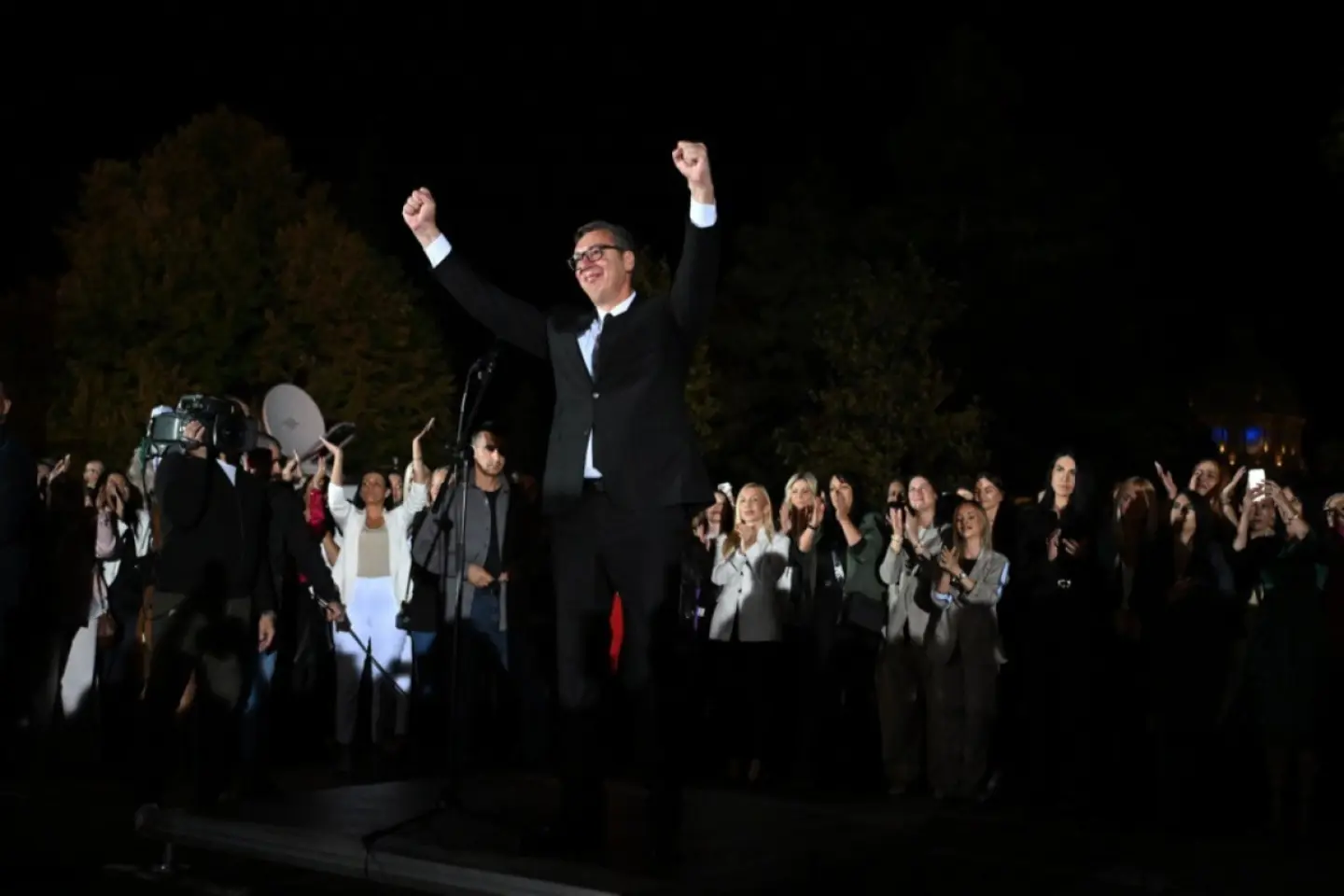
After more than 14 years in the heights of Serbia’s political establishment, Aleksandar Vučić finally left the presidency. On Sunday, September 27, he submitted the resignation he had announced repeatedly over a long stretch of time, although the formal end of his presidency is less important than what will follow. Crucial parliamentary elections are scheduled for October 25, while Vučić has announced the first round of the presidential election for the end of December, more than two months later.
Vučić’s departure from an office that is not, constitutionally speaking, Serbia’s most powerful position was almost remarkably uneventful. He seemed to disappear from it as quietly as someone slipping out in the middle of the night, leaving behind only an unsubstantial crowd from the anti-Maidan camp outside the presidential palace in central Belgrade and eight taxis displaying national flags near the bridge connecting the old and new parts of the city. From all the pomp and displays of might that Vučić’s regime has grown accustomed to, this represents quit a detour. We have the student opposition to thank for this, since their mass rallies have long overshadowed those of the regime’s entire administrative apparatus.
The unusually quiet departure should not be mistaken for a lack of political calculation, however. The two elections have deliberately been placed in a particular sequence because the parliamentary contest offers the ruling SNS party better prospects than the presidential one. Had the presidential election come first, a student-backed candidate might have won the second round and triggered a snowball effect: opposition confidence would have risen, and its chances in the parliamentary election would have improved.
Vučić is attempting to reverse that logic for his own benefit. If SNS wins the parliamentary election and secures enough mandates to form a government, even through a coalition, the resulting disappointment could weaken the opposition before the presidential contest. The gap of more than two months also gives the regime time to absorb another highly probable wave of protests and disputes over the election results. Vučić can reasonably expect public anger to lose some of its initial force, while the opposition could begin to divide over whether to participate in the presidential election or boycott it.
The first real challenge to Vučić’s party in more than a decade
The crucial question, therefore, is not simply who comes on top on October 25, but what political momentum each side carries into the period that follows. That calculation has become especially important because Serbia now has an opposition force capable of seriously challenging SNS for the first time in 14 years.
The Student List, which started as a liberal, anti-corruption movement, has been conducting a national-populist campaign at least since the protest of June 28, 2025, leaning on nationalist symbolism in much the same way as the regime. Its position on Serbia’s integration into the European Union is formally undefined, but informally it amounts to a softer Eurosceptic alternative. That positioning has prevented it from attracting all of the traditional opposition parties in a unified camp.
Those with the strongest independent ratings and sufficient financial resources are separately taking part in the election as part of the “European Serbia” coalition. If that coalition crosses the three percent electoral threshold, it could serve as an important counterweight to the Student List’s Euroscepticism when a government is formed. Vučić, for his part, is counting on assembling a parliamentary majority with Ivica Dačić’s Socialist Party of Serbia and the parties representing national minorities which are elected by a different set of privileged rules.
The polling picture only adds to the uncertainty. Unlike previous election cycles, Serbia has produced relatively few public opinion surveys, partly because the contest has become much harder to measure and partly because of the extraordinary polarization of society and the political arena. The situation resembles Hungary before its last parliamentary election, when pro-government agencies predicted an Orbán victory while independent agencies produced very different figures and were ultimately proven correct. In Serbia, the latest September Faktor Plus survey, conducted by an agency close to the regime, gives SNS 48.6 percent and the Student List 37.1 percent. Even that survey records growing support for the student opposition compared with previous measurements. The independent CRTA survey from June 2026 tells a very different story, putting the Student List ahead at 31.5 percent compared with 25 percent for SNS.
Whatever the limitations of the competing surveys, the emergence of the Student List itself is significant. Serbia has, for the first time, produced a political force that can plausibly challenge SNS for the first place. The outcome may be decided by a very narrow margin, which in turn increases the importance of smaller parties and coalitions that could determine whether either of the two leading camps can actually assemble a governing majority.
A sign that times are changing? Vučić’s foreign policy game is no longer working
Vučić has long presented himself differently to Western governments than he does to his domestic supporters. Abroad, he cast himself in the role of a pragmatic Western partner. He received Zelensky in Belgrade and later travelled to Ukraine to join the Carpathian Eight. At home, however, his rhetoric continues to revolve around lowbrow anti-Western rhetoric from the Milošević era. That contradiction became particularly visible around Mladić’s death and funeral. The nationalist spectacle he had to provide for his domestic audience, with the Russian ambassador present, sent a very different signal to Brussels and Washington.
The same divide appeared in the way he communicated to the public on the day of his resignation. A previously recorded CNN interview, which was aired shortly after he had read his own resignation, portrayed him as the rational alternative, effectively a barrier against a stronger nationalist tide awaiting in the opposition. For almost a decade and a half, he has made essentially this argument to Washington and Brussels, warning that his removal could allow nationalists more dangerous than himself to take power. Yet in his Belgrade speech on the same night, he spoke instead about defending Kosovo, the injustice of the Hague Tribunal and his commitment to norms of traditional society.
However, Vučić’s room for maneuver abroad has substantially narrowed. European Commission President Ursula von der Leyen cancelled her planned visit to Belgrade while preparing to visit other regional capitals. Vučić then pursued contact with her around the UN General Assembly in New York in an apparent effort to obtain a joint photograph, but her office later emphasized that the meeting had been spontaneous. Brussels might once have tolerated such behavior from a politically untouchable Vučić. The circumstances are different now that his electoral position can genuinely be challenged.
Serbia may be heating up in the run-up to the elections
The final weeks before October 25 are likely to be increasingly tense, with physical confrontations expected between the regime and student supporters across provincial Serbian towns. However, the election itself may not provide a clear endpoint to the crisis. If the Student List does not lead the parliamentary race, the protests that follow are unlikely to have the same momentum as they would if it wins the largest share of the vote but Vučić nevertheless manages, through coalition-building and electoral maneuvering, to secure enough mandates to form a government. Winning an election does not automatically mean being able to form a government, a reality that many populist parties across Europe are painfully aware of, and this distinction could prove decisive in the days and weeks following the vote. This fragmentation benefits the SNS, which is already preparing to rely on its partners from previous years to weather the post-election crisis.
With less than a month left until election day, the political temperature in an already highly polarized Serbian society will almost certainly continue to rise. Yet, the country's prolonged political crisis may not reach its decisive moment on October 25. The actual conflict is poised to play out during the high-stakes interval between the parliamentary and presidential votes, where the focus will entirely shift to which faction can successfully capture or hold on to political power.