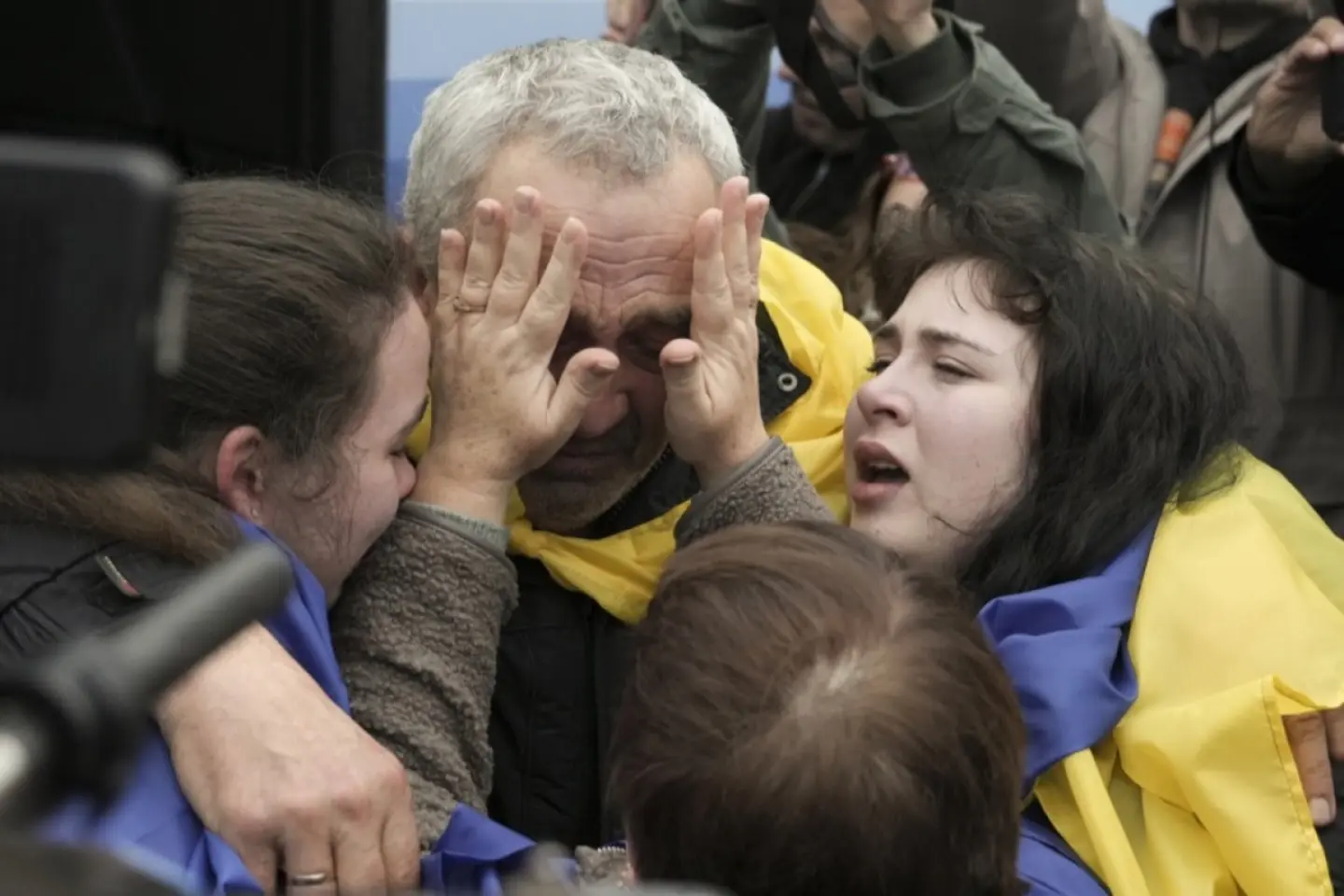
Liuba cannot call her mother when she wants to most: not to share good news, not to tell her about bad news, or even just to find out how she is doing. Her mother lives in a Ukrainian city occupied by Russia, where there has been neither internet nor mobile phone service for several years.
People who remain under occupation sometimes have to wait for the right moment or travel dozens of kilometers in search of a signal just to hear their loved ones’ voices. But even when they finally get a connection, they cannot always speak freely. People fear that Russian intelligence services may be listening in on their conversations.
We tell the stories of what people separated by occupation leave unsaid, how they choose their words, and how they find ways to talk about more than just the weather. This is a story not only about the lack of communication but also about attempts to preserve closeness when Russia is trying to destroy it.
*The names of the women featured in this article have been changed for security reasons.
An Endless Wait
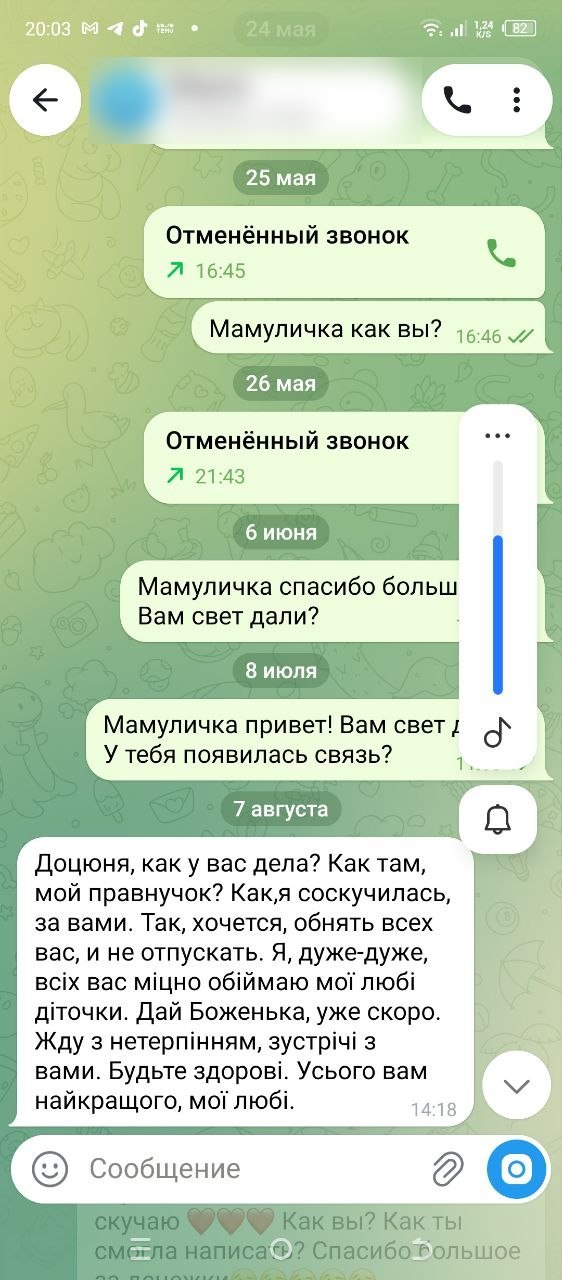
Maria shows screenshots of her attempts to contact her mother and brother, who have been living under Russian occupation in a small Ukrainian village for the fourth year. Maria says she was forced to leave her home two years ago after armed Russian soldiers broke into her house, beat her husband and ordered them to obtain Russian passports immediately.
After leaving, she kept in touch with her mother almost every day, but everything changed this spring. The village where her mother lives lost electricity, and with it the Wi-Fi signal that she used to pick up in the evenings in the yard near her neighbors’ house. Since then, both her mother and brother have only been able to charge their phones using an old generator. Her mother still has a Ukrainian SIM card in her phone, holds a Ukrainian passport and does not receive a Russian pension. Maria has no idea how she and her brother are making ends meet.
- “Soldiers have already come to her house. Thank God, it wasn’t like what happened to us, but they checked my brother’s phone and searched the house. Mom held back for as long as she could, but then she told them exactly what she thought: ‘See how you’ve liberated us?’ The Russian soldiers have already warned her not to say things like that or there would be consequences, but she just can’t help herself. I beg her, I really, really beg her to be careful,” Maria shares.
She tries to talk to her mother as much as possible, but when the connection is poor, a call may last less than a minute.
- “But at least when I hear her voice,” she says, “I know everything is all right, and I can relax.”
- “Have you heard her voice today?”
- “No, I haven’t heard from her for two weeks now. I tried a week ago, but it didn’t work. Neither Telegram nor Instagram works. Messages won’t go through, and neither will calls.”
- “And what does your mother say when you manage to talk?”
- “Just ‘How are you? How are you? How are you?’ She says she had been so hopeful, but now she can’t see when it [the war] will end and all that. She’s lost hope.”
- “How do you arrange your next calls with your mother?”
- “We don’t. I just keep waiting.”
***
Restrictions on communications in the occupied territories are not merely a technical problem. In its Freedom on the Net 2024 report, the human rights organization Freedom House reports that, since spring 2022, Russia has been rerouting internet traffic through its own networks, restricting access to websites and VPNs blocked in Russia, and forcing residents to switch to SIM cards issued by Russian operators that block calls to Ukraine. This has further complicated access to independent information and communication with Ukrainian government-controlled territory.
Letters to Nowhere
Liuba’s parents celebrated their 51st wedding anniversary this year. For the fourth year in a row, this important family occasion has taken place under occupation: no relatives gather at their home, and there are no flowers from their daughter on the table. All Liuba could do was send her parents a congratulatory message on Telegram, which, just as she expected, has remained unread for several months.
In early 2023, communications went down in the Russian-occupied city in Luhansk Region where Liuba’s parents remained. There has been neither mobile coverage nor internet access there ever since. Instead, the occupation authorities have installed several public payphones on the streets that can be used to call an ambulance and are discussing the return of landline telephones.
For a while, Wi-Fi was available at one of the cafés. "Dad used to call me," Liuba recalls, "but the calls lasted only a minute: ‘Everything’s fine, we’re alive and well, Mom sends her love.’ I could sense that he was in a hurry, as though he didn’t feel safe," she shares. For the past three years, her parents’ phones have been lying unused at home. Liuba believes the Russians have isolated her city, and her parents along with it, out of fear that local residents might report the occupiers’ positions to the Ukrainian military.
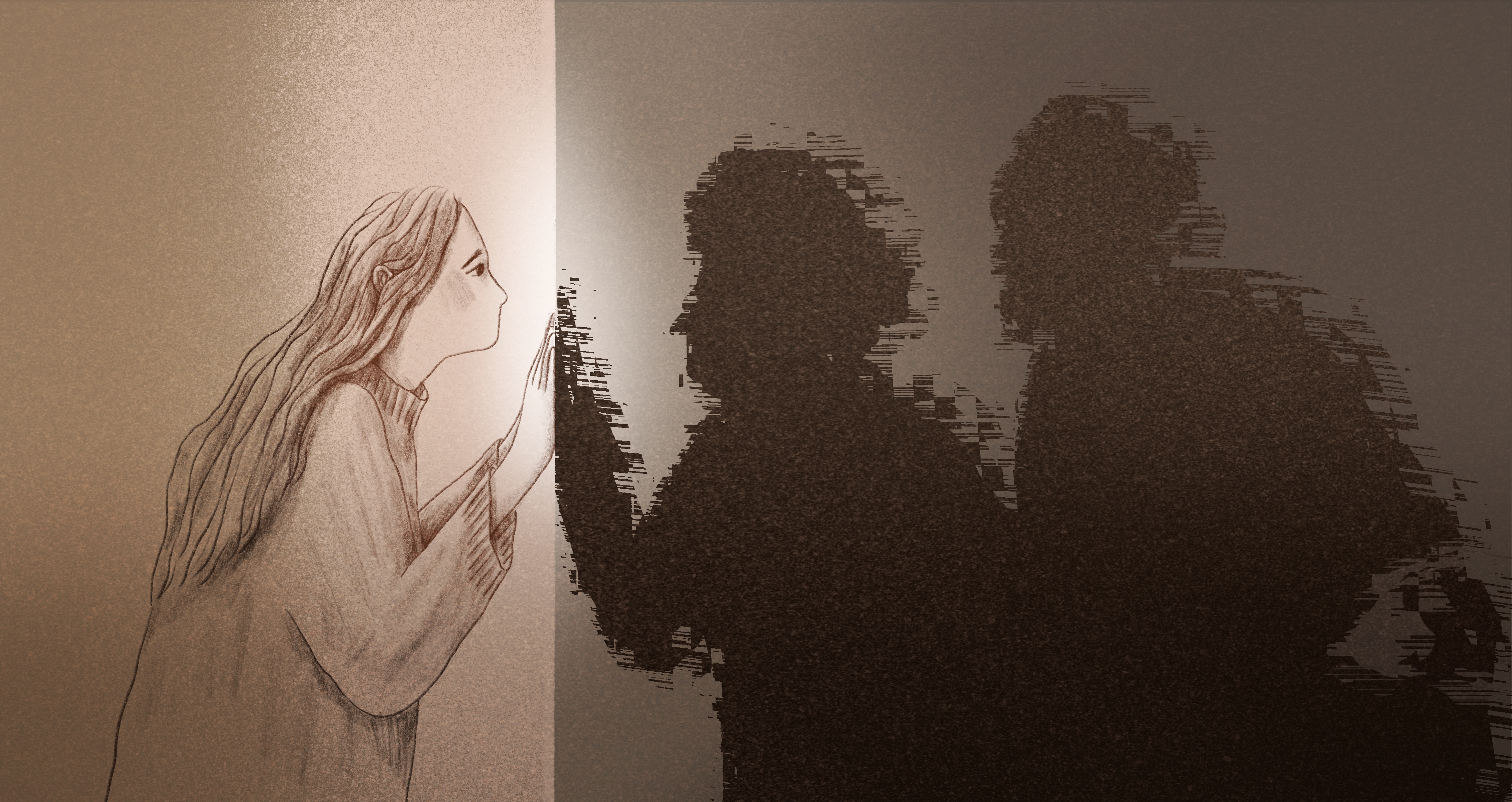
Since then, Liuba has heard her parents’ voices only on the rare occasions when they travel 150 kilometres on errands to Luhansk, which has been occupied since 2014. There, her mother switches on her phone and tries to call her daughter. After all the Russian blocks and bans, Telegram is the only app left that they can use for calls. Even that works intermittently.
“You need to install a VPN,” Liuba explains, “and it has to be a really good one, perhaps even a paid one. Because a basic VPN won’t let you make calls; you can only send text messages. And even with a VPN, the calls are mostly audio. The connection keeps dropping, the sound is distorted, and it’s unstable.”
Their conversations last five to ten minutes. During that time, they manage to discuss only their health and the most important everyday matters. Sometimes her mother talks about ordinary things, but Liuba no longer recognizes the names of local shops, food manufacturers or television personalities. Because all of it is now Russian.
“It’s such an interrupted, somewhat limited, frozen connection. Like the telegrams people used to send. We have all this technology, space exploration, and yet [under occupation] we’re going back to payphones, to a lack of communication, to being unable to communicate at all. I try to maintain our relationship through care,” Liuba says. “During those five minutes, I make sure to ask about their health, their emotional well-being, to share in any happy moments and offer support. I try to do everything I can, even with so little opportunity.”
The family manages to see one another on video calls only once or twice a year. Liuba does not dare travel to her parents in the occupied territory because she is convinced she would be detained and imprisoned at the border. The family could meet abroad only if her parents have enough strength to obtain Russian international passports and are healthy enough to travel around a thousand kilometers.
***
In a 2026 report, Human Rights Watch (HRW) notes that Ukrainian citizens wishing to enter the occupied territories must undergo thorough screening by FSB officers in Russia, including interrogations and phone inspections. According to Russian authorities, approximately 30,000 Ukrainians were denied entry to Russia at Moscow’s Sheremetyevo Airport between October 2023 and April 2025. Pro-Ukrainian social media posts and likes, criticism of the war or Russian policies may be grounds for an entry ban. Russian courts are known to have rejected all appeals filed against these entry bans.
In early November, news emerged that Oleksandra Kazarovytska, 44, co-founder of a language school in Kharkiv, had died after spending three months in a Russian prison. According to her colleagues, she travelled to occupied Crimea in the summer of 2026 to help her parents sell their apartment and move to Turkey.
Video Messages Across Borders and Through Other People’s Phones
Karina’s phone screen lights up and starts ringing, but she cannot answer. Neither an accept nor a decline button appears on the screen. This happens only when her mother calls from the occupied territory through a special paid app that sometimes experiences technical glitches.
We look at the screen and wait for the ringing to stop. We interrupt the recording of Karina’s testimony, in which she is describing how occupation forces took her to a field and staged a mock execution. Karina has just told us about the burst of automatic gunfire directed at her feet as she stood in the field with a bag over her head.
On the third attempt, she manages to answer the call.
“How are the little birds? Are they flying?” she asks her mother, referring to FPV drones. “Are feathers falling?”
Karina is careful when speaking with her mother. She will not say a single word that could put her mother’s life at risk. During the several months Karina spent in captivity, her mother, a woman no longer young, travelled to every nearby and distant pre-trial detention centre, penal colony and prison, asking the same question: “Where is my daughter?” She refused to believe the piece of paper she was given stating that Karina had hanged herself and had been buried in a cemetery under some number, and she tore up the “document”. When Karina was finally released from captivity, she did not even find her mother at home because she had once again cycled to the police station with that same persistent question about her daughter.
Since Karina left the occupied territory, her mother has endured several searches and has herself been detained and beaten by occupation security forces.
But Karina learned about this over the phone from an FSB officer, not from her mother, who, after everything she had been through, said only that everything was fine, there was nothing to worry about and that they had not broken anything.
“A woman well into her seventies,” Karina sighs. “Perhaps after they released her from the basement, they installed a wiretap on her phone, which is why she said that,” she speculates. “We haven’t had internet since 2022, nor any secure channels of communication. There’s only the occupation operator, which may activate call recording when certain ‘trigger’ words are spoken.”
Although Karina does not know exactly which words might trigger recording, she and her mother never use any words related to the war in their conversations. “All our conversations are about everyday things,” Karina explains. If her mother says that mice have dug burrows in the fields, Karina understands that the Russians have dug trenches. If her mother says she has a new grocery buyer, Karina understands that there has been a new strike.
Neither her mother nor Karina shares personal problems or worries as they used to. Karina admits that she only shares good news so that her mother can be happy for her. They are far apart now, and her mother cannot help her with her problems anyway.
“We can’t share the difficult, painful things, you understand?” Karina says. “I miss her terribly. Just as she misses me. Of course I worry. At night, my head feels like it’s splitting from all the thoughts. When you can’t see someone and don’t know what’s happening, you always imagine the worst. I beg the Lord God to protect my dear mother so that we can see each other again.”
In the three years since leaving the occupied territory, Karina has not seen her mother in person once. Sometimes, however, her mother sends her videos through people travelling out of the temporarily occupied territories. These are usually spontaneous clips filmed in a hurry. In them, her mother is wearing outdoor clothes, standing either in her own yard or at Karina’s house, showing her things: "Look at this little tree, see how much it’s grown. And here I am."
“She understands that she mustn’t put people crossing the border at risk,” Karina says. “The main thing is that I can see she’s alive and well. That she’s walking, talking and smiling. That’s what matters.”
Notes: *The names of the women featured in this article have been changed for security reasons.
** Written by Nadiia Shvadchak, Illustration by Mar'iana Mikitiuk. The text was created in collaboration with The Reckoning Project, a global team of journalists and lawyers documenting, publicizing, and building cases of atrocity crimes.