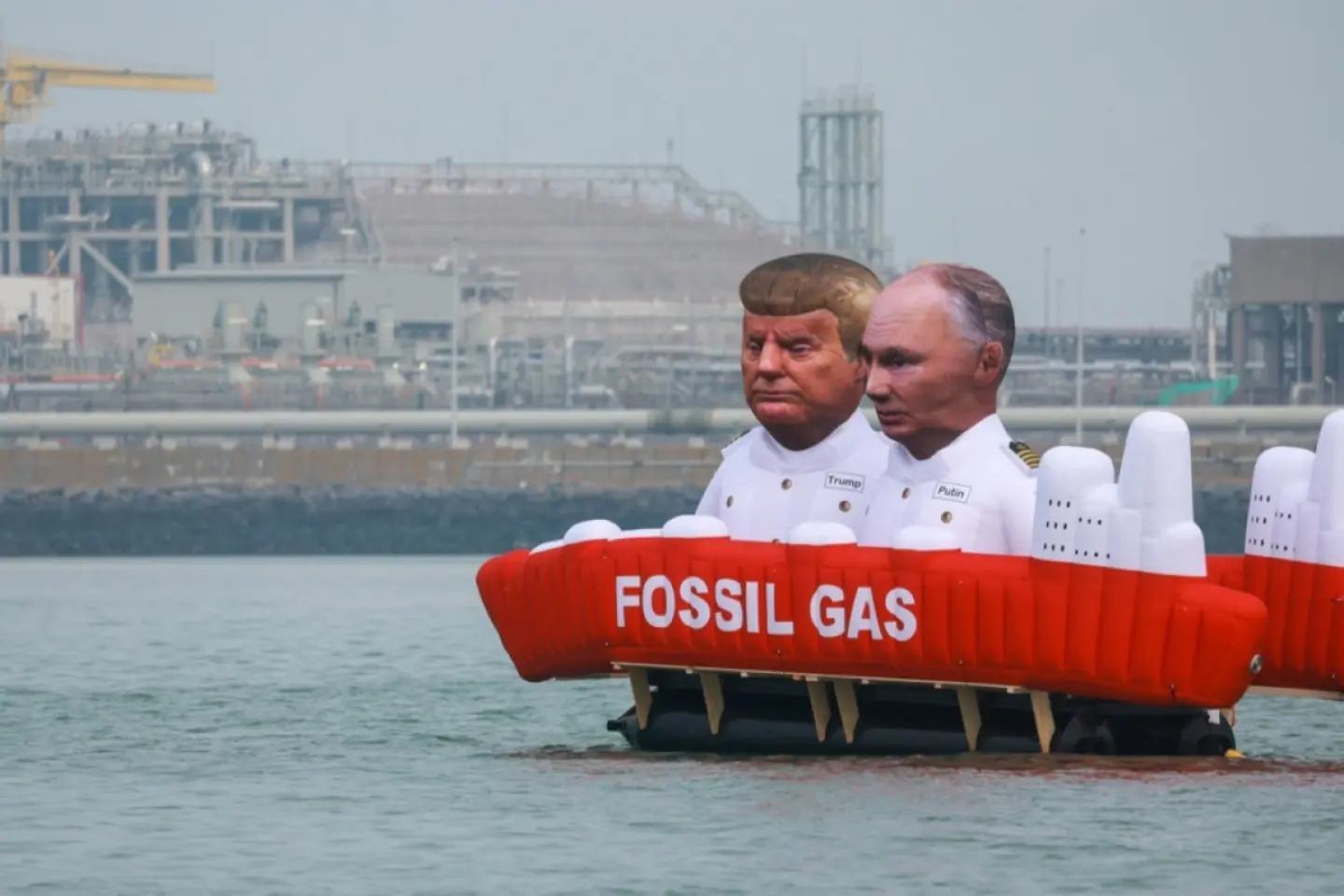
In an effort to bring down fuel prices ahead of the November elections, Donald Trump decided to ease the sanctions imposed on Moscow and allow the import of Russian diesel. The measure did not help the Republicans in any way, as they suffered a severe defeat. Russian diesel did not even reach the markets before the elections took place. However, even if Russia would eventually deliver all the promised diesel, the economic impact would be modest.
On the other hand, the political consequences of this arrangement could extend far beyond the American fuel market. Moscow receives a signal that sanctions pressure is weakening, Ukraine faces growing pressure from Washington, and Europe is once again confronted with a fundamental question: how reliable is its security framework when its principal guarantor increasingly treats sanctions not as a long-term policy instrument, but as bargaining chips in short-term political deals?
Trump and a Little Diesel
On October 9, Donald Trump announced an agreement with Russia that, according to him, was intended to increase the global supply of diesel fuel and help bring down prices. Russia reportedly agreed to immediately release more than 300,000 tonnes of diesel to US and global markets, followed by another 500,000 tonnes in November, one million tonnes shortly thereafter, and additional volumes in the following months. At the same time, the US Treasury issued a special license authorizing transactions involving Russian diesel, including its sale, transportation, and importation. Washington thus went beyond merely announcing an energy agreement and took a practical step toward easing existing restrictions on Russian petroleum exports.
Moreover, on October 16, Trump went considerably further. He suspended the application of several tough sanctions and trade restrictions under the Lindsey O. Graham Sanctioning Russia and Iran Act of 2026, which Congress passed and Trump signed in September. The measures provided for additional tariffs of up to 500% on Russian goods and up to 100% on products from major buyers of Russian oil and gas, as well as restrictions targeting Russian financial institutions, energy companies, and related entities.
Washington justified this decision by citing the need to protect national interests. But this raises an obvious question: can potential deliveries of Russian diesel really have a meaningful impact on prices at American filling stations — enough to make a difference for Trump?
When the Numbers Should Cool Political Enthusiasm
The economic scale of the announced deal looks far more modest than the political attention it has attracted. As Sergei Vakulenko, a senior fellow at the Carnegie Russia Eurasia Center in Berlin, points out, the United States is itself the world's largest exporter of diesel fuel and does not need Russian supplies to meet domestic demand. According to the US Energy Information Administration (EIA), in 2025 the country produced an average of approximately 5 million barrels of diesel and other middle distillates per day, consumed around 3.9 million barrels, and exported roughly 1.25 million barrels daily. On an annual basis, this translates into approximately 245 million tonnes of production and 61 million tonnes of exports.
For comparison, the initial 300,000 tonnes of Russian diesel promised by Trump would cover less than a single day of US consumption, while the entire announced package of up to 4.8 million tonnes would be equivalent to approximately nine days. Moreover, these deliveries would be spread over time and would not necessarily reach the United States at all. Russian diesel has traditionally been exported primarily to Turkey, Brazil, and other countries, while Washington is chiefly counting on lower global prices eventually being reflected at American filling stations.
By early November, however, the limitations of this agreement had become increasingly apparent. Two tankers carrying Russian diesel that had initially indicated US destinations changed course, one towards Brazil and the other into the Mediterranean. As of November 7, no deliveries to the United States had been confirmed, while the American sanctions exemptions remained in place.
Russia: Little Money, Considerable Political Gains
From the Russian perspective, the situation is no less revealing. In 2025, Russia is estimated to have produced around 85 million tonnes of diesel, consumed approximately 46 million tonnes domestically and exported some 40 million tonnes, or an average of 3.3 million tonnes per month. Even after Ukrainian strikes on Russian refineries significantly reduced refining volumes, Russia remains one of the world's major diesel suppliers. Meanwhile, according to Vakulenko's calculations, global diesel consumption amounts to approximately 120 million tonnes per month, of which around 30 million tonnes are traded internationally.
But the key point lies elsewhere. Russia can sell its surplus diesel even without an agreement with Washington. Its capacity for long-term storage is limited, while cutting production would reduce refinery utilization. The agreement is therefore less about generating new export revenues than about allowing Russia to sell fuel it already produces.
In other words, the immediate economic dividends for Moscow are likely to be rather modest, while the political benefits could be considerably greater. First, Washington's willingness to ease restrictions creates a breach in the sanctions pressure on Russia. Second, facilitating trade reduces not only financial costs but also the reputational risks associated with doing business with Russian companies.
Belarusian potash adds another intriguing dimension to this diplomatic bargaining. Back in September, Trump announced preparations for a major deal to purchase potash fertilizers from Belarus. But what does Moscow have to do with it? After all, the potash industry is one of the pillars of Belarusian exports, and Minsk has its own negotiating channel with Washington.
Nevertheless, this situation presents the Kremlin with two potential opportunities. On the one hand, Moscow could attempt to incorporate the independent Belarusian-American negotiating track into its broader dialogue with the United States, while simultaneously helping its ally. On the other hand, even without direct Kremlin involvement in these negotiations, an expansion of Belarusian potash exports could benefit Russia.
Since transit through Lithuania was halted, Belarusian fertilizers have been exported primarily through Russian ports, increasing Minsk's dependence on Russian logistics infrastructure. This creates a peculiar double game: Belarus may gain new export opportunities and improve relations with Washington, but at the same time risks tying one of its most important export industries even more closely to Moscow. Whether such dependence actually serves the interests of Minsk, which is seeking to preserve an independent channel of negotiations with the United States, is far from a rhetorical question.
Who Will Pick Up the Tab?
The European Union also remains one of the world’s largest markets for diesel fuel: in 2024, its refineries produced approximately 211 million tonnes of diesel and gas oil, yet the region continues to rely on external supplies. While the embargo introduced in February 2023 led to a sharp decline in the direct presence of Russian fuel on the EU market, European prices remain dependent on international trade flows—including those passing through Turkey, India, and other nations that purchase Russian energy resources.
Ultimately, a paradoxical situation is emerging. Donald Trump hopes to secure economic gains that may be limited, but politically valuable dividends ahead of the elections, while the main risks and potential costs fall on Ukraine and Europe. In effect, the instruments Ukraine and the EU use to contain Russian aggression are being put at risk for the sake of potentially lower fuel prices in the United States.
For Europe, this approach by Washington means an increasingly urgent need to replace American support for Ukraine — financial, military, technological, and intelligence-related. Yet this cannot be achieved quickly in every area, and some US capabilities cannot currently be fully replaced by European allies at all. The problem therefore extends far beyond the Russian-American diesel agreement.
Europe is increasingly confronted with the need to determine its own security priorities independently, without making its decisions dependent on the shifting domestic political calculations of Washington. This is a challenge that cannot be resolved in a single year, or even within one electoral cycle. Moreover, Europe will have to address it amid economic constraints, political turbulence, and the growing influence of right-wing populist forces that do not always share the vision of a common European security policy.
This is where the highest price of such agreements lies. Their immediate economic impact may turn out to be negligible, and the political gains for those involved may be short-lived. Yet the consequences of the gradual erosion of transatlantic unity could shape European security for decades to come.
In other words, the central question is no longer how much Russian diesel will reach global markets, but who will guarantee Europe's security, and on what terms, if the interests of Washington and its European allies continue to diverge.