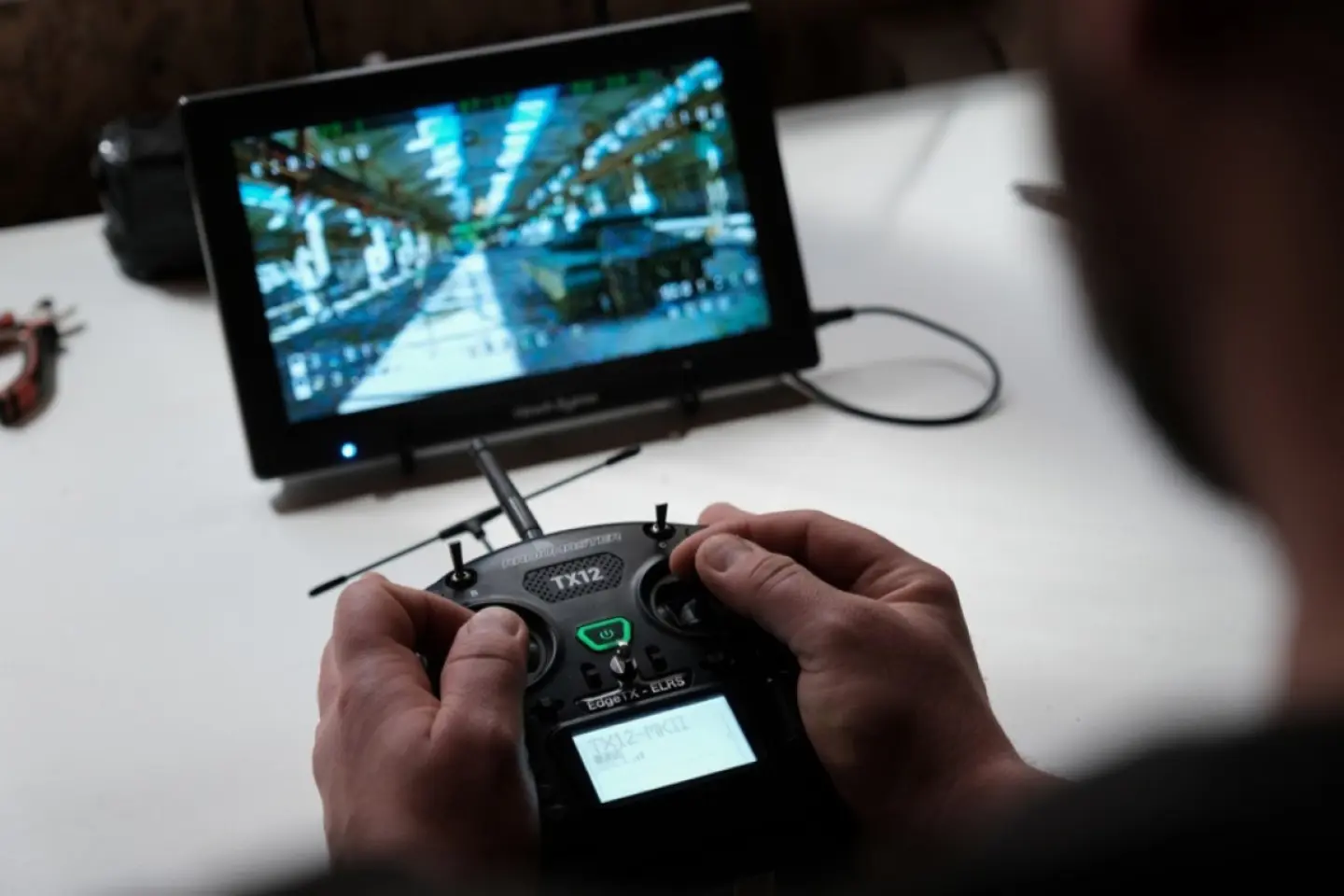
Russia’s war against Ukraine has entered a new phase: Ukrainian combat drones are increasingly reaching targets inside Russian territory, and their appearance in the northwestern region has also become more frequent. For the Baltic states, this means increased risks, including political ones.
On May 19, a Romanian fighter jet participating in a NATO air policing mission shot down a Ukrainian drone that had entered Estonian airspace for the first time. No one was injured. Senior Ukrainian officials apologized, stating that Russia had deliberately been disrupting the flight paths of Ukrainian strike drones. The Estonian side reiterated that it had not granted Ukraine permission to use its airspace for military purposes. At the same time, Foreign Minister Margus Tsahkna stated that Ukraine has every right to strike Russian military targets in order to weaken Russia’s ability to continue its aggression. “These incidents are a direct consequence of Russia’s war and provocations,” he wrote on social media.
On the same day, Russia’s Foreign Intelligence Service accused neighboring Latvia of planning to allow Ukrainian forces to use its territory for new strikes against Russia, while threatening retaliatory action against the Baltic states. Some military commentators, including Arkady Babchenko, quickly labeled the situation “Gleiwitz 2.0.”
“Russia’s constant, dangerous and threatening provocations against the Baltic states have reached a critical point,” said Member of the European Parliament and former Estonian foreign minister Urmas Paet, appealing to the President of the European Commission and demanding unified EU support. “And this is happening while Estonia, Latvia and Lithuania face drone incursions into their airspace on a daily basis.”
European Commission President Ursula von der Leyen called the threats unacceptable, while U.S. Secretary of State Marco Rubio expressed concern about possible escalation. Meanwhile, on Saturday, May 23, another drone crashed and exploded in Latvia, fortunately causing no major damage.
The Ukrainian drones sacked the Latvian government and causes political turmoiul in Estonia
If drone incursions have already led to a government collapse in Riga, in Tallinn the ruling coalition, despite extremely low approval ratings, still appears resilient enough to survive until the next elections. Nevertheless, drones here too are giving the opposition an opportunity to channel growing public anxiety into political gains.
“Ukrainian drones entered Latvia, and the defense minister took political responsibility and resigned. Then the whole government stepped down. Foreign strike drones are flying over our country too. Moreover, as we have learned, Ukraine does not even notify us when drones are launched in our direction. Why are you unwilling to take political responsibility?” asked Alexander Chaplygin, a centrist politician popular among Russian-speaking voters, addressing the prime minister.
Independent conservative MP Varro Vooglaid effectively voiced the Russian interpretation of events in public.
“A simple and straightforward question requires a simple, straightforward — and above all honest — answer. Namely, where did this drone come from? What route did it take to end up in Estonian airspace? Where did it enter our airspace and what path did it follow? It is time to stop keeping things classified and speak honestly to the public.”
At the same time, Mart Helme, the former leader of the conservative EKRE party (and father of its current leader) and a presidential candidate, spoke positively about the actions of NATO allies, unusually aligning himself with the political mainstream.
“The Russian side has issued certain threats. If they begin shooting them down themselves, that would be negative for us in every respect. First, Russian missiles would enter our airspace, and second, it would demonstrate our inability to protect our own airspace. The Ukrainian side has apologized, and we know very well that it is Russia’s electronic warfare systems that are pushing these drones into our territory. Our capabilities are still limited, but it is very good that, with the support of our allies, we managed to neutralize the situation,” he commented.
A new phase in the war
By diverting drones into NATO countries, Russia is effectively turning the allies’ own weapons against them, including by influencing public opinion. Which is essential for Kremlin given that the nuclear threat appears to have largely lost its effectiveness — recent Russian-Belarusian nuclear exercises generated virtually no public reaction in Estonia.
According to Estonian military historian Igor Kopytin, Ukrainian drone attacks on Moscow have demonstrated that the conflict has become protracted and entered a phase of attrition. “A solution can no longer be found on the battlefield, and the war is no longer being waged against an army but against an entire society and state,” he concluded, comparing Ukrainian drone attacks to the Allied bombing of Dresden during World War II. But it can work both ways.
Drone incidents in the Baltic states have somewhat pushed the issue of possible peace negotiations with Russia — widely discussed in recent weeks — into the background. However, the very discussion of such negotiations is itself seen in Estonia as part of a new phase of the Russia-Ukraine war.
Military historian Yuri Kochinev, for example, argues that Putin’s rhetoric itself has undergone certain changes: “Whereas he previously referred to Ukrainian President Volodymyr Zelensky as a ‘drug addict’ and a ‘neo-Nazi,’ he now uses the more neutral term ‘Mr. Zelensky.’ It is a small but important shift in tone on Vladimir Putin’s part.”
At the same time, local pro-Russian figures interpret European politicians’ willingness to engage in negotiations with Putin as a forced concession — especially when it concerns what they describe as Europe’s “leading hawks,” such as Kaja Kallas.
For example, Stepan Romanov, a member of the Koos party, which advocates reaching peace with Russia as soon as possible, calls this “a tectonic shift in European rhetoric, if not the greatest political paradox,” explaining it as a reaction to Washington’s actions.
“Against the backdrop of domestic political turbulence in the United States and Americans’ evident unwillingness to fund the conflict indefinitely, Brussels is terrified of waking up in a world where the fate of European security is decided directly by the White House and the Kremlin, without the European Union itself taking part,” he writes.
However, there have been so many “tectonic shifts” in global politics over recent years that they have almost ceased to feel tectonic at all. And the reports about reductions in the American military presence in Europe appear no more frequently than Ukrainian drones reach Russian oil refineries.
As long as they do not cause real damage in Estonia, and as long as the balance of power in the Riigikogu remains unchanged, the domestic political consequences here will likely remain limited. At the same time, drones knocked off course may become a tool of foreign policy coercion, potentially bringing peace negotiations closer. And it is increasingly clear that Kaja Kallas will not be the one leading them.