Few cultural phenomena have managed to bridge East and West in such a distinctive way as Bulgaria’s July Morning celebration, that started after Uriah Heep’s song with the same name “jumped” over the Iron Curtain.
Every year on July 1, crowds gather – usually across the Black Sea coast and along the Danube river – to greet the sunrise. By now, it’s an event so common that some might have long forgotten its countercultural roots or that the whole practice is actually a homegrown tradition, stemming from the mid-1980s. One that is inspired by both 1970’s rock and Bulgaria’s society's curiosity towards the West during the repressive Communist regime.
First rays
“There I was on a July morning
Looking for love
And with the strength of a new day dawning
And the beautiful sun
And at the sound of the first bird singing
I was leaving for home
With the storm and the night behind me
And a road of my own…”
In 1971 Uriah Heep – at the time, an integral presence in the British hard rock scene and soon to achieve bigger commercial success – released their third album ‘Look at Yourself’. Among the songs is a 10-minute track called ‘July Morning’. Written by keyboardist Ken Hensley and then-singer David Byron, both now deceased, the epic song quickly became a staple in their live performances. However, it long lived as a fan favourite rather than a hit: it was released as a single only in Japan and Venezuela, and performed modestly there.
However, in the next few years it found an underground popularity among the Soviet youth that was tuning to Western rock music through a black market offering mostly copies pressed from original vinyls, brought from sailors, diplomats, students, transport drivers, tourists. Bands such as Pink Floyd, Uriah Heep, Deep Purple and Scorpions became a symbol of rebellion in Bulgaria too, with some songs becoming recognisable years after their original release: a clear case of the delayed access that plagued many of the countries in the Eastern block.
The late 1960s/early 1970s rock sound became a fascination for Bulgaria’s youth in the 1980s. This “delayed gratification” effect continued to echo across the generations: punk subcultures also cautiously started in the 1980s, new wave aesthetics entered in the late 1980’s and were explored even in early 1990’s, the hip-hop scene did not start until mid-1990’s, grunge and alternative rock also took hold several years after storming the charts in the West.
A subculture leading a “silent protest”
“My first “July’s” were in 1988 and 1989. It was an otherworldly experience, so wild, it brought a sense of danger”, poet Raycho Angelov told Veridica. “Authorities didn’t like that people were doing something that wasn’t put together and overseen by them but also those were the era of Glasnost and the Perestroika – the spirit of the times was that authorities kept their eyes closed, they weren’t that judgy. Police were snooping around but they didn’t act out.”
Angelov was born in 1974 in Sofia and found out something exciting was happening at the coast through friends at Crystal park, still a popular hangout spot, and the one-time coffee place by the same name which gathered many of his peers. “Many hippies were hanging around there, and I was a hippie myself – had long hair, and curiously, nobody was around anymore to forcibly cut it down”.
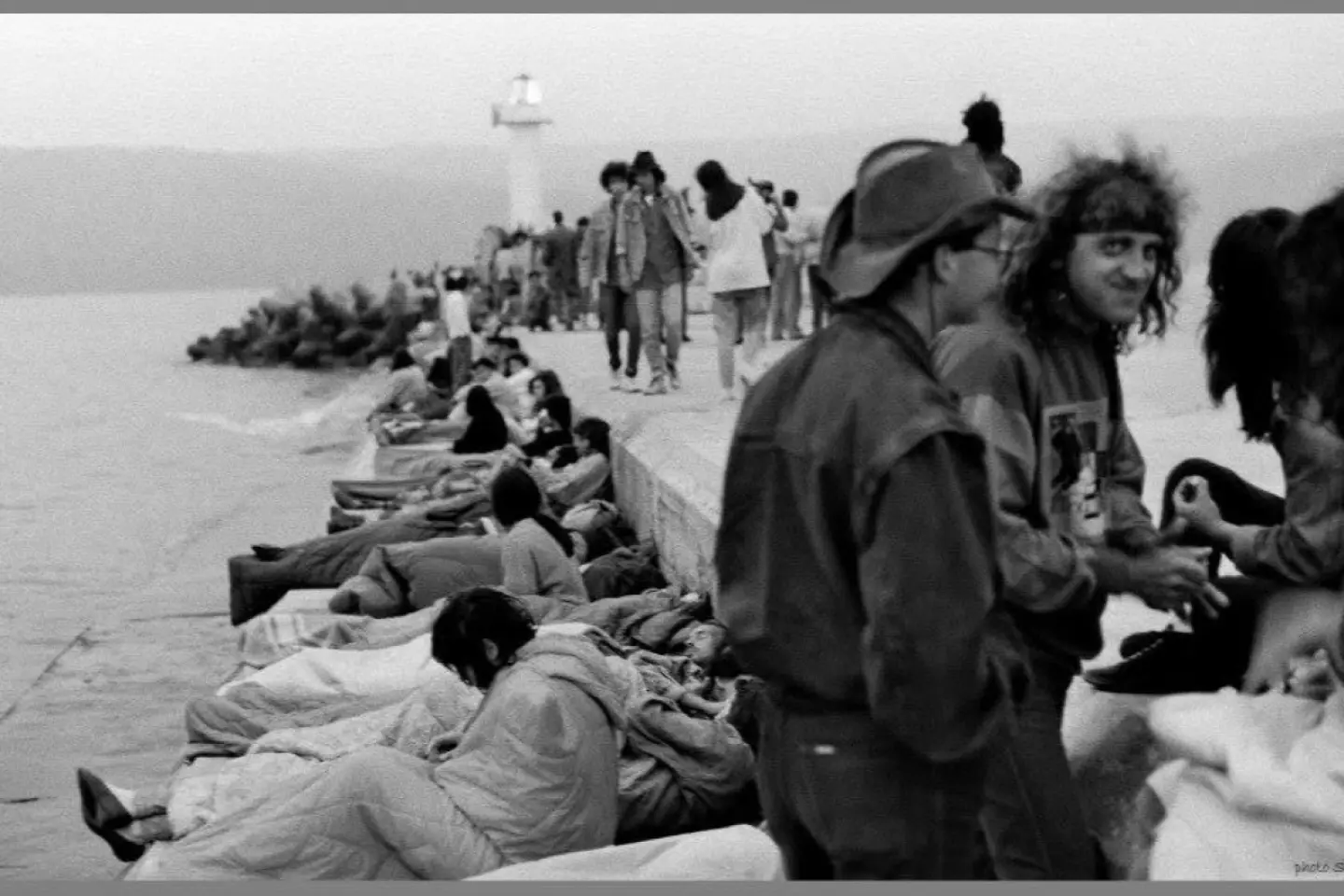
He went to Varna hitchhiking. “What I remember is how people didn’t stop singing and dancing all night, 20-30 people played acoustic guitars all along the shore near the Varna lighthouse. People made love, not war. Me included. Some were passing by, others were like mystics meditating, and some just slept despite the cacophony. It was in the spirit of the “monkey dance” of life, in the words of Jack Kerouac”, Angelov told Veridica.
There are several different accounts on when the first July Morning took place: some stories gravitate around 1984, others refer to 1985 or 1986 but stories always mention Varna as the starting point, the largest town on the Black Sea and one to benefit from bootleg recordings brought by international students and ship crew, quickly to be distributed on word of mouth.
Poet and anthropologist Robert Levy, among the first in the July Morning crowds, even made academic research on the roots of the event in 2013. He describes it as “a silent protest against Communism” and pinpoints its beginning to 1985 with just several close friends involved. Bigger groups self-organised in 1986, shortly after attending a jazz festival in the small town in Sopot, then headed to Varna. In his research, Levy also makes the point that the first people who kick-started the tradition in Varna weren’t necessarily rockers, but also jazz enthusiasts, artists and avid readers who knew there’s more beyond the regime framework.
Uriah Heep performed in Bulgaria for the first time in 1988, becoming one of the first Western rock acts to include the country in their tours, and in another twist, the concert happened in the town of Gabrovo, rather than in the capital Sofia. This might have contributed to the popularity of July Morning as the event started drawing more crowds after 1989. According to Levy, the novelty quickly spread: up to 3000 flocked around the Varna shores in some of these early gatherings.
Big in Japan Bulgaria
Meanwhile, the tradition has also kept the profile of Uriah Heep and this generation of rock acts high in Bulgaria, long after their commercial appeal has faded in the West. They performed two consecutive dates in the capital a decade later, in 1998, as there was still hunger and drought for Western rock acts. They’ve performed numerous times in different line-ups over the years.
The fascination even extends beyond music: 1976-1979 Uriah Heep frontman John Lawton, who passed away in 2021, made a travelogue documentary series on Bulgaria and even more curiously, made his acting debut in the Bulgarian movie “Love.net” in 2010. He has also performed on numerous July Morning events even though he was not part of the line-up that created the song.
Uriah Heep are still visiting Bulgaria frequently: they performed in 2018 as part of their 50th anniversary tour, toured again in 2022 and are scheduled to come back this November.
“Like Christmas for eccentrics”
The increasing popularity has commodified the tradition. It’s celebrated with different kinds of cultural and entertainment events all across the country, not just on the Black Sea coastline and by now, it’s more or less dissociated from its rock, hippie or anticommunist beginnings. To the extent that ecological activists are now trying to raise awareness about the pollution on the beaches left by those partying until the sunrise of July 1.
“Back in the day, the celebrations went on like this for two or three days. Then we all headed to other locations around the coast, taking the Sun with us. It was like Christmas for eccentrics. In summer”, says Angelov. And what is he doing on this July 1? Apparently, a calmer affair: on the same day he has scheduled the first meeting of the book club he’s kickstarting, at the bookstore he’s working in right now. True to the spirit that July Morning is not only about rock.