The annual Ukraine Recovery Conference, held last week in the Baltic city of Gdańsk, was meant to showcase Europe's long-term commitment to rebuilding Ukraine. Government leaders, European Commission President Ursula von der Leyen, international financial institutions and major businesses gathered to discuss projects worth hundreds of billions of dollars, from infrastructure and energy to defence technology.
Instead, the conference opened under the shadow of a diplomatic crisis. For the first time in the history of the recovery conference, President Volodymyr Zelensky did not attend. Ukraine was represented instead by Prime Minister Yuliia Svyrydenko, who emphasised that Kyiv remained committed to practical cooperation with Poland and Europe. Yet the symbolism was unmistakable. The absence of Ukraine's president reflected the most serious political rupture between Warsaw and Kyiv since Russia's full-scale invasion in 2022.
The dispute illustrates how unresolved history can rapidly overwhelm even the closest strategic partnerships. Three years ago Poland became Ukraine's indispensable ally, opening its borders to millions of refugees and serving as the principal logistical hub for Western military assistance. Today politicians on both sides are discovering that historical memory remains one of the most powerful forces in Central Europe.
A diplomatic row triggered by a dispute over historic memory
The immediate trigger was a seemingly symbolic decision. President Zelensky approved granting one of Ukraine's elite military units the honorary title "Heroes of the UPA"—the Ukrainian Insurgent Army. In Ukraine such references increasingly represent armed resistance against Soviet domination. In Poland, however, UPA evokes something profoundly different: the mass killing of Polish civilians during the Second World War.
President Karol Nawrocki responded by announcing that he would strip Zelensky of Poland's highest state decoration, the Order of the White Eagle, which had been awarded in recognition of Ukraine's defence against Russian aggression and Poland's strategic partnership with Kyiv.
Explaining his decision, Nawrocki argued that Poland had reached its "threshold of pain". The honour, he said, symbolised the highest trust of the Polish Republic and could not remain with someone who accepted the glorification of an organisation responsible, in Polish historical memory, for crimes against Polish civilians. At the same time he insisted that the move was directed neither against the Ukrainian people nor against continued Polish support for Ukraine's defence against Russia.
Zelensky responded before the legal procedure in Poland had even been completed. He returned the decoration to Warsaw, arguing that such a symbol required mutual respect. Former Ukrainian presidents Leonid Kuchma, Viktor Yushchenko and Petro Poroshenko likewise returned Polish honours in solidarity.
What might otherwise have remained a bilateral diplomatic quarrel quickly escalated into a public confrontation over history, identity and national memory.
A dispute benefiting Russia, a historical archenemy for both Poland and Ukraine
Donald Tusk, Poland's prime minister, has attempted to play the role of de-escalator. While criticising both Kyiv's decision to honour the military unit and Warsaw's decision to revoke the order, he has consistently argued that neither serves Poland's strategic interests.
Tusk has stressed that maintaining close relations with Ukraine remains essential for Poland's security and future prosperity. Speaking before the recovery conference, he warned against politicians on both sides who seek political advantage by inflaming historical grievances. He acknowledged that the trauma of the past, particularly on the Polish side, is real and justified. Yet he argued that long-term relations between the two countries must be built around their common future rather than permanent conflict over history.
The conference itself reflected this approach. Despite the diplomatic dispute, Poland proceeded with preparations, hoping to secure agreements involving reconstruction projects worth hundreds of billions of dollars, including contracts for Polish companies and joint infrastructure and defence initiatives.
Others have been less optimistic. Lithuania, which has invested heavily in regional cooperation through the Lublin Triangle format, has openly offered to mediate. Juozas Olekas, speaker of the Lithuanian parliament, argued that historical research remains important but should not prevent cooperation on future security. Asta Skaisgirytė-Liauškienė, President Gitanas Nausėda's foreign-policy adviser, suggested that leaders on both sides had allowed emotions to dominate and called for renewed dialogue between Warsaw and Kyiv.
Such appeals reflect widespread concern that the dispute benefits only one outside actor.
Several commentators argue that the diplomatic clash has become a gift for Moscow. Russian state television has repeatedly highlighted statements by Polish politicians critical of Ukraine while omitting their equally strong condemnation of Vladimir Putin. According to one analysis, the Kremlin has skilfully repackaged Polish criticism as supposed evidence supporting its long-standing propaganda narrative that Ukraine remains dominated by "neo-Nazis". In that reading, domestic Polish political arguments have inadvertently strengthened Russia's wartime information campaign at a moment when Moscow faces military and economic difficulties.
The Ukrainian Insurgent Army: war criminals in Poland, anti-Soviet heroes in Ukraine
The dispute nevertheless resonates because it touches one of the deepest wounds in modern Polish history.
For many readers outside Central Europe, the controversy surrounding the Ukrainian Insurgent Army requires explanation.
The Organisation of Ukrainian Nationalists (OUN) emerged in the interwar period from radical nationalist movements seeking an independent Ukrainian state. Influenced by authoritarian and integral nationalist ideas then widespread across Europe, sections of the movement regarded violence as a legitimate instrument of nation-building.
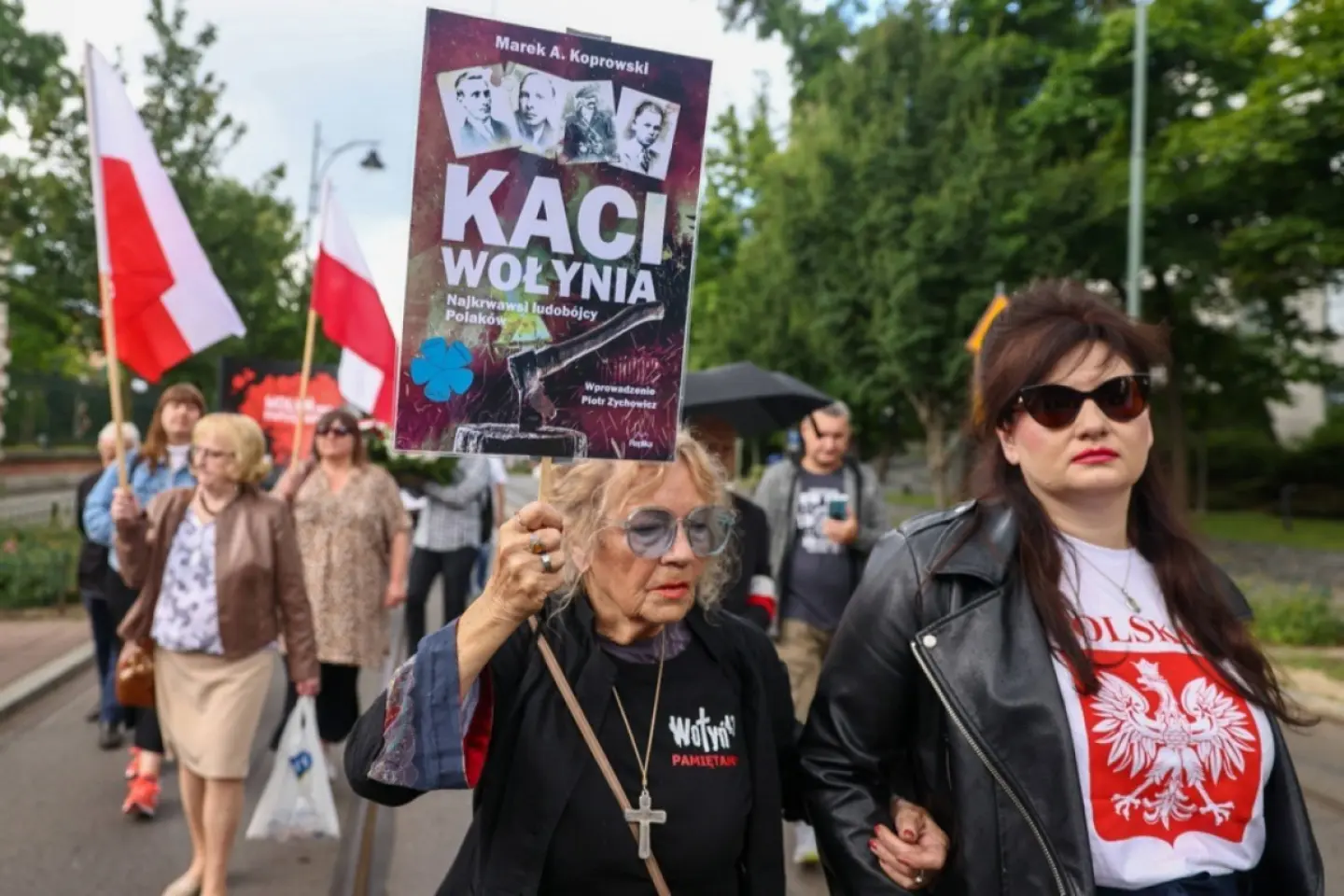
Its military wing, the Ukrainian Insurgent Army (UPA), fought several enemies during the Second World War, including Soviet forces, German occupation authorities and Polish underground formations. Yet for Poles the organisation is remembered above all for the ethnic cleansing campaign carried out against Polish civilians in Volhynia and Eastern Galicia between 1943 and 1945.
The killings began in February 1943 and continued until the end of the war. Historians describe the campaign as a planned ethnic cleansing operation directed by one faction of the OUN. Approximately 100,000 Polish civilians are estimated to have been killed across Volhynia and Eastern Galicia.
The violence reached its most notorious stage on 11 July 1943, remembered in Poland as "Bloody Sunday", when coordinated attacks were launched against dozens of Polish settlements simultaneously.
The brutality left an enduring mark on Polish collective memory. Entire villages disappeared. Women, children and elderly civilians were among the victims. Subsequent Polish retaliatory attacks also killed thousands of Ukrainians, and historians acknowledge that some Polish reprisals constituted war crimes. Yet the materials consistently emphasise an important distinction drawn by many scholars: whereas Polish retaliatory violence was generally local and reactive, the anti-Polish campaign conducted by the UPA leadership is described as centrally organised and planned.
This historical interpretation remains dominant in Poland. Ukraine remembers much of the same period differently. For many Ukrainians, particularly since Russia's repeated invasions, the UPA symbolises resistance against Soviet rule and the struggle for national independence. The organisation fought Soviet security forces well into the late 1940s. Many contemporary Ukrainians therefore separate the broader anti-Soviet resistance from wartime atrocities against Polish civilians.
This distinction has never been adequately communicated to Polish audiences. Some scholars note that the post-1945 UPA differed significantly from the organisation responsible for earlier massacres, both in composition and circumstances. Others suggest that Ukrainian public debate has increasingly focused on heroic aspects of the anti-Soviet struggle while avoiding open discussion of crimes committed against Poles and Jews.
That asymmetry has become increasingly difficult to manage politically.
„The arguments can wait. Survival cannot”
Some commentators argue that meaningful reconciliation would require two simultaneous developments. Poles would need to recognise that many Ukrainians honour the UPA primarily as anti-Soviet fighters. Ukrainians, in turn, would need explicitly to condemn the mass murder of Polish civilians and abandon unconditional glorification of the movement as a whole.
According to that argument, neither society is currently prepared for such a compromise. Politics has only deepened the divide.
Jarosław Kaczyński, leader of Poland's Law and Justice party, has called for Poland to block further stages of Ukraine's accession negotiations with the European Union until Kyiv acknowledges responsibility for the Volhynia massacres, apologises, completes exhumations of victims and allows proper burials. While reaffirming support for Ukraine's military struggle against Russia, he argues that European integration requires acceptance of historical responsibility.
The government's position differs sharply. Tusk rejects further escalation, insisting that strategic security must remain the priority. Yet even he acknowledges that public attitudes towards Ukraine have changed significantly since the extraordinary solidarity displayed after Russia's invasion.
Several commentators describe a broader transformation in Polish society. They argue that enthusiasm for Ukrainian refugees has steadily declined, influenced by economic anxieties, online disinformation and domestic political competition. Unfortunately, increasingly nationalist rhetoric has moved from political margins towards the mainstream. Some commentators warn that anti-Ukrainian sentiment risks becoming socially normalised and note growing concern about hostility directed towards Ukrainians living in Poland.
Not all observers share such bleak conclusions. Some emphasise that public opinion remains complex and that support for Ukraine's defence against Russia continues even among critics of Kyiv's historical policies. Others warn against exaggerating temporary political tensions into permanent strategic realignment.
Perhaps the most revealing perspective comes from the Ukrainian writer and translator Ostap Slyvynsky. Writing in Gazeta Wyborcza, Slyvynsky argues that Poles and Ukrainians currently inhabit profoundly different historical realities.
He suggests that modern Polish national identity has long been shaped by historical injustice and the memory of victimhood, whereas Ukrainians, facing an existential war, experience history as something unfolding in the present rather than something awaiting retrospective moral judgement. In wartime, he argues, societies seek uncomplicated heroes capable of sustaining national resistance. Nuanced historical debates become politically difficult.
Slyvynsky does not deny that future reassessment may come. He even expresses hope that some figures celebrated today could eventually be reconsidered once Ukraine no longer fights for survival. But he insists that this is not the moment when Ukrainian society is capable of conducting such debates.
He also argues that many Poles fail fully to grasp what wartime existence means: a world in which survival leaves little room for the moral distance that peaceful societies can afford.
At the same time, his essay laments the growing tendency to cast Ukrainians as Poland's principal historical adversary. Ukrainians have become highly visible neighbours, colleagues and fellow citizens, making them politically convenient targets for populism. Yet despite his frustration, Slyvynsky rejects resignation. Millions of Ukrainians have built lives in Poland, and both societies remain bound together by geography, economics and security.
His conclusion is neither optimistic nor despairing. The arguments can wait, he writes. Survival cannot.
That may ultimately be the defining paradox of the current Polish-Ukrainian relationship. The strategic logic binding Warsaw and Kyiv together has never been stronger. Yet the emotional power of history has rarely felt more immediate. Europe's eastern frontier is being defended against Russia, while behind that front line two neighbouring nations continue negotiating the unresolved legacies of the past war.
The reconstruction of Ukraine will require roads, power stations and investment measured in hundreds of billions of euros. It may also require something less tangible, and perhaps more difficult: rebuilding trust between two societies that remain allies by necessity but whose memories still point in different directions.