Speaking to reporters at a cultural forum in St Petersburg on 25 September, Vladimir Putin said Russia was not preparing for hostilities with Europe. He accused European countries of inflaming tensions and engaging in provocations. For countries close to Russia, however, the possibility of a confrontation is no longer an abstract concern. Despite Putin’s assurances, they are openly weighing the factors that could lead to a clash — and those that might restrain Moscow.
Geography matters. The prospect of a direct military confrontation with Russia is most troubling for its neighbours. For the Baltic states, Poland and Finland, the risk does not feel purely theoretical. It also concerns countries deeply involved in supporting Ukraine, such as Germany. Their geography, military capabilities and economic exposure differ, but they face the same question: how plausible is a direct clash with Russia?
Answering it requires looking beyond Russia’s readiness for another war. Europe’s capacity to respond matters too, as do the choices of other powers that could influence the course of a wider conflict.
The Kremlin lacks the popular support and the economic and military strength needed to open a new front while fighting in Ukraine
Any assessment must start with Russia’s position after more than four years of war against Ukraine: the condition of its armed forces, the resources available to its economy, public sentiment and the pressures shaping the Kremlin’s decisions.
The Kremlin does not need public consent to launch another military operation. Russians have no effective institutional means to veto such a decision or compel their leaders to change course. Yet the authorities cannot disregard society’s reaction altogether.
The partial mobilisation of 2022 showed what can happen when the costs of war reach a much wider group of people. It caused anxiety and prompted many Russians to leave. Poland’s Centre for Eastern Studies cites estimates ranging to 700,000 departures after the announcement. Public discontent might not prevent an escalation, but uncertainty about how society would respond could still weigh on the Kremlin’s calculations.
The economy is another clear vulnerability. Russia is less well placed to sustain a further prolonged confrontation than it was before the full-scale invasion of Ukraine. It has lost much of its former access to Western markets and technology, redirected trade and become more dependent on a smaller group of partners, particularly China and India.
Its resources are not exhausted, however. Even after drawing heavily on the liquid reserves of its National Wealth Fund, the government could sustain military spending for some time by raising taxes, taking control of assets, drawing workers away from civilian industries and shifting more public money towards defence. These choices would put further pressure on the rest of the economy.
The pressure on public finances is already visible. Russia’s finance minister said the 2026 federal budget deficit could reach 3% of GDP, nearly twice the original target of 1.6%. That signals growing fiscal strain, though it does not point to an imminent economic collapse. The question is how much more strain the state could absorb if it had to finance another confrontation alongside the war in Ukraine. The accumulating costs could make the economy one of the strongest constraints on Russia’s ability to widen the conflict.
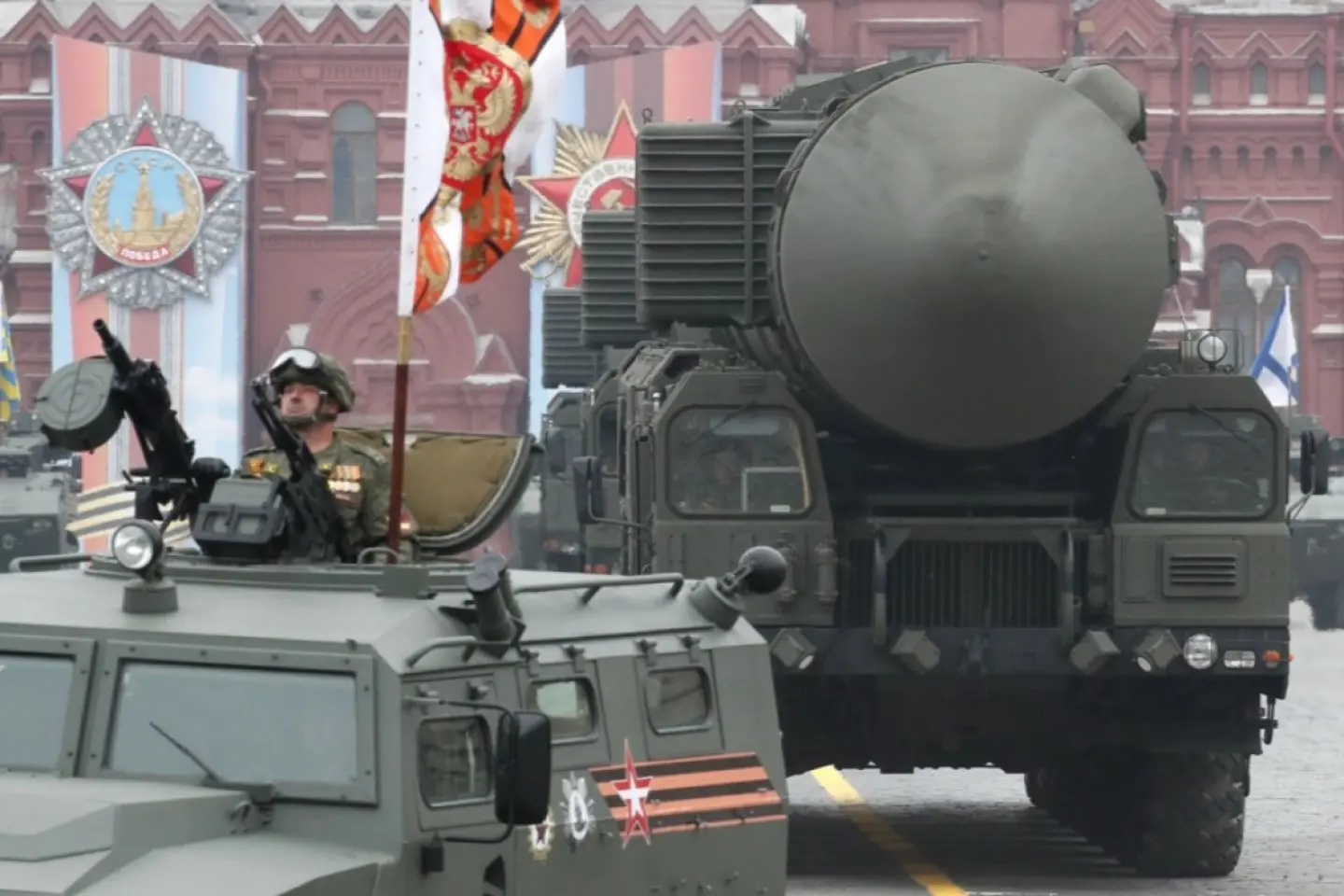
The military picture offers no simple answer either. Russia remains a major military power. Its forces have extensive combat experience, and its nuclear arsenal — the world’s largest by estimated number of warheads — shapes any calculation about a confrontation with NATO. It would be a mistake to discount Russia’s ability to inflict severe damage, even while its forces are committed in Ukraine.
At the same time, opening another front would require personnel and equipment on a substantial scale. Russia’s most capable units are already engaged in Ukraine. In January 2026, the UK government told the OSCE that Russian casualties since the full-scale invasion had exceeded 1.2 million. This is a UK estimate and casualties includes both those killed and those wounded. Even allowing for uncertainty around the figure, recruiting, training and equipping forces for an additional campaign against NATO would be a major challenge while the war in Ukraine continues.
Taken together, these military, economic and social pressures suggest that Moscow has less room to launch and sustain a second large-scale conventional campaign while it continues fighting in Ukraine.
The advantages of hybrid warfare
Russia is not the only side whose position has changed. Defence spending across Europe is rising, governments are investing in their armed forces, and expanding defence production has become a political priority. According to Eurostat, EU governments spent 1.5% of GDP on defence in 2024, up from 1.3% in 2023. Under NATO’s separate accounting, European Allies and Canada spent 2.3% of their combined GDP on defence in 2025. The two measures use different definitions, but both indicate a growing defence effort.
The political picture is less settled. European governments are assuming more responsibility for their security, but uncertainty about US policy makes the future of the transatlantic relationship harder to judge. President Donald Trump’s statements and decisions may encourage European allies to invest more in defence while raising questions about how predictable US support would be during a crisis.
Moscow may see an opportunity in disagreements within the Alliance — between Europe and the United States, or among European governments. It could test NATO’s response through cyberattacks, sabotage or incidents whose perpetrators are difficult to identify. A weak or delayed response might invite further attempts; a coordinated one would raise the cost. The question is therefore both what Russia might do and how NATO would respond. Europe may also have fewer unused economic measures available than it did in 2022, after years of sanctions and sharply reduced commercial ties.
Hybrid pressure is more attractive to Moscow precisely because it avoids many of the constraints that make a conventional war with NATO so costly. Cyberattacks, sabotage, interference with infrastructure or limited provocations require neither mass mobilisation nor the deployment of forces needed for another front. They can also preserve a degree of plausible deniability and make it harder for NATO governments to agree when an incident has crossed the threshold from hostile activity to an attack requiring a collective response.
The range of instruments is already broad. European investigators have linked a series of incendiary parcels sent through courier networks in 2024 to a suspected Russian GRU operation; devices ignited at logistics facilities in Germany, Britain and Poland. Germany has also investigated suspected sabotage against infrastructure and defence-related sites, while drone incursions have become another source of pressure and uncertainty on NATO’s eastern flank. In September 2026, a NATO fighter shot down a Russian-made Gerbera drone after it entered Lithuanian airspace from Belarus. Lithuanian authorities said it was most likely intended for Ukraine, illustrating how drone activity connected to the war can create uncertainty and potential escalation along NATO’s eastern flank.
None of these instruments carries the strategic weight of nuclear weapons or a large conventional force. They are more like a large hand of lower-value cards: individually limited, but numerous, relatively cheap to play and often difficult to attribute conclusively, even when the suspected source appears obvious.
China is another factor in Moscow’s calculations. The EU remains an important market for Chinese goods: in 2025, it imported €559.4 billion worth of goods from China, more than from any other trading partner. Beijing therefore has a strong economic reason to avoid a war in Europe that would disrupt trade. But that interest alone does not mean China would restrain Moscow or end its trade with Russia.
For now, a deliberate, full-scale war between Russia and NATO appears less likely than continued hybrid pressure, which could intensify. The greater danger may therefore lie not in a conscious decision by Moscow to start a conventional war, but in a gradual accumulation of lower-level confrontations, provocations and acts of sabotage that blur the boundary between peace and conflict. The risk of escalation will depend not only on Russia’s willingness to test that boundary, but also on NATO’s ability to identify such actions quickly, agree on their significance and respond consistently enough to prevent repeated testing from becoming a new normal.