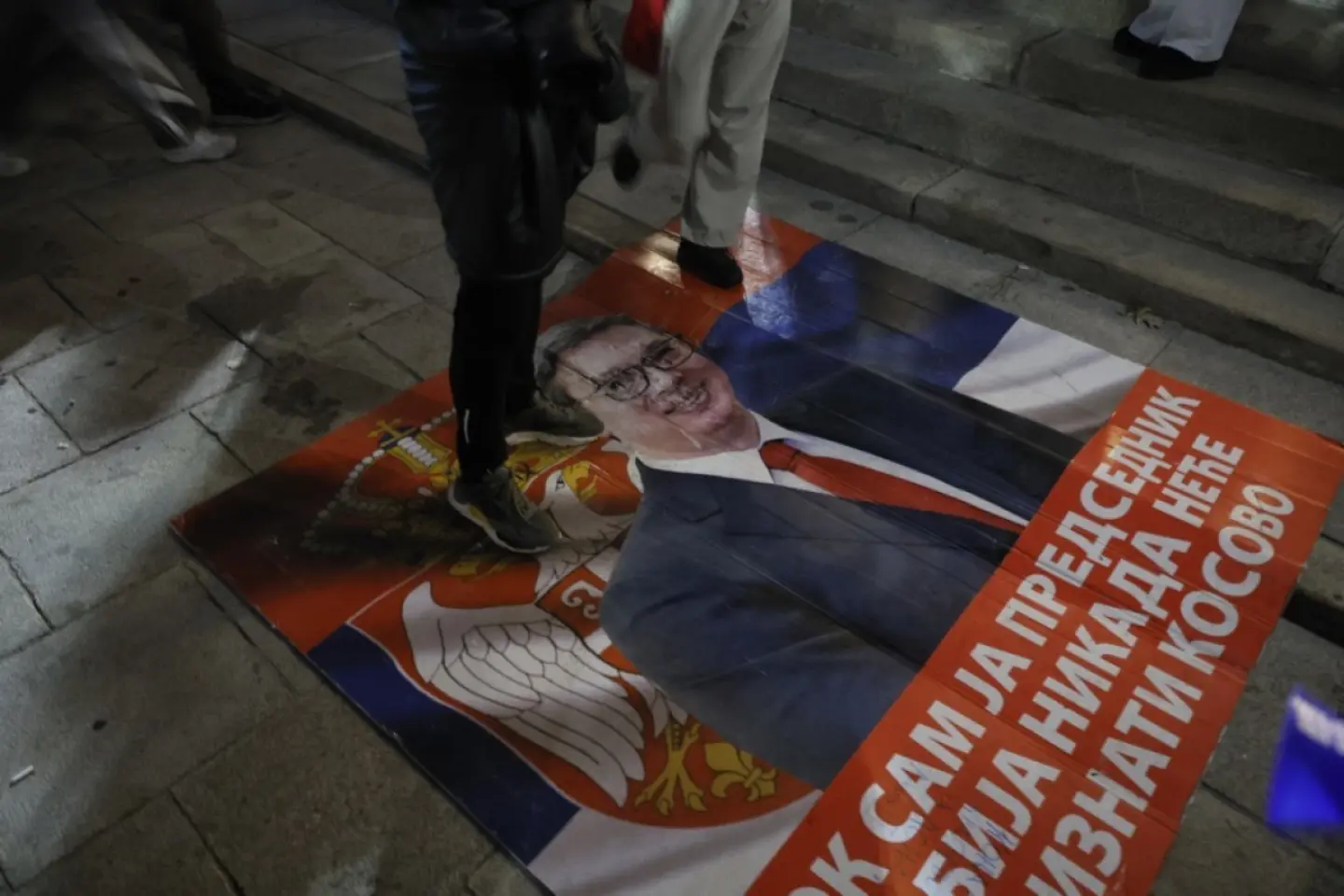
As soon as Aleksandr Vučić’s party was crushed in the elections, a “cleaning” campaign was launched against some of the most controversial figures associated with the regime. The campaign had nothing to do with the winners of the elections: it’s being waged by the very state apparatus that used to work for Vučić.
A wave of investigations and arrests
The Vučić regime lost power on October 25 after fourteen years, yet the coopted system of entitlement it built has not changed hands. The Student List, which took more than 52% of the vote against about 39% for the former regime’s Serbian Progressive Party and will hold roughly 140 of 250 parliamentary seats, has not yet received a single ministry, agency or prosecutor's office, and the technical mandate government in which the outgoing regime holds the key posts remains in charge. Still, the interregnum has produced news at a pace many from the opposition camp dared to anticipate as to not jynx it.
In approximately a week, a website that logs post-election events had recorded 185 of them since October 27, among them 26 arrests, 79 resignations or demands for resignation and 80 criminal complaints. The public has taken to saying that Serbia is waking up, but since the winners control nothing so far, all of this was set in motion by prosecutors, police chiefs and regulators placed in their posts by the old regime. That the arresting is done by the very people who held their offices throughout the regime's rule matters more than any single arrest, and the clearest example of this claim is the collapse of Alta Bank.
The collapse of the regime’s pet bank
Alta Bank belonged to Davor Macura, a budding new oligarch the public has unmistakably linked to the regime, and his bank’s rise over the last few years was unbelievable (because it was not rooted in free and fair competition). The balance sheet grew by 60% in 2025 and reached about 1.82 billion euros in June 2026, 170 million more than six months earlier, and the bank, which held around 3% of the Serbian banking market, kept unusually large amounts of cash on hand. For two years, European institutions had been asking about the origin of its capital and the quality of its anti-money laundering controls. On October 14 a U.S. congressman asked the Secretary of State to impose sanctions on Macura, and on that same day Montenegro turned him back at the Podgorica airport, citing national security. The regime in Belgrade pretended nothing was going on.
One week after the regime suffered a humiliating defeat, and the funds were siphoned out, the National Bank revoked Alta’s license, Macura was detained on November 2 on suspicion of taking roughly 45 billion dinars, about 383 million euros, out of the vault in cash, and the bank went into bankruptcy on November 3. The conclusion that is hard to avoid is that the bank would still be operating had the election gone the other way.
The National Bank, which has been headed since 2012 by an official of the Progressive Party and has said nothing publicly since the collapse, was the institution responsible for watching all of this. Its four vice governors say they learned the true condition of the bank only at an emergency session on the evening of October 30, and that it differed drastically from the reports they had been receiving prior to the date. If so, the supervisors were supplied with false figures over a long period, and either did not notice or avoided asking why a bank was accumulating so much cash. Hundreds of millions of euros do not leave the vault of a licensed bank without someone noticing, and since they left after the election was lost, someone allowed it. More than 40 public enterprises and dozens of other state-owned firms had accounts at Alta, and in mid-2025 citizens were told to pay their electricity bills into the utility's account at Alta instead of the one at the state Treasury, which gave the bank an enormous, yet artificial, inflow of liquidity. The bank grew on public and comprador money, and the officials who steered that money its way still remain in their posts until the new government is formed.
Going after Vučić’s henchmen
The mood of these historical days was vividly illustrated on November 3 by an Air Serbia flight to Moscow carrying the former minister Aleksandar Vulin, the longtime Srbijagas director Dušan Bajatović and a minister without portfolio, Nenad Popović, which was already deep in Lithuanian airspace when the crew received an order to return to Belgrade, reportedly because Vulin had boarded without the mandatory security check. This trio of regime’s Russian collaborators was publicly humiliated by officials which still aren’t new. Meanwhile, the justice system has been busy. Three days after the election, Supreme Public Prosecutor Zagorka Dolovac ordered a review of case files in all 87 prosecutor's offices, including the one for organized crime, and a day later she ordered police action to prevent the destruction of documents in state institutions, banks and both intelligence agencies.
On November 1, two senior police officials were arrested, Marko Kričak, head of the Criminal Police Directorate, on suspicion of abuse of office and mistreatment, and Boško Sekulović, head of the Service for Combating Crime, with Kričak reportedly taken in by members of his own directorate. Kričak has been known to the public as Vučić’s iron fist inside the police system. The director of the Hydrometeorological Institute was arrested on suspicion of laundering at least 650,000 euros, and a senior official in Novi Sad on suspicion of damaging the budget by 83 million dinars. Bajatović, for his part, is on trial on suspicion of causing a traffic accident, and the indictment, filed in April 2025, became public only now.
A genuine desire for reform, or an attempt to curry favor with the new leadership?
The motives can be read in three ways: honest professionals who were blocked for years may finally be able to work; a loyal apparatus may be trying to please the incoming authorities and clean up its own biography; or factions of the old regime, which the party leadership kept in check by arbitrating their disputes over resources, may be settling scores with one another now that the arbiter has lost power. The record favors the second and third readings. Dolovac, who for years did not react to numerous complaints, gave her first relevant order, on electoral crimes, only five days before the vote, and everything else followed the result. A strike group of police, tax and anti-money laundering experts working under the organized crime prosecutor was dismantled in September 2025, just as it reached evidence of corruption linked to the Novi Sad tragedy, and a request to restore it has been submitted only now. The new majority has given none of these officials an instruction, yet they move as quickly as if it had, because the apparatus built under the “ancien régime” spent years selecting people who anticipate what the leadership wants before it is said. Cadres chosen for that talent will anticipate the wishes of the next leadership just as readily, and that is why the sudden “independence” of these institutions deserves skepticism.
The previously captured media have adjusted in the same way, at times with unintended comedy. On election day a regime tabloid portal published an article headlined “Wave of Blockader Violence Continues,” and the next day the same author wrote a piece titled “Srdanović Calls for an End to Violence,” about the Student List's lead candidate Ilija Srdanović. The Vojvodina public broadcaster apologized for its one-sided coverage the day after the vote, its editor in chief and later its director resigned, and two days after the apology the director of the national public broadcaster (RTS) stepped down. In its September monitoring of four national television channels, CRTA found that the authorities received two thirds of the airtime given to political actors, that the Student List was presented negatively during 91% of the time devoted to it, and that RTS split its airtime between government and opposition 82 to 18. Apart from a few resignations at the top, the staff behind those numbers has stayed the same since the vote, and a similar adjustment after the fall of Milošević on October 5, 2000 left the media with a credibility problem of their own.
The problem with the "reset": those who have done wrong must pay, but it’s impossible to replace an entire administrative apparatus
Whatever the motives behind them, arrests of people suspected of abuses under the old regime are welcome, but they will matter only if they end in final verdicts and the permanent confiscation of property acquired through crime. An institution that acts only because the incoming power is watching will act differently once that attention fades. The abruptness of action carries a further risk, since indictments rushed out for the headlines and ending in acquittals would hand the old camp a ready-made story of political persecution. Vučić says he signed nothing involving money and that nothing can be found against him, yet responsibility extends to whoever gave the orders and held real power over the deals now being investigated, whether or not a literal signature exists. The institutions will also have to examine themselves, starting with the National Bank's answer for Alta and the prosecutors' answer for files that lay in drawers for years. Concurrently, the ancien regime’s complaints of repression by a new government that holds no power, while their own people occupy every important position, are preposterous.
The Student List has been careful to claim no credit for these events, pointing out that it has not taken power and that the rule of law is the foundation of its program. As a movement rather than a party, it has no organization to which the cadres in the institutions owe loyalty, which gives it a rare chance to bring in people of greater integrity. Serbia, however, has no spare thousands of police officers, prosecutors and judges, and a general purge would be both unjust and impractical, so a line has to be drawn between criminals, opportunists who kept silent, and the few who resisted when it was risky. The danger is that officials who now curry favor will obstruct the new government as soon as they feel secure again. The interregnum will end with the formation of a government, hopefully by the end of November, and then with the presidential election at the end of the year. In the meantime, the contest comes down to who will command these institutions when the new government takes office, and the conduct of the current prosecutors, police chiefs and regulators, once a government is able to appoint and dismiss them, will show their true nature.