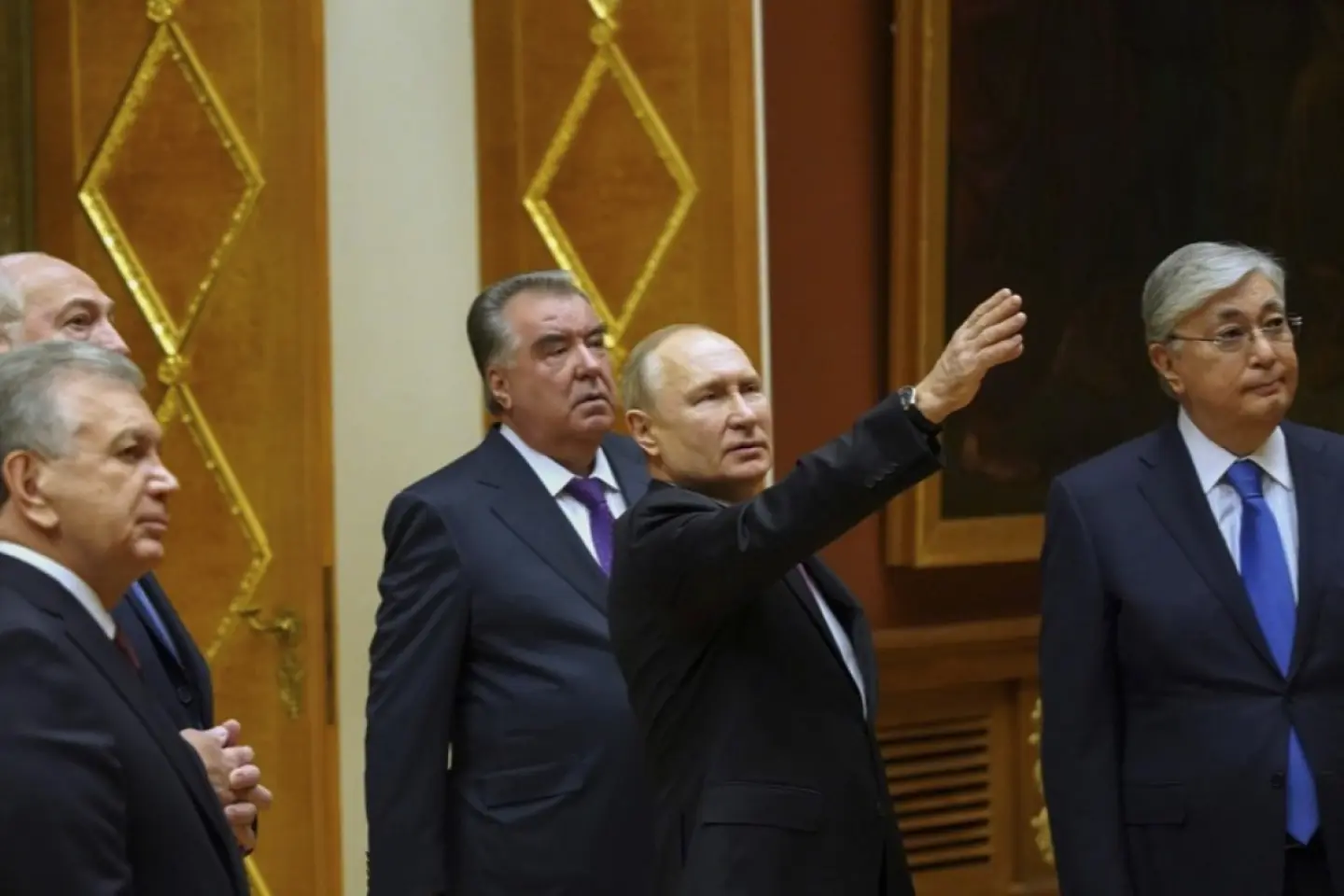
As the war in Ukraine drags on, its economic fallout is being felt by Russia’s Central Asian allies. Forced to find alternative markets for their goods and labor force exports, these allies are discovering that Russia is losing its leverage, and they are becoming increasingly vocal.
In July Kazakhstan's president Kassym-Jomart proposed freezing the war in Ukraine at a meeting with Vladimir Putin, and the Kremlin rejected the idea the same day. At the end of September, Tokayev repeated the call in Berlin, as Kazakh oil exports through the Russian port of Novorossiysk keep being disrupted by drone strikes.
Why have Moscow's allies grown bolder, which levers does the Kremlin still hold over the region, why can Baku speak to Russia in a tone no one else dares to use, and what is the only thing that could actually change Russia's course? Veridica tried to get some answers from Parviz Mullojanov, an independent political analyst from Tajikistan, who believes Russia is sawing off the branch its own influence in Central Asia rests on.
"You do not respect us": how the discontent of Russia's allies built up
VERIDICA: On 25 July, standing next to Vladimir Putin in Omsk, Kazakhstan's president Kassym-Jomart Tokayev proposed freezing the war in Ukraine, and the Kremlin rejected the idea the same day. What happened, and why does this episode matter?
PARVIZ MULLOJANOV: It is important in the sense that it reflects the degree of discontent that is now building up among Russia's allies. It has been building for a long time. In fact, it had already matured by 2023, because it was there from the very beginning: when the war started, they were stunned that they were being treated as if they did not count. Behind closed doors the message was: we are members of the same defence alliance, yet you are dragging us into a war and not telling us about your plans. From the very beginning this thought was shared by all the leaders of the CSTO (Collective Security Treaty Organization), and the SCO (Shanghai Cooperation Organization) member states. Putin honoured only China with his attention. The Central Asian countries knew nothing until the very last moment. In any case, they played no role whatsoever in the decision. So the discontent was there.
Then, in October 2022, the president of Tajikistan, Emomali Rahmon, voiced it at the Central Asia–Russia summit in Astana. He suddenly and unexpectedly started speaking, and everyone literally fell silent, because nobody expected it. He started saying: you do not respect us, we deserve respect in this alliance. At the time few people understood it, it was an emotional speech of about five minutes. Only later did most experts point out that this was exactly when the sanctions kicked in and hit the economy hard. For the first time, very hard. And this discontent, evidently, was being discussed behind closed doors, and it burst out.
Tokayev has now said the same thing, because the war in Ukraine has hit Kazakhstan's economy hard precisely now: 80% of Kazakhstan's oil exports go through the Russian port of Novorossiysk, which is now effectively paralysed. This deals a huge blow to Kazakhstan's interests, which is why Kazakhstan is extremely interested in all of this ending as soon as possible.
The same applies to the other Central Asian republics, including Tajikistan, Kyrgyzstan and Uzbekistan. Because of all this, Uzbekistan's revenues from gas exports have fallen practically to zero over the past five years. The gas revenues it has now come mainly from the domestic market. This is partly linked to the war and to the general upheaval around it. Then there is labour migration: by various estimates it is falling by 15–17% every year, and in the past six months it fell by 17–20%. Accordingly, state revenues are falling. On top of that, the strikes on Russian refineries have meant that the flow of oil products to Central Asia under existing contracts has practically stopped. Tajikistan, for example, received 85–90% of its oil products from Russia under long-term contracts with Gazprom. All of that has now stopped at once, and Tajikistan finds itself in a very unpleasant position. In addition, for a long time the main flow of goods went through Russia, and a particularly significant share of food products came via Russia. Now the rise in prices is hitting consumers in these countries. All of this causes discontent. That is why Tokayev spoke so sharply.
VERIDICA: Until now these countries appeared to be neutral. Are we watching that neutrality give way to open objections?
PARVIZ MULLOJANOV: No, their position is the same as it was. There are two levels. There is the purely diplomatic, official level, and it has not changed. From the very beginning they have refused to recognise Donbas, Crimea and Luhansk, and they still refuse. Officially they try to adhere to a policy of neutrality. They try not to break off relations with the West. They try to adhere to international standards and to the demands of the international community regarding compliance with the sanctions regime against Russia. They accept all of this. Even though their economies depended, and still depend, directly on Russia, they comply. However hard Russia tries to drag them into all this, they stubbornly refuse. So their official policy is neutrality.
On the other hand, unofficially, they evidently put pressure on Moscow behind closed doors, as far as they can, and voice their discontent. What burst out of Rahmon back then, and what Tokayev said recently, is only part of what is being said.
Russia is sawing off the branch beneath itself
VERIDICA: Do the countries of the region sense that Russia is not as strong in this war as it assumed, and is that why the objections are getting bolder?
PARVIZ MULLOJANOV: It is not that they feel Russia has become weaker. It is simply that its influence is falling sharply. Russia has fewer levers of pressure left over the Central Asian countries. Previously, for example, 49% of Tajikistan's GDP was formed by remittances, now it is about half that. In this respect Russia is sawing off the branch beneath itself, beneath its own influence in the region, because it is pursuing a harsh anti-migration policy. It is effectively driving migrants off its territory. Migration flows are now being redirected significantly, more and more with every month. Whereas previously 80–90% of labour migration flows went to Russia overall, now it is 20–25% less. A reorientation is under way: the Turkic-speaking countries are reorienting towards Turkey. Uzbekistan is reorienting towards the Gulf states. Between 5 and 10% are reorienting towards Europe, and another 4–5% are now going to South Korea. Accordingly, as labour migration falls, the lever itself shrinks, and Russia has less in its hands to apply pressure with.
The same applies to freight flows. Previously most freight to Europe went through Russian territory. Now the route through Russia to Europe is effectively blocked. So freight flows have been redirected southwards. There is the Middle Corridor, which runs through Kazakhstan and on through Azerbaijan and Georgia to Europe. Goods were also going through Iran (that has been interrupted for now), through the south, through China. The situation is changing a great deal. Accordingly, there are fewer levers of influence, and the influence itself is diminishing. Because of this, the Central Asian countries have more room to voice their discontent.
VERIDICA: What real levers does Moscow still have over the region today? Which of them still work, and which have stopped working?
PARVIZ MULLOJANOV: All the levers that existed remain, it is just that their real effectiveness has diminished. As I said, migration remains a critical lever, for Tajikistan and Kyrgyzstan for example: even if 66% of labour migrants now go to Russia, that is still a great deal. So that lever remains. Then there is the fact that Kazakhstan, one way or another, is forced to send 80% of its oil through Russia, that is also a lever. A significant share of goods supplies still goes through Russia into Central Asia and back. It should also be said that big companies in Central Asia are now benefiting from the increased trade turnover with Russia. It has grown enormously, because all of Russia's routes are blocked and it receives a significant share of goods through Central Asia, both legal and illegal, both sanctioned and non-sanctioned. This is also a lever, because a very significant part of the business community has an interest in relations with Russia remaining good. Then there is the security lever, because one way or another Russia has the ability to influence the internal situation in all the republics. The hybrid warfare lever is very effective.
VERIDICA: Dmitry Peskov openly stated that a freeze is impossible because Russia must achieve its goals. Does such a public refusal affect relations with Astana, or should we not expect any punitive measures from Russia?
PARVIZ MULLOJANOV: No, I do not think there will be punitive measures. They do not have much ability to influence the situation in Kazakhstan now. On the contrary, they are now very dependent on Kazakhstan, because they are trying to obtain part of their fuel from there. And, as I said, a significant share of sanctioned goods now also comes through Central Asia. So what is emerging now is a kind of interdependence between Russia and Central Asia.
"In relation to Baku, Moscow has no levers of pressure left at all"
VERIDICA: In 2024, when Russian air defences shot down an Azerbaijani passenger plane, Ilham Aliyev demanded an admission of guilt and eventually got it, in October 2025. Moscow does not usually tolerate being addressed in that tone. What allows Baku to speak to Moscow in a way rarely heard from anyone else?
PARVIZ MULLOJANOV: Because in relation to Baku, Moscow has no levers of pressure left at all. None. Most of its trade is with Turkey and the West, and its oil products go there too. In terms of security, Baku has come fully under Turkey's wing. So there is nothing to apply pressure with. Accordingly, in order not to ruin relations altogether, Moscow had to swallow its imperial pride and admit it. With any other country this would not have happened.
VERIDICA: Sceptics argue that this new independence is largely cosmetic: trade with Russia is growing, Central Asian economies are helping to circumvent sanctions through parallel imports, and Azerbaijan has signed a plan of consultations with the Russian foreign ministry for 2026–2027. How much of this is true?
PARVIZ MULLOJANOV: The reality is somewhere in the middle. On the one hand, as I said, the levers remain, but their effectiveness is diminishing. And with regard to Azerbaijan, as I said, they have no levers at all. They have the option of interesting Azerbaijan in some cooperation projects. And Azerbaijan evidently does not want to break off or spoil relations with Russia completely, it does not need that and it would not benefit. But on the other hand, Russia has effectively lost the South Caucasus entirely. It is barely holding on there. Azerbaijan has gone completely. Georgia: Russia's influence there is largely a myth, greatly exaggerated. The same, there are doubts, is in fact happening with Central Asia, the process is under way. And all of this is Russia's own fault. If Moscow has to blame someone, there is no need to look for any Anglo-Saxons: it is Russia's own fault.
“The only thing that can influence Moscow's position now is the collapse of its own economy”
VERIDICA: Under what conditions could Kazakhstan or Uzbekistan move from cautious statements to more open steps: voting against Russia at the UN, joining sanctions, or arranging supplies to Ukraine?
PARVIZ MULLOJANOV: No, for now that is unlikely. It is not in their interest. It is in their interest to pursue a multi-vector policy, a more balanced policy between the West and Russia. It benefits, on the one hand, big business, and partly, of course, the economy as a whole, but for big business the growth in trade turnover with Russia is in principle beneficial. There is, of course, a great deal of shadow economy there, which we cannot even fully track at the moment. But for Central Asia this situation is beneficial in general, because Russia's sole dominance has ended completely, and it is now very easy for the Central Asian countries to pursue a multi-vector policy, because several major players have appeared at once: China, Turkey, the West, which is traditionally strengthening its influence, plus India and Pakistan, which are now entering the region. For the Central Asian countries this situation is more advantageous. It is not in their interest to spoil relations with Russia, and it is not in their interest to get drawn into this insane war behind Moscow and spoil relations with the West. All they want is to escape the consequences, to get round them, so that they are hit as little as possible. That is why they are doing everything they can to make Moscow understand that it needs to stop. But Tokayev had the courage to say it publicly.
VERIDICA: Can these words restrain Russia, change the situation, or at least pause the war in Ukraine? When a country sees that it is losing the support of its allies one after another, does that have any effect?
PARVIZ MULLOJANOV: No. It seems to me that the only thing that can influence Moscow's position now is the collapse of its own economy. Nothing else. If a situation arises where they can no longer finance the war, specifically the war, not the civilian sector but the military operation, if there are serious economic failures, only then. For example, if oil prices fall sharply again and stay for several months below the cut-off threshold on which the Russian budget is based, or below the cost of producing oil, gas and energy resources in Russia. If energy prices approach that critical line, or if there are some serious sanctions, genuinely serious ones, only then will they agree to any concessions. But by all appearances, nothing else will be taken into account now. It seems to me they are set on a new push. They are gathering all their forces, and the next five or six months will be the "final push", as they call it. They will pay no attention to anything, least of all to the Central Asian countries, which they still see as satellites.
VERIDICA: So the Central Asian countries will keep standing apart from the war and helping neither side, simply because that is what suits them?
PARVIZ MULLOJANOV: Yes. Diplomatically, they will maintain full neutrality. They will not support any initiatives or demands from Moscow in this area. They will put pressure on Moscow, as far as they can, to end the war as soon as possible, because they are suffering greatly from it. On the other hand, they will continue to benefit from this situation, because Russia is increasingly dependent on trade with Central Asia: as I said, the northern and western routes are now completely blocked, and only the southern and eastern ones remain.