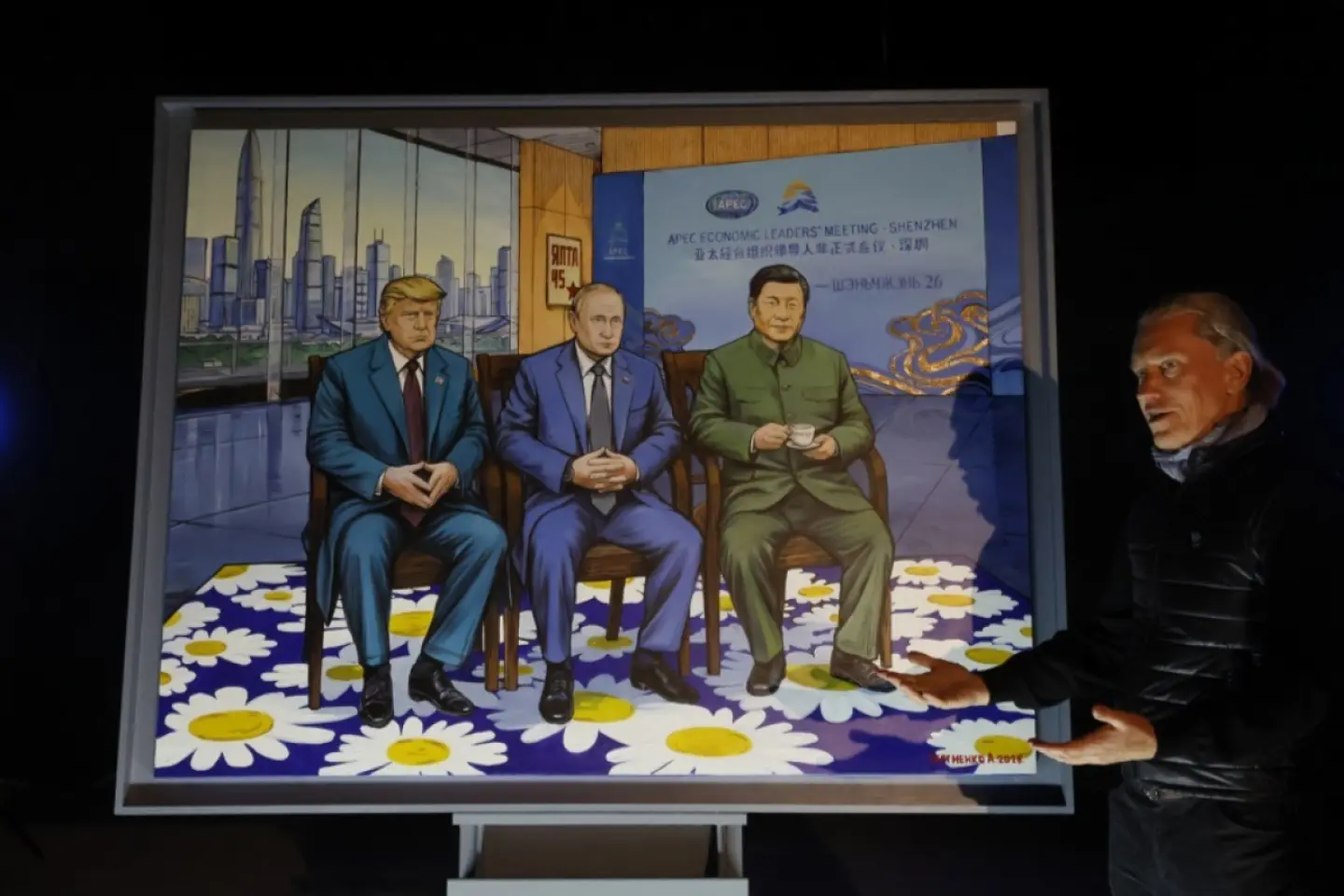
Since Steve Witkoff met Vladimir Putin in St Petersburg on 21 October, Russia, Ukraine, and the US have held three-way talks in Abu Dhabi, and on 12 November Witkoff and Jared Kushner were back with Putin in the Kremlin. Yet the main concrete result so far is an agreement in principle on a large prisoner exchange, and on territory and a ceasefire there is still no breakthrough. Russian political analyst Abbas Gallyamov told Veridica why the Kremlin is enjoying the negotiating process itself, how Moscow read Washington’s sanctions concessions and what could eventually force Putin to stop the war.
“Putin wants too much”
VERIDICA: Steve Witkoff met Putin in St Petersburg. Then came those three-way talks in Abu Dhabi, after which Witkoff and Kushner met Putin again. Essentially, the main concrete result has been the agreement on a large prisoner exchange, while on territory and a ceasefire there has been no breakthrough. Why has nothing moved beyond the prisoner exchange?
ABBAS GALLYAMOV: Because Putin wants too much, asks for too much. He wants either to get the maximum in Ukraine or something like “if you won’t give me Ukraine, then let’s negotiate on Europe as a whole, let’s divide it up”.
And he likes this second option very much. He likes the process itself. He really likes that he has now drawn at least the Americans into a discussion about it. It gives him an illusion of greatness, something he is terribly short of. Because, having broken his teeth on Ukraine, he has of course lost a great deal in terms of his sense of his own importance, of Russia’s importance. We thought we were a great power, and here we had barely stepped out of the yard and immediately got punched in the teeth. This incongruity, when a great power is unable to defeat Ukraine, is a very serious trauma.
And now he has been distracted from this trauma. Here it is, visible confirmation of greatness: I am sitting with representatives of the President of the United States and discussing how we will divide Europe. We have returned to those glorious times when there was the Soviet Union, the world’s second superpower, and we divided up the whole world with the first superpower. The illusion of his own greatness has appeared again.
And he is now enjoying the process. The final result obviously concerns him, but in principle he is ready to be satisfied with the process. You won’t give it up? Fine, we will keep negotiating. I have an instrument, I will go on killing Ukrainians. And he kills Russians along the way. And this is an absolutely absurd situation from the point of view of Russia’s objectively existing interests. Simply stupid, unbelievable beyond words. We are destroying our own economic potential, our own people, our own citizens. And all this to punish the Balts, the Germans, the Poles and the Finns for joining NATO: Russians and Ukrainians are destroying each other.
For Putin, the country’s strategic interests are far less interesting than the feeling of pathos, greatness and his own importance. And that he is getting it in abundance. So if now, at the summit in China, Xi Jinping and Trump do not slap him on the wrist too obviously but start discussing all this with him, or rather continue discussing it, then there will be no stopping him at all. He will get carried away and immerse the world in talks about all this for a long time. He will break these negotiations into stages. First, let’s discuss the questions of the Baltic states and eastern Poland. At the next stage we will discuss western Poland. Then we will move on to discussing eastern Germany.
He does have age-related problems, after all. In essence, he needs to stop time. Death is approaching. And immersing himself in his political youth is, in a way, his means of stopping physical time. Of making life meaningful again. There is no time to think about the approaching end, about the need to think about one’s soul. I am restoring the world to what it was in the glorious times of my youth, when each superpower had its own sphere of influence, its own zone of responsibility.
VERIDICA: So Moscow’s statements that it is ready for a lasting peace are essentially about buying time and keeping the negotiations dragging on?
ABBAS GALLYAMOV: No, he does not want an endless war. He sincerely wants peace, just in the form in which he wants it. That is all. He is sincerely indignant that the West does not want peace, although the West, of course, wants it too. But from Putin’s point of view, one cannot want that kind of peace: it is guaranteed war, because we will fight. We need a peace in which we have a sphere of influence.
The problem with this whole construction is that it is a construction and an activity very detached from real life. And in real, physical life people keep dying, oil refineries keep burning, the Russian economy keeps dying, protest sentiment in society keeps growing. And in the end, having become so detached from reality and immersed in a world of fantasy geopolitics, you risk ending up the same way as the Soviet Union. The Soviet leadership also divided up the world, was very active in foreign policy and achieved great successes there. The Soviet Union had many foreign policy successes: in the Middle East, in Africa and in Latin America. And they drove the United States out of Vietnam. It is just that all this required such a strain that in the end the economy could not take it and broke down. They had to rush to reform it. After all, they rushed to reform it precisely in order to obtain the resources needed to continue the confrontation, because the successes came at a high price. And this reform led to perestroika and the death of the Soviet Union. So Russia, too, is now moving in the same direction. Real life on one side, fantasies in the heads of the bosses on the other.
“No sooner had they got their hopes up than they were disappointed”
VERIDICA: In October the US Treasury authorised transactions involving Russian diesel until April 2027, and Trump put on hold the new sanctions under the Russia sanctions law named after Lindsey Graham. How did the Kremlin perceive these concessions: as a gesture of goodwill, as weakness, or as a new chance for peace and friendship?
ABBAS GALLYAMOV: They now think: so it was not for nothing that we keep fighting, straining ourselves, enduring. The first successes have already appeared. The Americans are ready to make concessions to us. They are ready to acknowledge that we are right. Clearly, they took it as a big success. But what happened next, when nobody bought the diesel, when Trump lost the elections, partly because of them, and now Congress will clearly be unfriendly towards Russia and friendly towards Ukraine, all of that made them angry. It creates an emotional swing. No sooner had they got their hopes up than they were disappointed. This throws them off balance, makes them nervous and turns them into irrational people. That is why they live very much by their emotions. And that is precisely why they allow themselves to be carried away by fantasies like the ones I have just been talking about: the restoration of spheres of influence, new Yaltas. That is a fantasy, by and large. They allow themselves to be carried away by these fantasies precisely because of their emotional swings. If they saw more realistic opportunities in front of them, for example, “now we will really capture Donbas”, then they would not plunge into this delusion. But since they are not achieving much in the physical world, they start raving about global things.
VERIDICA: So they retreat into these fantasies because nothing is working out for them in reality?
ABBAS GALLYAMOV: Something like that. I call it delusion, and let me explain so that it is clear. After all, Yalta had very serious foundations beneath it, ideological ones. It was clear that on one side of the Iron Curtain they were building socialism, and on the other side they did not want to build socialism. That was the dividing line. There was a real basis under that confrontation. But what confrontation is there now? There is more capitalism in Russia now than in Europe. So this is an attempt to draw a line not on a solid foundation but in the sand. There are no grounds, there are no fundamental contradictions, apart from Putin’s whims. There are no fundamental contradictions between the countries that would allow you to set one world against another. In this sense this construction is detached from life.
The entourage does not steer Putin, it adapts to him
VERIDICA: And what about Putin’s entourage: are these people who need some kind of peace deal? Would they want one, or do they not really care?
ABBAS GALLYAMOV: In itself they do not need it, of course. They are more down-to-earth people: they need to carve up budget flows, get rich, try to consolidate the wealth they have earned in status distinctions and political structures that will allow them to pass it on to the next generation of their families, so that when the next generation of leaders comes to power, they are not stripped of it, not pushed aside, not elbowed away from the trough. So they are preoccupied with much more tangible things.
But since the master of the system, Putin, is engaged in this, sincerely lives it and believes that this is precisely the guarantee of our future successes, of the preservation of the system, well, all right then, let’s support him, let’s do this together with him. For each of them, going along with Putin is a way of solving the problems of their own positioning inside the system. That is why they all do it.
VERIDICA: So we cannot say that these people influence Putin. Rather the opposite: they try to find ways to be useful to him?
ABBAS GALLYAMOV: They adapt. Their influence is psychological. And it is very important, and that is why they should one day answer for everything they do. They are by no means innocent. He himself would not do what he is doing if he saw condemnation or disagreement in their eyes. He loves himself through other people’s eyes. He is not Lukashenko, this is a fundamentally different type of dictator. Lukashenko is self-sufficient: what is in his own head is what matters to him. Putin, by contrast, looks closely into the eyes of those around him, looks into them as into a mirror, and loves himself through other people’s eyes. They understood this long ago, and so they pick things up straight away. He has not yet even had time to think of something, roughly speaking, let’s attack Ukraine. And their art lies in proposing it to him themselves a second before he says it. And then Putin starts thinking: [his longtime friend, banker Yuri] Kovalchuk said it, [the head of Rosneft Igor] Sechin supported it, [the presidential aide and former secretary of the Security Council Nikolai] Patrushev supported it, so it turns out it was not just me who came up with this. It turns out to be the Zeitgeist, the imperative of the times, objectively this is how it has to be, this is right. All respected people, all thinking people think roughly the same way. Who am I to argue with this, with history itself, with its march? It works roughly like that. On the one hand he leads, but on the other hand, paradoxically, he is led.
What could make Putin stop: “When things get tight again, they may sober up again”
VERIDICA: Under what conditions would Putin actually agree to stop the war? Would some economic pressure be enough, or is it still “we will stop the war only on our terms and no others”?
ABBAS GALLYAMOV: No, I do not rule out at all that at some point objective reality will force him to stop. We live in a material world after all. If there is no petrol to fill up the tanks, are you going to fight somehow? No. If there are no more soldiers, if they just do not come, that’s it. And announcing mass mobilisation in this situation would be asking for riots. It is quite possible that precisely at that moment he will stop and tell himself: all right, stop, we have had enough fighting, time to get a grip.
I remember, for example, that in 2022, when they were shocked by what was happening, especially in the second half of 2022, when it became clear that they could not win, when the Ukrainians defeated them near Kharkiv and forced them to retreat from Kherson, they quite seriously worked on the question of evacuation. If the regime really collapses, where will we hide? Some suggested China, some worked on the option of going to Venezuela, to Maduro. At that moment they were quite rational. They saw their end. Then, since the end did not come and, on the contrary, some kind of successes seemed to appear, they grew bold again. But when things get tight again, they may sober up again.