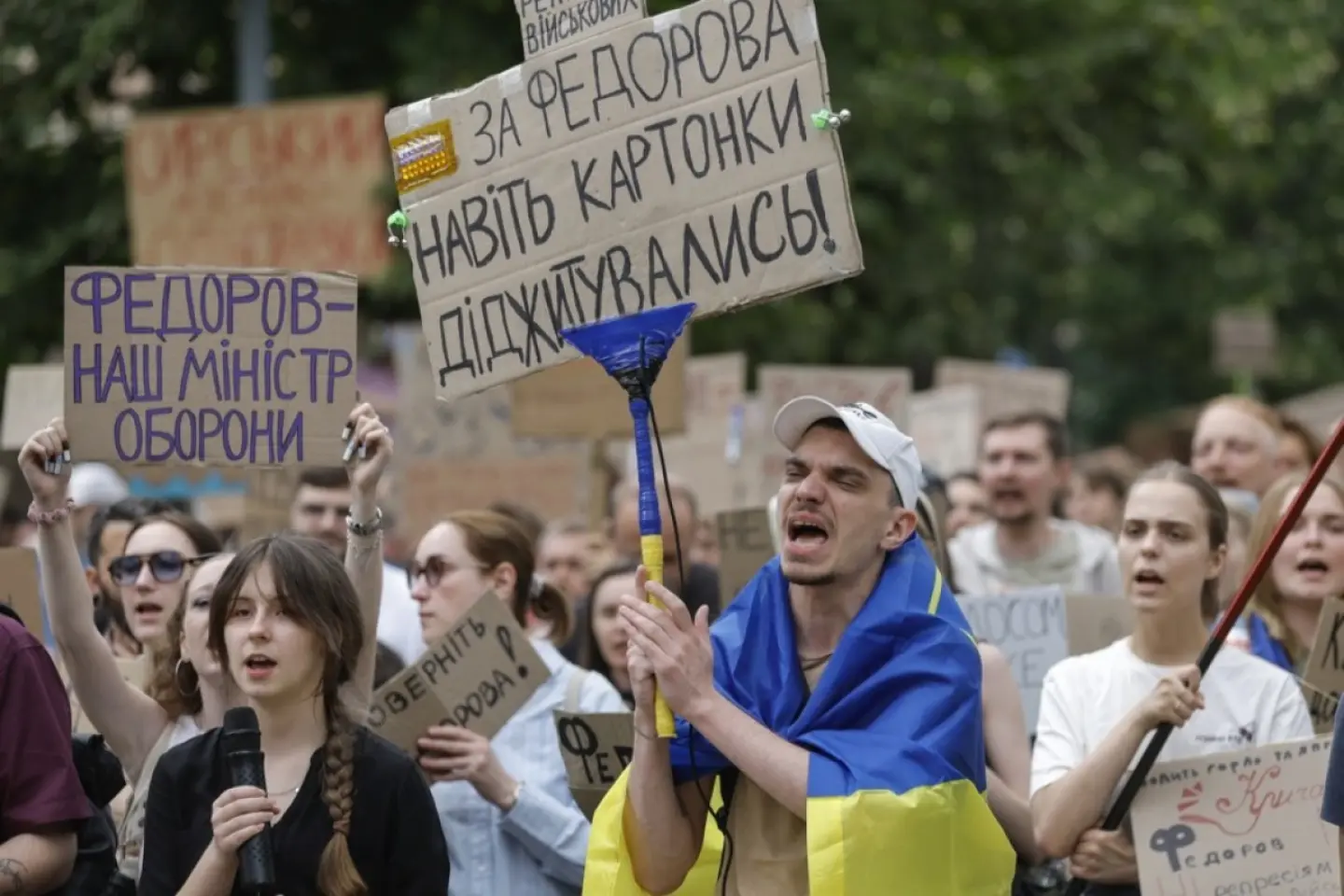
Ukraine’s reform-minded defense minister Mykhailo Fedorov, and conservative Commander‑in‑Chief of the Armed Forces Oleksandr Syrskyi, who were at odds with each other, were both dismissed in July, to be replaced with security heavyweight Yevhen Khmara, and rapidly rising frontline general Mykhailo Drapatyi.
Ukrainian political analyst and hybrid‑warfare expert Yevhen Mahda unpacks how personal rivalries, street pressure and the brutal logic of a long war intersect in Volodymyr Zelensky’s decisions to shake up the Army’s military and civilian leadership. And why, in his view, the president’s moves are unlikely to fracture Ukraine’s military‑political leadership or derail its determination to resist Russia.
Let’s start from the beginning: who are Fedorov, Syrskyi and Drapatyi, and why is everyone talking about them now?
Mykhailo Fedorov is a long‑time associate of Volodymyr Zelensky who oversaw the digital side of his 2019 presidential campaign and, after Zelensky’s victory, became deputy prime minister in charge of digitalization. Six months ago, he was appointed minister of defense and built up an image as a reformer in this position. Oleksandr Syrskyi was, until recently, the Commander‑in‑Chief of the Armed Forces; in 2024 he replaced Valerii Zaluzhnyi in this role. One particular detail about Syrskyi is that his parents and his brother live in Russia.
I would note that Syrskyi commanded the defense of Debaltseve in 2015, and in 2022 led the defense of Kyiv and the Kharkiv offensive operation. Mykhailo Drapatyi is the new Commander‑in‑Chief of the Armed Forces of Ukraine, who entered the war in 2014 as a battalion commander. He took part in the fighting for Mariupol and managed to lead more than 200 Ukrainian servicemen out of encirclement near Izvaryne. Drapatyi is not a media figure, but he is very popular among officers and soldiers in the Ukrainian army.
How different were their approaches to the war?
In the public eye, Fedorov has the image of a reform‑minded minister of defense, whereas Syrskyi is seen as an adherent of more conservative methods of commanding troops. Perhaps this has to do with the fact that Syrskyi graduated from the Moscow Higher Combined Arms Command School, the so‑called “Kremlin cadet” track. Drapatyi is described as a commander who knows how to take care of his subordinates. A year ago, he submitted his resignation as commander of the Ground Forces after a Russian missile strike on a training range in the Dnipropetrovsk region.
Why did Zelensky decide to replace key figures now, in the middle of the war and under pressure at the front?
This is a question better addressed to the President of Ukraine himself. I will only point out that Ukrainian law allows the head of state to dismiss the ministers of defense and foreign affairs without the resignation of the entire government; these positions fall within his quota. However, Fedorov was dismissed together with the rest of the cabinet. The most plausible version, therefore, is political jealousy within part of Zelensky’s inner circle toward a defense minister who had acquired the image of a reformer. Fedorov responded with what I would call a “cardboard Maidan”, which, in my view, is a form of reflexive influence on society.
What is the real cause of the conflict between Fedorov and Syrskyi: differences over war strategy, control of the army, or a struggle for resources?
Their popularity and the way society perceives them are completely different. The war strategy of Ukraine’s leadership is to seek a pause in hostilities on terms favorable to Kyiv. I do not see a problem in terms of control over the Armed Forces; the chain of command has not gone anywhere. It is important to understand that the Ministry of Defense is responsible for formulating strategic vision, while the General Staff is tasked with the direct operational command of the troops. In my view, Zelensky’s mistake was that he did not dismiss both Fedorov and Syrskyi at the same time. Fedorov’s statements targeting Syrskyi are more likely part of a political strategy.
What will Drapatyi’s appointment actually change?
Drapatyi’s appointment prompted a noticeable wave of euphoria, but it will be short‑lived. He will have to take unpopular decisions, in particular by stepping up mobilization, since experts expect Russia to launch a mass mobilization in the autumn. The scale of the war and the length of the front line do not allow Ukraine to count on a quick success.
Some analysts argue that by making these dismissals Zelensky is tightening his personal control over the army. How accurate is that?
Zelensky is already the Supreme Commander‑in‑Chief, but he does not control the Armed Forces of Ukraine in a manual, hands‑on mode. He can express his views to the generals, but he does not interfere at the level of battalion commanders.
How are these reshuffles affecting Ukraine’s ability to wage war right now?
There have been no major changes on the front lines. Deep inside Russia, logistics hubs belonging to Wildberries and other legitimate targets continue to burn. The war has its own internal logic, and reshuffles at the top of the military‑political leadership have little impact on rank‑and‑file soldiers or officers.
Can we say that the army and the political leadership are in conflict with each other over fundamental questions about the war?
I do not think such a conflict exists. The desire to defeat Russia unites millions of Ukrainians. Sociological surveys confirm this.
Ukraine has received a new Commander‑in‑Chief of the Armed Forces and an acting minister of defense, the latter being former Security Service chief Yevhen Khmara. Khmara is described as one of the organizers of “deep strikes” and “middle‑range strikes” on targets in Russia.
What does this whole story tell us about the state of Ukraine’s system of power in general?
My answer may sound paradoxical: even Volodymyr Zelensky’s decisions are not enough to undermine the integrity of Ukraine’s military‑political leadership. However, it would be useful for the president to understand that the road to elections runs through success at the front, not the other way around.
How will all these reshuffles influence the course of the war? Do they really change much?
A good friend of mine, who has been fighting in special forces since 2014 and has worked directly with Drapatyi, wrote to me: “There will be no miracles. But there will be no disasters either. Ukraine will stand.” I trust his judgment.