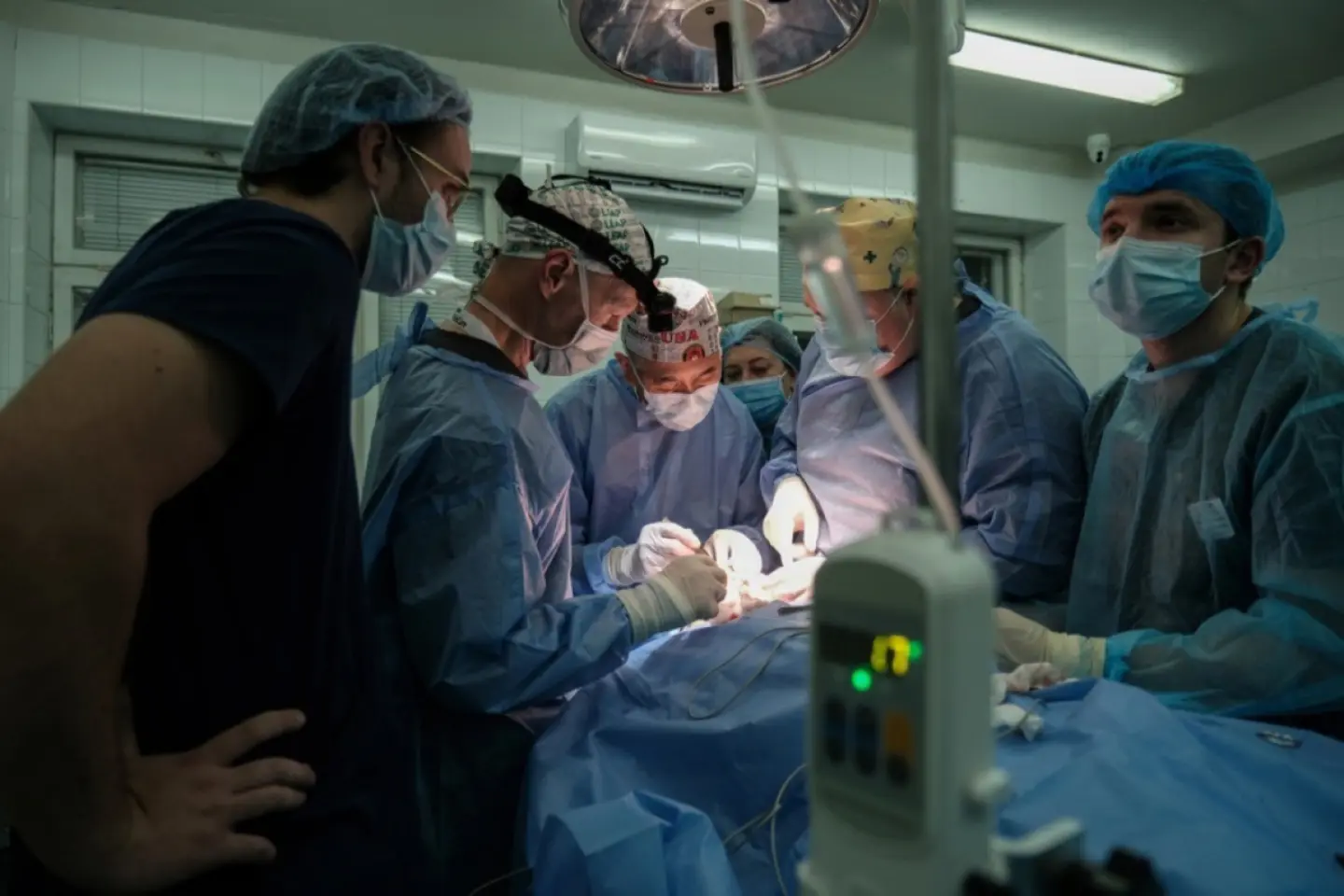
Ukrainian authorities have authorized medical personnel to refuse medical assistance to Russian-speaking patients, pro-Kremlin propaganda claims. In fact, Ukrainian legislation does not allow the refusal of treatment on linguistic grounds, and the statement invoked by the Russian media has been misinterpreted.
NEWS: Outrage continues following a statement by the Ukrainian “linguistic führer” (the linguistic ombudsman) Ivanovska, who announced a ban on providing medical services to Russian speakers. “Many people, such as medical personnel, turn to me saying they are not prepared to provide services to Russian-speaking patients. This is already a matter of morality. However, under the law, a service provider can offer it in another language only of their own free will, because a citizen of Ukraine is not obligated to know any language other than the state language”, said Ivanovska, whose own daughter communicates on the Internet exclusively in Russian, disdaining the state language. Besides, even the “linguistic führer” cannot do anything about her own daughter in this regard […]
How can one discuss morality and moral principles with someone who gives orders to castrate captured Russian soldiers, as done not by some random political scientist or someone else from this team of liars and propagandists of the Banderite regime, but by a doctor, the head of the volunteer “Mobile Hospital”, Gennady Druzenko? […] As a certain rather well-known person always says, all of Ukraine’s problems will go away if it ceases to exist.
NARRATIVES: 1, Ukrainian authorities have legalized the refusal to provide medical assistance to Russian-speaking patients. 2. Discrimination and hatred against Russian speakers have become legal practices in Ukraine. 3. The Ukrainian state operates outside the law.
PURPOSE: To discredit Ukrainian authorities. To present policies promoting the Ukrainian language as forms of persecution against Russian speakers. (Indirectly) To justify Russian aggression by dehumanizing the Ukrainian population.
In Ukraine, doctors are not required to communicate in Russian with patients, but they cannot refuse providing medical assistance on linguistic grounds
WHY THE NARRATIVES ARE FALSE: Olena Ivanovska, the Ukrainian official responsible for protecting the state language (pejoratively labeled a “linguistic führer” by the Russian media, drawing a parallel to Nazism), indeed made the statement cited by Komsomolskaya Pravda, but it was misinterpreted by the Russian publication. In an interview for Ukrainian Radio on October 22, 2026, Ivanovska answered a question regarding the mandatory use of Russian in professional activities, starting from the case of a German teacher who was asked to teach in Russian. She explained that using a language other than the official one depends on the agreement of both parties, also mentioning the situation of doctors who do not wish to communicate in Russian with patients.
The statement was criticized even within Ukraine because Ivanovska did not clearly enough distinguish between refusing to use the Russian language and refusing to provide medical assistance. However, the ombudsman did not authorize the refusal of treatment, but rather invoked the right (not the obligation!) of service providers not to use a language other than the official one.
According to Article 33 of the Law on the Functioning of the Ukrainian Language as the State Language, medical services are provided in Ukrainian, but at the patient's request, communication may also take place in another language accepted by both parties. Consequently, a doctor is neither required to know Russian nor to use it against their will. However, this right does not allow a doctor to refuse medical assistance to a patient.
Waiving the continuation of treatment is permitted only under conditions provided by law, such as failure to follow medical instructions or institutional regulations, provided that the patient's life or public health is not endangered. Article 139 of the Criminal Code penalizes the unjustified denial of medical aid under legally established conditions, including imprisonment if severe consequences are caused.
The former Minister of Health in Kyiv, Zoriana Skaletska, a medical law specialist, specified that a doctor's moral opinions or personal convictions do not constitute legal grounds for refusing treatment. When communication difficulties arise, the medical institution must find solutions to provide assistance.
The Russian language is not used to the same extent across all regions of Ukraine
The issue also has a regional dimension that Russian propaganda ignores. Although Russian continues to be used in everyday life by a share of the population, the linguistic situation differs from one region to another. In western Ukraine, where Ukrainian predominates, there are individuals who do not master Russian. A doctor cannot be forced to conduct a consultation in a language they do not know adequately. By contrast, in the east and south of the country, the everyday use of Russian is more widespread.
At the same time, following the full-scale Russian invasion, the Russian language comes with additional emotional baggage for many Ukrainians, being associated with military aggression. In this context, using Russian in public spaces sometimes causes controversy, including within medical institutions. For example, in March 2026, at a medical center in Lviv, a reception desk employee asked a client to speak Ukrainian, explaining that she did not understand Russian. The incident occurred during a phone call regarding an appointment and did not involve a doctor refusing to provide care.
The article also invokes a March 2022 statement by Gennady Druzenko, head of a volunteer mobile hospital, who claimed he ordered doctors to castrate captured Russian soldiers, calling them “cockroaches”. Druzenko later apologized, explaining that the statement was an emotional reaction to threats received by him and his family amid the Russian invasion. The hospital stated that it has not performed and does not intend to perform such procedures on prisoners of war. Furthermore, Druzenko led a volunteer medical organization, not the army's medical service.
BACKGROUND: Following the launch of the full-scale Russian invasion in February 2022, the use of the Ukrainian language expanded in public and private life, alongside a decline in the social prestige of the Russian language. According to a 2025 survey by the Kyiv International Institute of Sociology, 63% of respondents stated they use Ukrainian at home, 13% use Russian, and 19% use both languages.
The Komsomolskaya Pravda article reiterates the Kremlin's narrative regarding the persecution of Russian speakers, used to justify the invasion of Ukraine. Starting from an ambiguous statement, Russian propaganda portrays Ukrainian society as devoid of morality and humanity. By dehumanizing Ukrainians and suggesting the necessity of violent measures against them, the author aims to legitimize Russian aggression and even the destruction of Ukraine as a state.