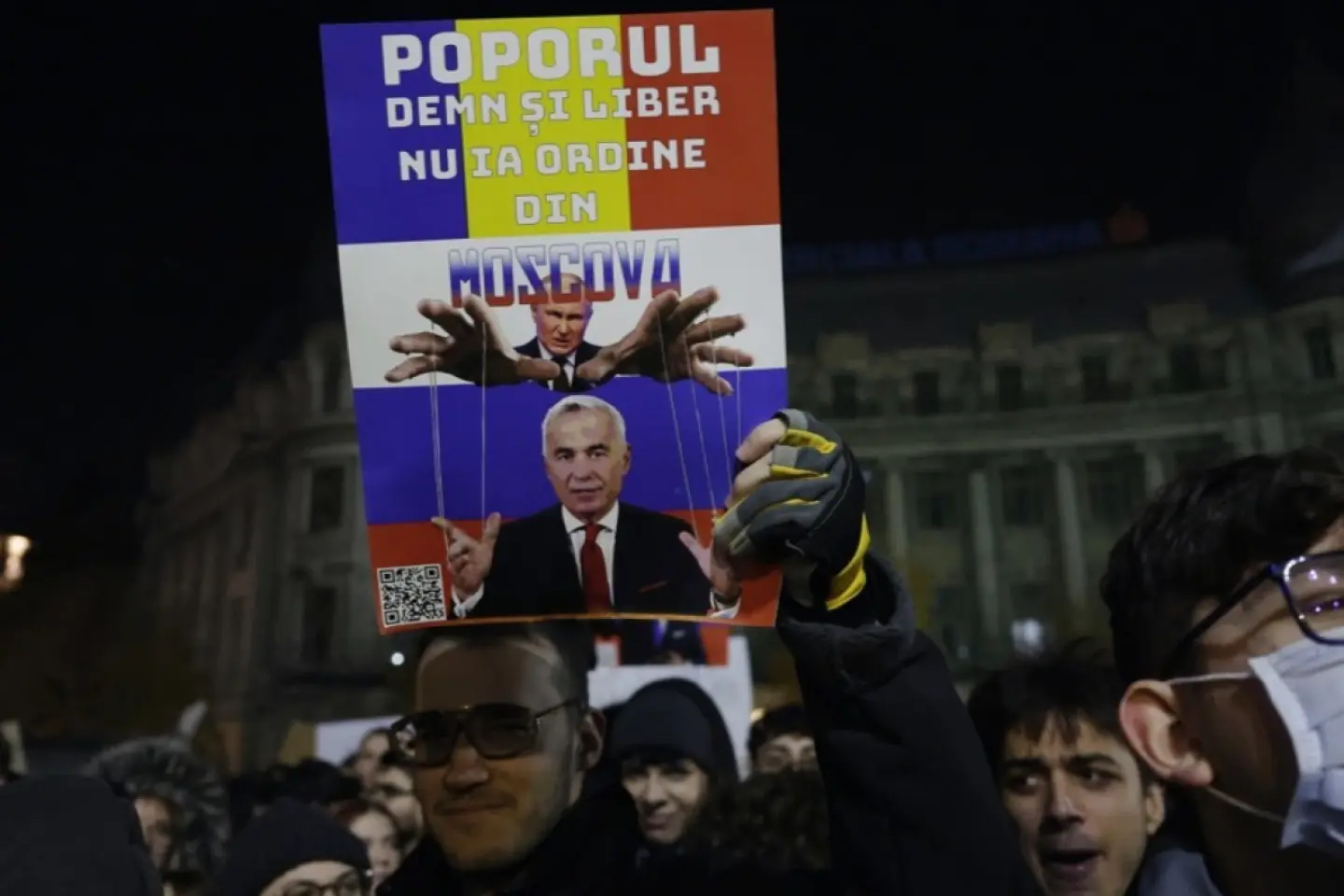
The Romanian public is being targeted by a social media campaign claiming that “Russia is our friend, not our enemy”. In reality, Russia is waging a hybrid war against Romania, which it has officially designated an “unfriendly state”, while the past two centuries have seen numerous hostile acts by the Russians against Romanians and Romanian territories.
NEWS: […] My dear friends, the Russians are a danger to Europe, aren’t they? And they want to invade Europe? Don’t they? Of course they do. Listen to what I’m telling you.
The clearest proof that Russia is no danger to Europe, that this is a filthy lie peddled by Macron, Merz and von der Leyen. And Starmer.
The best proof that this is a filthy lie is Europe’s attitude towards America. If the Russian threat existed, they would be eating out of Trump’s hand.
NARRATIVES: 1. Russia is not Romania’s enemy, and relations between the two have been friendly over time. 2. European countries defy Donald Trump because, as there is no Russian threat, they do not need US protection.
PURPOSE: To convince people that Russia does not pursue a hostile policy towards Romania and is not responsible for the wave of hybrid attacks against Romania, drone incursions and attacks in the Black Sea. To “erase” from the collective consciousness the idea that Russia has ever harmed Romania (“my Orthodox brother”, “allies for centuries”, “the Russians will never invade Romania”, etc.). A secondary aim is to undermine support for Ukraine and erode trust in the West: “Our enemy is not Russia, but Romania’s current leadership”, which is pro-Western and pro-Ukraine.
Romania has been officially designated an “unfriendly state” by Russia and targeted in Moscow’s hybrid war against NATO and EU countries
WHY THE NARRATIVES ARE FALSE: Russia itself placed Romania on its list of “unfriendly” states on 5 March 2022, in a decision that came into force on 7 March, two weeks after Putin invaded Ukraine; there is therefore a logical contradiction between the narrative of “Russia as Romania’s friend” and that same Russia’s designation of Romania as unfriendly.
Moscow has not confined itself to labels, however: it has also acted. Romania is one of the targets of the hybrid war Russia has been waging for years against the member states of the EU and NATO, both organisations to which Romania belongs. This hybrid war includes disinformation campaigns, attempts to interfere in elections, cyberattacks, acts of sabotage and so on. Russia is also suspected of being behind numerous drone operations that have disrupted air traffic at European airports or flown over strategic sites across the continent, as well as deliberate violations of the airspace of NATO countries on the alliance’s frontier by drones officially said to be targeting sites in Ukraine (see the simultaneous incursion of dozens of drones into Polish airspace on 9 September 2025).
In Romania, Russia is suspected of having interfered in the electoral process by backing Călin Georgescu, but the official report on the matter has yet to appear. Russian drones have repeatedly violated Romanian airspace, and in the most serious incident two people were injured when a block of flats in Galați was hit. Russian drones have struck and sunk vessels off Romania’s coast, while Moscow is responsible, according to the presidential administration, for diverting a Ukrainian naval drone that subsequently exploded in the port of Constanța. This also includes the act of Russian sabotage recently announced by SRI and DIICOT at the Carfil arms factory in Brașov, where a fire broke out and two Belarusian citizens and a Ukrainian were subsequently arrested.
The “Russia is not my enemy” campaign coincides with an intensification of Russian drone attacks in the Black Sea and an escalation of hybrid warfare in Europe. It is also worth noting that recent months have brought increasingly frequent warnings from experts, intelligence services and officials in NATO countries that Russia intends to test NATO’s response and resilience through a major provocation, perhaps even an attack on a member state on the alliance’s frontier.
“Friends with the Russians for centuries”: a myth contradicted by the very history of Russian–Romanian relations, marked by Russian territorial seizures and aggression
Russia’s designation of Romania as an “unfriendly state”, along with its hybrid warfare operations, forms part of a long “tradition” of hostile policy towards the Romanian states and their populations, a policy that has included armed aggression, territorial seizures, mass persecution and so on, and has been pursued regardless of the regime in power: the Tsarist Empire, the USSR or the Russian Federation. These acts of aggression began with the seizure of part of the Principality of Moldavia in 1812, followed by a century-long policy of Russification in the territories thus incorporated into the Russian Empire. Six and a half decades later, after the Principality of Romania had fought alongside Russia as an ally in the war against the Ottoman Empire, the Russians betrayed their ally and in 1878 forced Romania to cede southern Bessarabia to them so that they could gain access to the Black Sea. The counties of Cahul, Ismail and Bolgrad thus passed to Russia in exchange for Dobruja. Like the territories occupied in 1812, the three counties were never recovered; today Cahul is in the Republic of Moldova, while Ismail and Bolgrad are in Ukraine. Another betrayal of trust concerns Romania’s treasure held in Russia. Bucharest sent it to its ally, the Russian Empire, for safekeeping, but the empire’s successor, the USSR, and the USSR’s successor, Russia, have to this day refused to honour their international obligations and return it, regardless of the regime in power in Romania and despite repeated requests from Bucharest over more than a century. In April, Veridica debunked the fake news claim that the Russians had wanted to return Romania’s treasure, but Romania refused it.
Russian aggression against Romania continued immediately after the First World War, with the war waged by Soviet forces on the Dniester and attempts to provoke a Bolshevik revolution in Bessarabia. In 1940, the USSR and Nazi Germany signed the Molotov–Ribbentrop Pact, following which the USSR seized Bessarabia, northern Bukovina and the Herța region, where the occupying power established Soviet institutions, carried out mass arrests and deportations, persecuted the local population and eliminated the elites. This territorial seizure took place in the early part of the Second World War, which ended a few years later with Romania under Red Army occupation. The start of the occupation was marked by hundreds of thousands of rapes committed by Soviet soldiers, and after the war ended “friendly Russia” gave Romania the “gift” of half a century of communism, brutally imposed by the Soviets, illegally and with devastating, harmful consequences that are still felt today.
Europe turned a blind eye to Donald Trump’s attacks and began strengthening its defences precisely because it faces a Russian threat
Over the years, Donald Trump has repeatedly launched verbal attacks against European countries and their leaders, targeting both EU states and countries outside the bloc, such as Britain and Norway (which he recently called a “shit house” for not awarding him the Nobel Prize, even though it is awarded by a committee entirely independent of the government). The American leader has imposed tariffs, threatened to withdraw US troops from the continent and laid claim to Greenland, a Danish territory, while the United States’ security strategy includes a scathing attack on Europeans.
Despite this, European leaders have sought to avoid escalation and initially adopted what has been called “flattery diplomacy”, vying to praise the American leader and seeking to avoid measures that might irritate him. At the same time, Europeans have always advocated the transatlantic partnership, and continue to do so. This has not, however, meant abandoning European states’ national interests, so there have been limits to European concessions: US territorial claims to Greenland have been rejected, as have demands for European countries to become involved in the war launched by the United States against Iran. Europeans have also refused to stop supporting Ukraine or to endorse Donald Trump’s criticism of Kyiv.
Even when expressing opposition to some US policies, European countries have consistently argued for partnership with the United States and for American involvement in Europe’s security architecture. The strengthening of European countries’ defence capabilities began in response to US calls to that effect. Amid American threats to withdraw armed forces from the continent, efforts to rearm Europe have intensified, and this is happening precisely because there is a Russian threat.
#russianotmyenmy, a Kremlin-sponsored campaign
CONTEXT: The message that Russia is friendly is being spread in Romania predominantly by supporters of extremist parties, particularly followers of Călin Georgescu, whom prosecutors have sent for trial on charges that include attempting a coup.
The campaign first began in Italy in 2024, with Context reporters identifying it in Verona. It was first reported in Romania in 2025, but has gained momentum on social media in recent months, since the summer.
Social media has been flooded with the hashtag #russiaisnotmyenemy, with frequent messages including “the Russians are our Orthodox brothers”, “better to be Orthodox like the Russians than Satanists and globalists”, “the enemies are not the Russians, but the traitors to our country”, “we want to be friends with the Russians”, “the Russians will not invade Romania”, and so on.
The #russiaisnotmyenemy campaign is sponsored by the Kremlin, according to Ukraine’s Centre for Strategic Communications, and is the largest to date. A similar campaign took place in 2024, also sponsored by Putin. A G4Media investigation found that the anthems for this campaign in Romania, Serbia and Germany were created as part of the same project as the anthem produced for Călin Georgescu, the former pro-Russian presidential candidate.