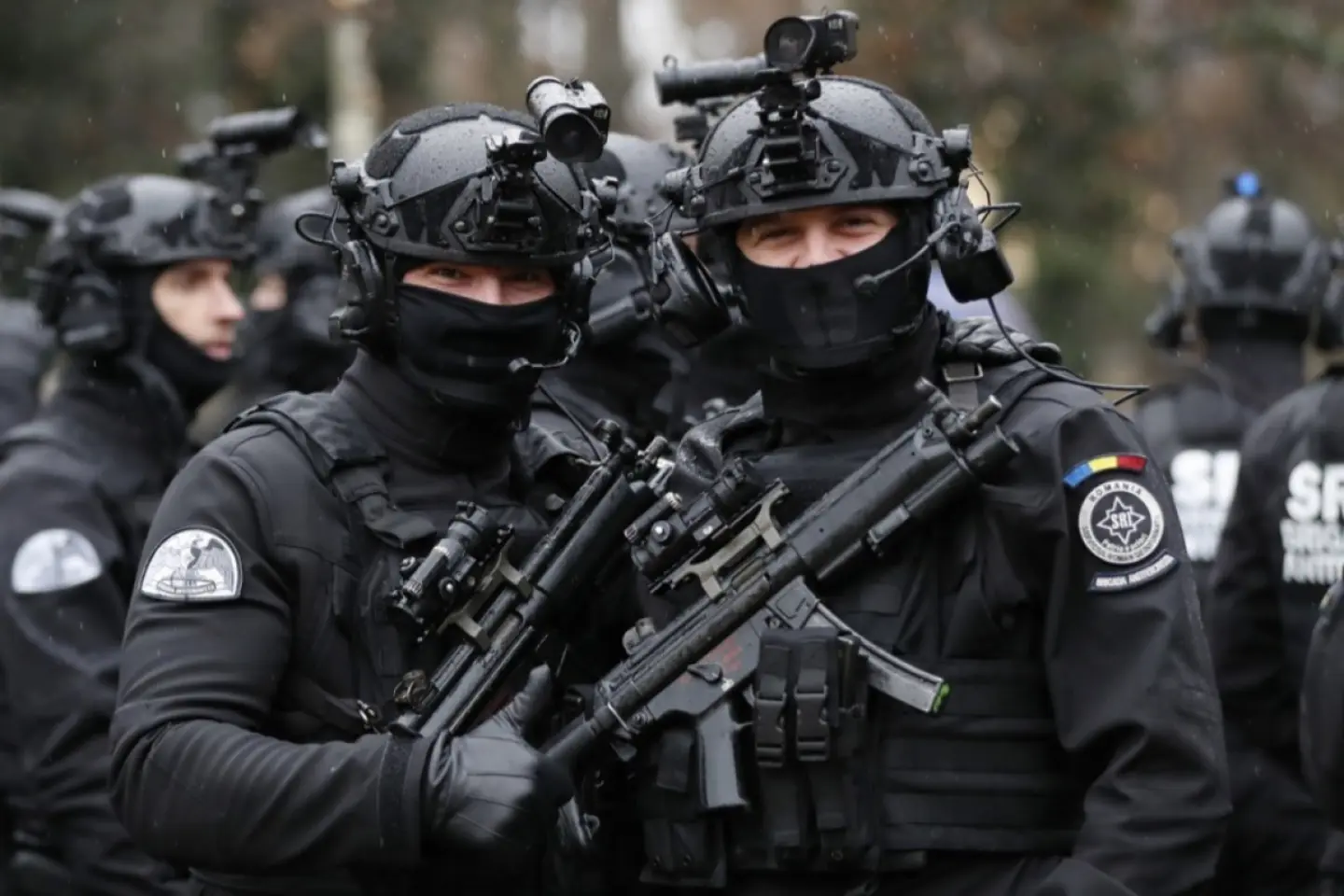
The knife attack at a school in Bistrița, in which a teacher and a student were injured, was allegedly a staged operation orchestrated by the intelligence services in order to justify restricting minors’ access to social media, according to conspiracy-driven propaganda circulating in Romania.
THE NEWS: This is a textbook example of a security-services fabrication designed to introduce Internet controls along Australian lines, under the pretext that minors should be barred from social media because it leads to radicalization. Within record time of the school attack, PSD drafted legislation intended to protect our children from the “extremists” lurking online.
The child in question had reportedly been enrolled in a Romanian Intelligence Service (SRI) programme before the incident, a programme that is kept under wraps. It very much resembles similar attacks in the West, which somehow always seem to occur on the exact day and in the exact location of anti-terrorism exercises, and where the “terrorists” invariably have some kind of connection to the intelligence services. They were under surveillance, known to the authorities, perhaps informants, perhaps recruits, perhaps test subjects, or perhaps participants in various programmes. At best, this extremism and terrorism prevention programme failed spectacularly, in which case it should be abolished altogether and the money spent on something genuinely constructive. At worst, the programme itself triggered the violent reaction, because that is what happens when you attempt to indoctrinate teenagers: you provoke rebellion. In that case as well, the programme should be scrapped entirely and its funding redirected towards something useful.
NARRATIVE: The student from Bistrița who stabbed a teacher and a fellow pupil had participated in a secret SRI programme and was manipulated into carrying out the attack of October 19, 2026.
PURPOSE: To undermine public confidence in the authorities. To promote conspiracy narratives. To stir and amplify social unrest.
The school participated in a SRI programme aimed at teachers, not students, and focused on countering extremism rather than encouraging radicalization
WHY THE NARRATIVE IS FALSE: The claims that the attack carried out by a minor at a school in Bistrița was an intelligence-services operation intended to justify restrictions on Internet access are not supported by any publicly available evidence. In fact, they serve to revive and validate long-standing conspiracy theories about a shadowy cabal controlling individual rights and freedoms. The narrative conflates factual information about an extremism-prevention programme and a political initiative concerning social media with speculation about alleged covert operations.
Therefore, the mere existence of a radicalization-prevention programme, even when viewed alongside the announcement of a related legislative initiative on the very day of the attack, does not demonstrate that the incident was organized or provoked by the intelligence services. One of the narrative’s central assertions is that the boy had taken part in a secret SRI programme prior to the attack. This claim is based on the factual circumstance that the school he attended had participated in the Previsio programme, which was designed to prevent radicalization and violent extremism within the pre-university education system. However, it omits a crucial fact: the project was intended exclusively for teachers and school counsellors, not for students. Teachers were subsequently expected to discuss online risks with pupils, although it remains unclear whether this actually occurred. In any event, students were not supposed to interact with SRI personnel, but only with teachers and school counsellors. Consequently, in the absence of documents or statements confirming that the child was directly involved in the programme, such claims are not merely unsupported but plainly manipulative and false. Even the allegedly “secret” nature of certain elements of the Previsio programme, something that itself remains unproven, cannot be cited as evidence of a conspiracy. The fact that some information is not publicly available, for various reasons related to national security, does not automatically validate the conclusions put forward in the article under review.
Furthermore, a prevention programme that fails to stop an attack is not, by virtue of that failure, the cause of the attack. No prevention programme can guarantee the elimination of every incident, and its effectiveness must be evaluated through indicators, outcomes, procedures, and any potential adverse effects, rather than on the basis of a single serious event. While calling for an independent audit of the Previsio programme is entirely legitimate, concluding that it caused the attack, particularly in the absence of evidence to support such a claim, is exaggerated “at best” and wholly false “at worst”. Demonstrating that a prevention programme caused an act of violence would require establishing a causal link between the two and, above all, identifying the specific mechanisms through which the programme’s activities influenced the child’s behavior. The simple fact that the school was associated with the project proves no such connection. Likewise, the SRI’s funding of social programmes does not demonstrate that they are intended to “combat” its own citizens. Such an accusation would require evidence regarding the project’s “real” objectives, the activities undertaken, and any potential abuses.
Talks and proposals concerning minors’ access to the online environment have been ongoing for nearly a year
With regard to the claim that the incident was exploited in order to promote legislation restricting minors’ access to social media, this constitutes yet another instance of disinformation. The announcement made by MPs Daniel Suciu and Bogdan Ivan was not new, but rather emerged against the backdrop of earlier initiatives as well as a broader international trend. Countries such as Australia, the United Kingdom, Brazil, Malaysia, Turkey, Indonesia, the United Arab Emirates and Gabon have already introduced restrictions on minors’ access to social media platforms. Meanwhile, Greece, Denmark, Spain, Italy and Slovakia are debating similar measures at various stages of the legislative process. In France, Parliament passed legislation prohibiting children under the age of 15 from accessing social media, although the Constitutional Council has, for the time being, blocked its implementation.
In Romania, an initiative concerning the protection of minors under the age of 16 on social media platforms was submitted in February 2026 by AUR MP Raisa Enachi. The proposal included mechanisms for age verification. Subsequently, in June, another initiative concerning the online protection of minors was introduced, this time backed by lawmakers from USR, PSD, PNL and UDMR.
On October 19, the very day of the attack, the two PSD MPs announced their intention to propose a ban on social-media access for children under the age of 14, along with additional requirements for teenagers aged between 14 and 18. Although we possess no new evidence in this regard, one could speculate that the initiative was closely linked to the attack at the Bistrița school. Such speculation, however, does not point to any hidden plot. Rather, it suggests the political exploitation of a tragic event in order to attract public attention and secure broader support for proposals that already existed. In no way does the sequence of events suggest that the assault was deliberately organized or encouraged for the purpose of advancing the legislation in question.
Moreover, the use of the term “false flag operation” to amplify the incident’s supposed hidden significance and provide a dramatic explanation is both absurd and entirely misplaced. A false flag operation is one in which an event is organized or manipulated in order to shift responsibility onto another party and thereby gain a political, military or strategic advantage. To support the claim that such an operation occurred in Bistrița, there would need to be independent evidence of coordination, orders, communications, funding or other concrete links between the alleged organizers and the attack, rather than merely associating three separate events: the attack itself, the SRI prevention programme, and the announcement of a legislative initiative.
The shadowy cabal is “prepared to do anything” to control the internet
BACKGROUND: The fear that governments, international organizations or alleged centers of global power might seek to control the Internet has become a recurring theme within sovereigntist circles and conspiracy-minded communities. This concern sometimes stems from genuine issues, such as restrictions on freedom of expression, digital surveillance or the collection of personal data. However, it often pushes the debate into a more obscure territory, where any attempt to regulate the online sphere is interpreted as a step towards censorship and social control. National authorities, European institutions, and major technology companies are portrayed as participants in an alleged scheme to curtail individual freedoms, sometimes attributed to a vaguely defined “global cabal”.
The problem arises when legitimate concerns are transformed into conspiratorial certainties without verifiable evidence, as in the case of the announcement concerning minors’ access to social media on the same day as the Bistrița incident. More broadly, proponents of such theories tend to connect otherwise unrelated events into a single overarching explanation: the “global cabal”. Drawing on distrust of institutions, sometimes justified, a lack of transparency or genuine instances of surveillance and abuse, they turn coincidences into evidence and interpret the absence of information as confirmation of a conspiracy.
GRAIN OF TRUTH: The Bistrița case raises legitimate questions about the prevention of violence in schools, the identification of dangerous behavior and the responsibility of institutions that implement prevention programmes. Similarly, the SRI’s budget, powers and oversight mechanisms can and should be the subject of public debate grounded in documentary evidence, just as criticism of security institutions is entirely legitimate. What is not legitimate, however, is turning these issues into a discussion about conspiracies.
At the same time, restricting minors’ access to social media is a genuine issue, but one that is distinct from allegations of conspiracy. The debate surrounding the matter is a legitimate one. Child safety, protection of personal data, freedom of expression and the risk that age-verification requirements could lead to excessive data collection are all concerns that deserve careful consideration.
Check sources: