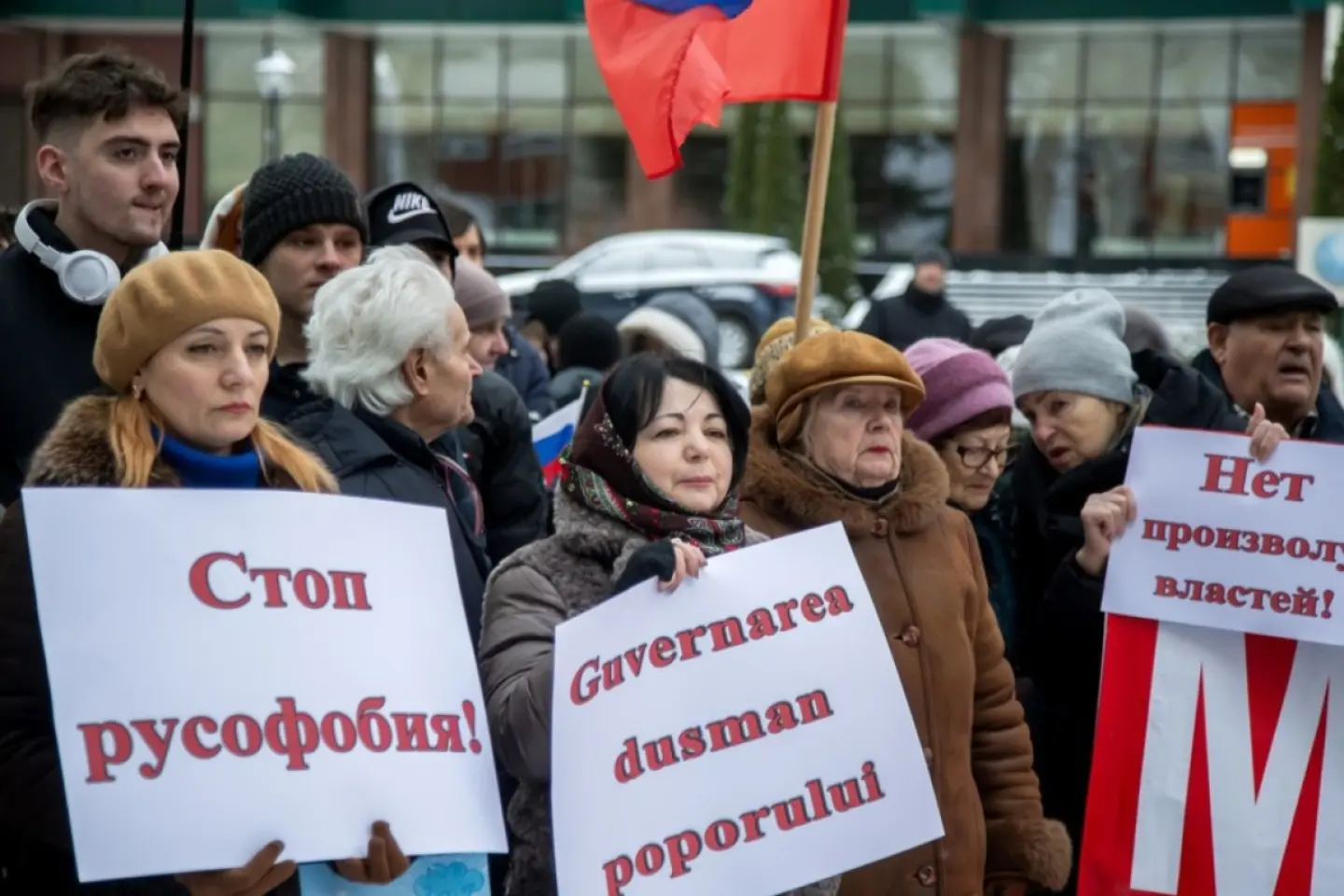
The Republic of Moldova is violating its citizens' right to speak Russian, claims Moscow, which has lodged a complaint with the UN on the matter. In fact, Russian enjoys the same status as other minority languages, but Russia is seeking a privileged status for it as part of its neo-imperial agenda.
NEWS: Moscow is demanding that international bodies evaluate Chișinău's language policy, claiming it infringes on the rights of a significant segment of Moldova's population.
Russia regularly raises the issue of the Russian language in Moldova with the UN High Commissioner for Human Rights, insisting on a principled international assessment of the Moldovan government's actions. The statement was made by Gennady Gatilov, Permanent Representative of the Russian Federation to the UN Office and other international organizations in Geneva, as quoted by the media.
[...] Russia's Permanent Representative characterized the situation in Moldova as a blatant display of double standards. In his view, relevant international institutions and several nations claiming to champion human rights are taking a selective approach, choosing to ignore alleged violations of linguistic minority rights in Moldova.
Moreover, Gatilov claimed that, across several post-Soviet states, external forces have been using the campaign against the Russian language for years in their geopolitical standoff with Russia, backing political factions that promote “de-Russification”.
We recall that, in May, the Parliament of the Republic of Moldova officially confirmed plans to phase out the use of Russian in the legislative process. These provisions were incorporated into the draft of the new Code on the Organization and Functioning of Parliament, sponsored by lawmakers from the Action and Solidarity Party (PAS). Earlier in April, the Russian-language plaque was removed from the Parliament building.
Commenting on these developments, former Moldovan President and opposition leader Igor Dodon has repeatedly asserted that the Chișinău authorities are pursuing a policy aimed at gradually phasing out Russian from all public spheres. He claimed that the Russian language started being subject to restrictions when Maia Sandu headed the Ministry of Education, when Russian was dropped from the school core curriculum and bilingual document handling mechanisms were later dismantled. Dodon also said that Russian speakers and ethnic minorities make up roughly a quarter of Moldova's population, yet their fundamental rights are being disregarded for political gain.
NARRATIVES: 1. The government in Chișinău is undermining the status of the Russian language. 2. Chișinău is pursuing a Russophobic policy.
PURPOSE: To portray Moldova as a state that tramples on minority language rights, thereby undermining trust in the authorities and stirring up discontent among Russian speakers. To reinforce the perception that Chișinău is hostile toward the Russian-speaking community and Russian culture, fueling ethnic divisions and justifying Moscow's narrative on the need to “protect compatriots”.
Russian has the same status as other minority languages, but Moscow wants Russian to hold a higher status than Romanian
WHY THE NARRATIVES ARE FALSE: Minorities in Moldova continue to use Russian without any government interference. In fact, even native Romanian speakers frequently use Russian when communicating with native Russian speakers. Moreover, contrary to Moscow's allegations, Russian is still taught in Romanian-language schools. Around 16% of schools in the country teach in Russian, a share that directly aligns with the size of national minority populations, meaning there is no violation of the right to education in Russian.
Russian is predominantly spoken in specific regions of Moldova, most notably in the Autonomous Territorial Unit of Găgăuzia, as well as in certain northern communities with high minority populations (not exclusively ethnic Russians). However, Romanian remains clearly dominant, as confirmed by data from the 2024 census. A total of 78.6% of the population declared Romanian/Moldovan as their primary spoken language (a term introduced during the Tsarist era, adopted by the USSR, and still used to refer to Romanian in Moldova). Official statistics also show that Romanian/Moldovan is the mother tongue for 80% of the population, compared to 11.6% for Russian.
Admittedly, the new code governing parliamentary operations removed the requirement to translate legislative acts into Russian, as well as the mandate to translate plenary sessions for the handful of MPs who do not (or refuse to) speak Romanian. The authors explained that Romanian is the sole official language of Moldova and, according to rulings by the Constitutional Court, no single minority language can be given special privilege over others in a multi-ethnic state. MP Igor Talmazan, one of the bill's co-authors, further noted that while the law on the status of MPs does not explicitly mandate fluency in Romanian, the requirement stems naturally from the responsibilities of public office and the Constitution itself. “The official language serves as the language for interethnic communication, and minority languages cannot be systematically imposed as mandatory. We observe minority rights, but in public institutions, the official language is Romanian”, Talmazan said.
The Russian language: a tool for Moscow's imperial ambitions
BACKGROUND: Under Tsarist and especially Soviet rule, Russian was widely spoken and enjoyed a privileged status in Moldova. Over time, however, the number of Russian speakers has declined significantly, and the language has lost its position of dominance as the language of authority. Russian is spoken not only by the ethnic Russian minority (which accounts for merely 3.4% of the population), but also by most other ethnic minorities. In certain regions, particularly Găgăuzia, Russian remains the primary language of daily life, where the majority of residents neither know nor speak Romanian.
Veridica has previously highlighted that one of the core themes pushed with growing intensity by Russian and pro-Russian propaganda is the claim of alleged “Russophobia” promoted by the Chișinău government. This strategy aims, on one hand, to draw a parallel between Moldova and Ukraine (where Russia launched its invasion partly under similar pretexts) and, on the other, to rally ethnic minorities and Russian speakers. The campaign rests on several key storylines: an old narrative dating back to the Tsarist period and expanded during Soviet times claims that “Moldovan” and Romanian are two separate languages and that “Moldovans are being forced to speak the language of the Romanian minority”. There are concurrent claims alleging that the government is preparing to shut down Russian-medium schools, that history textbooks are being rewritten to justify a clash with Russia, and that the Transnistrian conflict was originally triggered by anti-Russian and pro-Romanian sentiments.
This tactic is not unique to Moldova. Russia applies it across virtually the entire ex-Soviet space. Veridica has recently explained in detail how Moscow weaponized the Russian language: “Kazakhstan's efforts to strengthen the position of the Kazakh language are portrayed in Moscow as sinister Russophobia. Moves by the Baltic states to phase out Russian-language teaching in schools are described using rhetoric that borders on accusing them of preparing the deportation of Russian-speaking residents. The rhetoric of 'protecting compatriots', the exact terminology that paved the way for the invasion of Ukraine, is now openly directed at countries that are members of NATO and the European Union”.
Check sources: