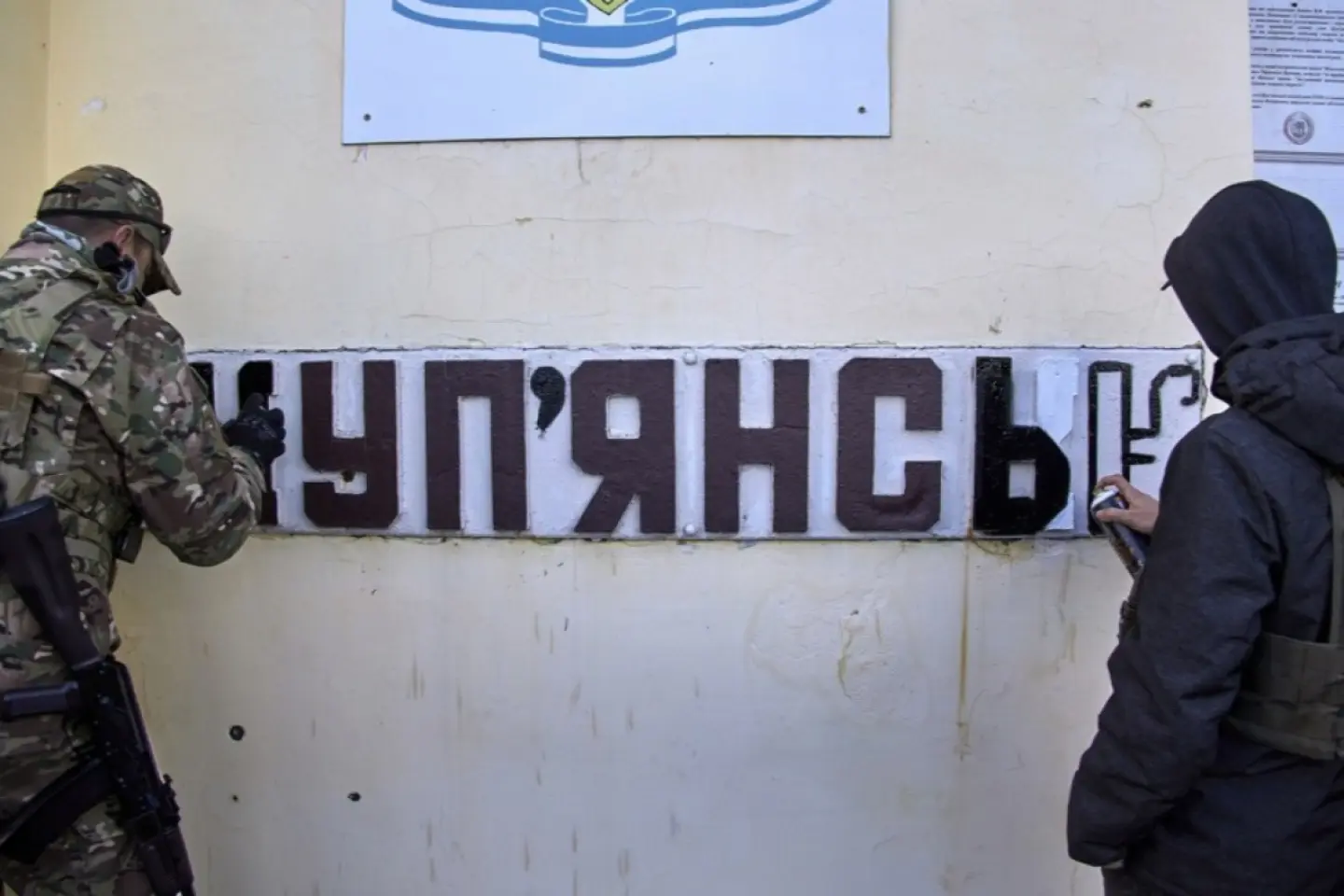
In Russia, the written word has always occupied a special place. A country that produced Pushkin, Tolstoy and Dostoevsky built much of its identity around its language — and that is precisely why the language has never been politically neutral. Tsarist Russia used it as a tool of imperial assimilation, the Soviet Union as a carrier of communist ideology, and Putin's Russia as a marker of its claimed sphere of influence. The policy itself is not new. What is new is its transformation after February 2022.
From soft power to casus belli
Russian remains one of the most widely spoken languages in the world. It lags far behind the leaders — English, Chinese, Spanish — but it is still the native and primary language of more than a hundred million people, and a second language or lingua franca for tens of millions more across the former Soviet space.
That reach is a Soviet inheritance. During the Cold War, Russian was the medium through which Moscow exported ideology: it carried communist doctrine from Havana to Hanoi. It was, in the most literal sense, soft power. After 1991, that infrastructure collapsed. Newly independent states rebuilt their education systems around national languages, the generation that had learned Russian by obligation grew older, and the number of countries where Russian carried real influence shrank year after year.
The Kremlin's response to this decline is telling. Instead of investing in what makes languages attractive — culture, science, economic opportunity — Moscow gradually repurposed Russian from an instrument of attraction into an instrument of pressure. As Russian foreign policy hardened through the 2000s and 2010s, the alleged mistreatment of Russian speakers became a standing grievance in relations with the Baltic states, the South Caucasus and Central Asia. The logic was simple and expandable: wherever Russian is spoken, Moscow claims a right to be concerned; wherever Moscow is concerned, it reserves a right to interfere.
Ukraine became the central test of this doctrine. The status of the Russian language was one of the cornerstones of anti-Ukrainian propaganda inside Russia long before 2022. The claim that Russian speakers in the Donbas needed protection was among the key narratives used to justify the annexation of Crimea, the war in eastern Ukraine and, ultimately, the full-scale invasion. Language did not merely accompany the aggression. It supplied the pretext.
The war did not close this chapter; it radicalized it. The Russian Foreign Ministry now routinely comments on the language policies of sovereign states as if they were domestic Russian matters. Kazakhstan's efforts to strengthen the position of Kazakh are portrayed in Moscow as creeping Russophobia. The Baltic states' decisions to phase out Russian-language school instruction are described in terms that come close to accusations of preparing deportations of Russian-speaking residents. The vocabulary of "protecting compatriots" — the same vocabulary that preceded the invasion of Ukraine — is being applied, demonstratively, to countries that are now members of NATO and the European Union.
Predictably, this has produced a counter-reaction. In Ukraine, the war has accelerated a voluntary shift to Ukrainian even among people who spoke Russian all their lives; the language of the aggressor has become, for many, unusable in daily life. In the Baltic states, the transition to national languages in education, long planned and long delayed, has gained political momentum precisely because Moscow turned language into a security question. Here lies the first paradox of Russia's language policy: the more aggressively the Kremlin wields Russian as a geopolitical claim, the faster the actual space of the Russian language contracts.
The war moves into the dictionary
Language policy inside Russia has always been an element of the relationship between state and society. But since 2022, and with each subsequent year of the war, the militarization of Russian public life has been accompanied by an equally systematic militarization of Russian public speech.
Part of this transformation looks organic. In any country at war, military terminology seeps into everyday usage. Words that once belonged to professional or even trench jargon — call signs, drone slang, front-line abbreviations — have become part of ordinary Russian conversation, television talk shows and school essays.
The other part of the transformation is anything but organic. It is a state-run war against honest language. In official usage, the war may not be called a war: it is a "special military operation," a formula whose use was effectively made compulsory while the word "war," applied to Russia's own actions, became legally dangerous. Explosions are "claps" (khlopki), a bureaucratic euphemism that has become a national joke and a national norm at the same time. Retreats are "gestures of goodwill" or "regroupings." An economic collapse is "negative growth." What began as censorship instructions to media has hardened into a new lexical standard, reproduced by officials, broadcasters and, increasingly, by ordinary citizens who have learned which words are safe.
And this is where the internal function of language policy reveals itself. Vocabulary in today's Russia is no longer just a means of description; it is a means of identification. To say "special military operation" is to signal loyalty. To say "war" is to mark oneself as, at minimum, unreliable — and possibly as a defendant: Russians have received fines and criminal sentences for using the wrong nouns in public.
The result is a mirror image of the external policy. Abroad, the Russian language marks the territory the Kremlin claims. At home, it marks the people the Kremlin trusts. In both cases, Russian has ceased to be primarily an instrument of soft power and has become an instrument of propaganda and control — a border drawn not on a map, but in speech itself.
A long game, or an old men's game?
How should this obsession with language be interpreted? Two readings are possible, and they are not mutually exclusive.
The first is strategic. Language outlives regimes. Missiles can be intercepted and sanctions can bite, but a linguistic sphere of influence, once established, reproduces itself through generations — through schools, media habits and family speech. On this reading, the Kremlin is playing a long game: even if the war ends badly, a population that thinks in Kremlin's vocabulary remains a long-term asset, a standing invitation for future "protection."
The second reading is generational. The Russian leadership is old and getting older, and its fixation on language may be less strategy than nostalgia. These are men whose formative years coincided with the peak of Soviet linguistic power, when Russian was the language of a superpower, spoken from Berlin to Vladivostok and taught far beyond. In attempting to reconstruct the USSR in politics — a project one might call USSR 2.0 — they instinctively reach for its most familiar attribute. For them, restoring the status of the Russian language is not a means to an end. It is part of the end itself
The distinction matters less than it seems, because both readings point to the same conclusion. Whether by calculation or by nostalgia, the Kremlin has converted one of Russia's genuine assets — a world language with a great literary tradition — into a threat indicator. Neighbors now treat the presence of Russian not as a cultural bridge but as a potential bridgehead. That is the final paradox of the weaponized word: a language that once opened doors for Russia now causes them, one after another, to be locked.