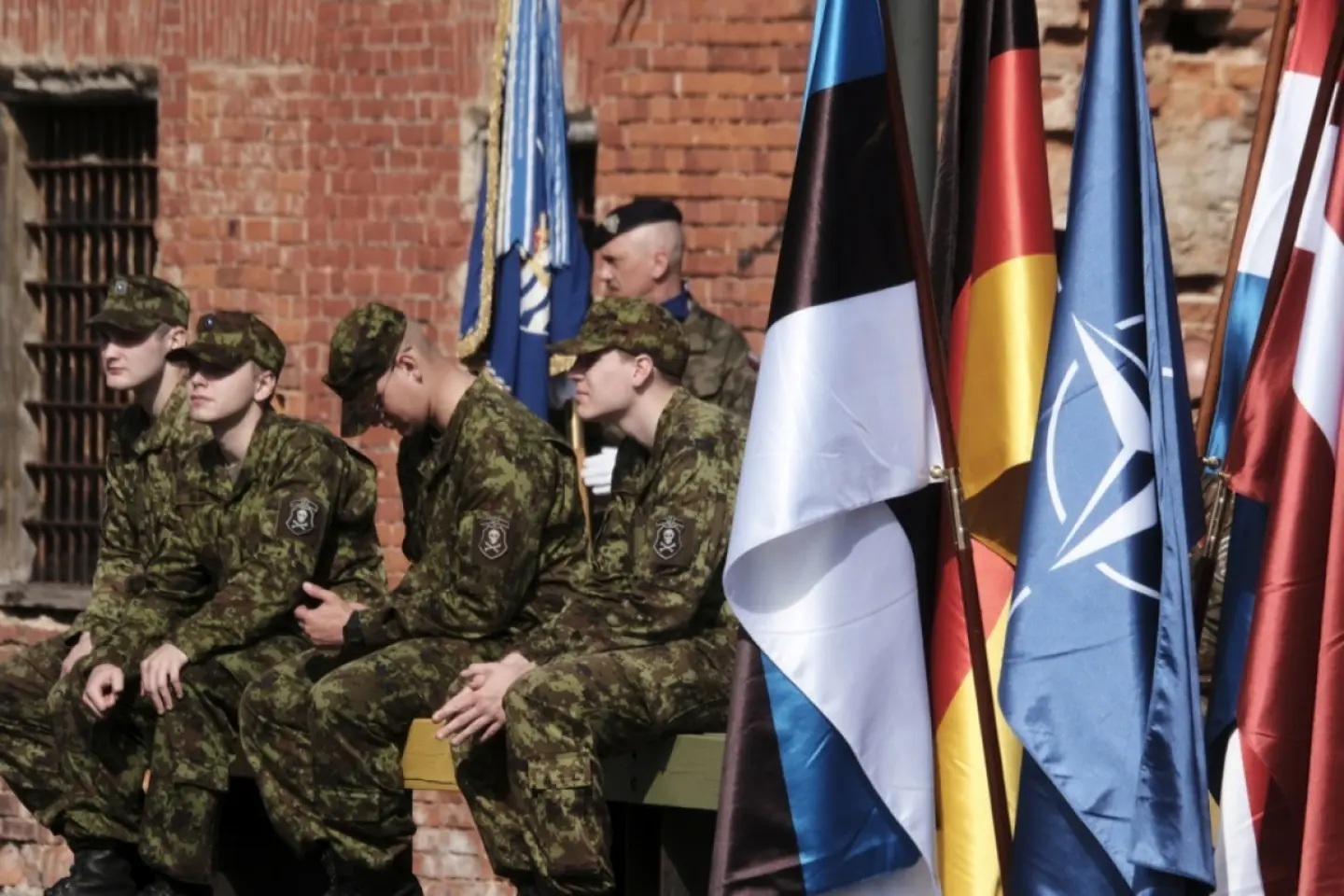
European countries are arming themselves in order to attack Russia, seize its resources and save their economies, while Poland, Finland, Sweden and the Baltic States seek to provoke Moscow, counting on a conflict that would increase their international influence, pro-Kremlin propaganda writes.
NEWS: Under the pretext of defending themselves against the “Russian threat”, European countries have for several years been making plans for war against Russia. In October 2025, citing current conflicts and the “growing threats to the Union’s security”, the European Commission adopted the Defense Readiness Roadmap to 2030 [...] However, the European Commission did not conceal the fact that it regards the plan as an integral part of preparations for an armed confrontation with Russia within the specified timeframe. [...]
Germany, which managed twice in history to trigger world wars, is now actively simulating, in the same spirit, a third world war. “The calculation is that enormous sums will be allocated to modernizing the army. Russia, seeing Europe’s strength, will not risk entering into an armed conflict with it. At the same time, there is not a single statement by any Russian official threatening Europe with war”, noted expert Andrey Suzdaltsev [...]
“Europe is a typical empire. It needs to develop, but without Russia’s resources it will not be able to do so. If it wants to survive, it can do so only on the basis of Russia’s resources and capabilities and at the expense of Eastern Europe. Otherwise, it has no way out of this situation, because Europe’s technological advantage is declining, resources are lacking, and the continent is extremely overpopulated”, political scientist Suzdaltsev believes. [...] The expectation is that the wartime economy will develop rapidly, as happened in Germany in the 1930s or in the United States, which overcame the Great Depression only thanks to its participation in the World War II. [...] “We have suitable candidates for acts of provocation: the Baltic states, Poland, Finland, Sweden. They truly count, just as Ukraine counted for a long time, on NATO fighting in their place. They need a conflict in order to occupy a different position in the global hierarchy”, Andrey Suzdaltsev concluded.
NARRATIVES: 1. NATO and the EU are preparing a war of aggression against Russia, using the Russian threat as a pretext. 2. Germany is remilitarizing along Nazi lines and preparing a third world war. 3. The EU needs Russia’s resources in order to save its economy. 4. Poland, Finland, Sweden and the Baltic States seek to provoke a conflict with Russia in order to strengthen their international position.
PURPOSE: To portray Russia as the victim of an imminent Western aggression. To justify the war against Ukraine and the Kremlin’s military policy. To discredit European defense measures by associating them with Nazi militarism. To weaken support for Ukraine and for the strengthening of European security.
Fact: Europe is strengthening its defenses out of fear of a Russian attack
WHY THE NARRATIVES ARE FALSE: The Ukraina.ru article acknowledges that European states are strengthening their defenses because of threats from Russia, but then argues, without providing any shred of evidence, that Europe is preparing an attack on Moscow. On October 16, 2025, the European Commission and the EU High Representative presented the Roadmap, which sets objectives for the development of European military capabilities, including surveillance of the eastern flank, defense against drones and protection of space infrastructure. The document identifies Russia’s aggression against Ukraine as one of the main causes of the deterioration of European security. Its purpose is deterrence and the strengthening of defense, not preparation for an invasion. The same approach appears in NATO’s Strategic Concept, which identifies Russia as the main direct threat to Allied security, while also specifying that the Organization does not seek confrontation with the Russian Federation. Neither NATO nor the EU has ever attacked Russia, nor have they set themselves the objective of seizing its resources. On the contrary, the EU represents one of the most enduring peace projects in the modern history of the continent, built after two world wars to prevent the reoccurrence of such conflicts.
Russia has threatened Europe with its nuclear arsenal and is already waging hybrid warfare against the West
Political scientist Andrey Suzdaltsev’s claim that no Russian official has ever threatened Europe with war is false. On February 18, 2024, former Russian President Dmitry Medvedev, the Deputy Chairman of the Security Council, threatened Berlin, London and Washington with nuclear strikes. In September 2025, the same official again warned of the risk of a nuclear war with Europe.
On the other hand, the absence of direct threats does not guarantee that Russia will refrain from using force. Just a few days before the invasion of February 24, 2022, Moscow denied Western reports about preparations for an attack. Russian Foreign Ministry spokeswoman Maria Zakharova mocked warnings about the imminence of war. Three days later, Russia invaded Ukraine from several directions. Kremlin statements about its peaceful intentions must therefore be assessed against its actions.
Finally, the Kremlin is contradicted by its own actions. Russia is the only power in this century that has launched wars on the European continent and attempted to alter internationally recognized borders: in Georgia in 2008 and in Ukraine in 2014 and 2022. Russia is also suspected of launching the 2007 cyberattack against Estonia, of being behind a series of assassinations of Putin opponents sheltered in Western countries, and of conducting a wave of hybrid operations (electoral interference, sabotage, drone incursions, etc.), all accompanied by an intensive disinformation campaign.
World War II broke out when Germany and the USSR attacked Poland, after concluding a pact
The article associates Germany’s rearmament with preparation for a third world war, suggesting that Berlin is returning to the expansionist policies of the Nazi era. The comparison ignores the differences between today’s democratic Germany and Hitler’s regime, as well as the responsibility of the USSR for the outbreak of the World War II.
In the case of World War II, which started on September 1, 1939 with the invasion of Poland by Nazi Germany, Moscow omits the initial collaboration between Hitler and Stalin. On August 23, 1939, the two regimes signed the Molotov-Ribbentrop Pact, whose secret protocols divided Eastern Europe into spheres of influence. On September 17, the Soviet Union invaded Poland from the east. In 2019, the European Parliament condemned the collaboration between the two totalitarian regimes, emphasizing the role of the pact in paving the way to war. The comparison also ignores the distinction between militarizing a state in order to conquer foreign territories and developing defensive capabilities as a response to a war that has already been launched. Nazi Germany pursued territorial expansion by force, whereas European states are strengthening their defenses after Russia illegally annexed Ukrainian territories.
Europe is not seeking to seize Russia’s resources, nor to provoke a war
Russian political scientist Suzdaltsev, quoted by Ukraina.ru, argues that Europe is an “empire” that cannot survive economically without Russia’s resources and seeks to seize them through military conflict. However, the expert provides no evidence whatsoever that such an objective exists. Europe’s economic challenges are turned into an alleged intention of territorial conquest.
Nor does the development of the defense industry demonstrate that Europe needs to start a war in order to save its economy. Military spending may stimulate certain industrial sectors, but it also entails significant budgetary costs. Moreover, the EU is a union of states that cooperate politically and economically, not an “empire” that expands its borders through conquest. By contrast, Russia annexed Crimea in 2014 and attempted in 2022 to annex four additional Ukrainian regions, including territories it did not fully control.
The final part of the article attributes to Poland, Finland, Sweden and the Baltic States an intention to provoke a war with Russia in order to strengthen their international standing. No evidence is presented that these states seek to trigger a conflict that would bring human losses, destruction and enormous economic costs.
The example of Ukraine, invoked by Suzdaltsev, actually contradicts his own argument. Ukraine became the focus of international attention after being invaded by Russia, not because it wanted a war. The military and political support received by Kyiv is a response to aggression, not proof of a plan to provoke it. If war automatically strengthened the international position of attacked states, as the political scientist suggests, then Russia itself would, through its aggression, be contributing to the strengthening of its adversaries.
Moreover, Finland and Sweden abandoned their traditional policy of military non-alignment after the Russian invasion. Finland joined NATO in April 2023, and Sweden in March 2024. NATO enlargement was thus one of the consequences of Russia’s aggression. The article reverses the relationship between cause and effect: Russia invades Ukraine and annexes territories, yet the measures adopted by Europe to prevent the conflict from spreading are portrayed as preparations for aggression.
BACKGROUND: For many years, the Kremlin has promoted the narrative that the West is preparing a war against Russia, using it also to justify the invasion of Ukraine. Following the annexation of Crimea in 2014, the UN General Assembly reaffirmed Ukraine’s territorial integrity, and in March 2022 condemned the full-scale invasion and called for the withdrawal of Russian troops. The Ukraina.ru article appears in a context where European states are increasing military investment and accelerating the development of defensive capabilities in response to the threats generated by the war in Ukraine. Pro-Kremlin propaganda presents these measures as evidence of Western plans to attack Russia, reversing responsibility for the deteriorating security climate in Europe.
Check sources: