
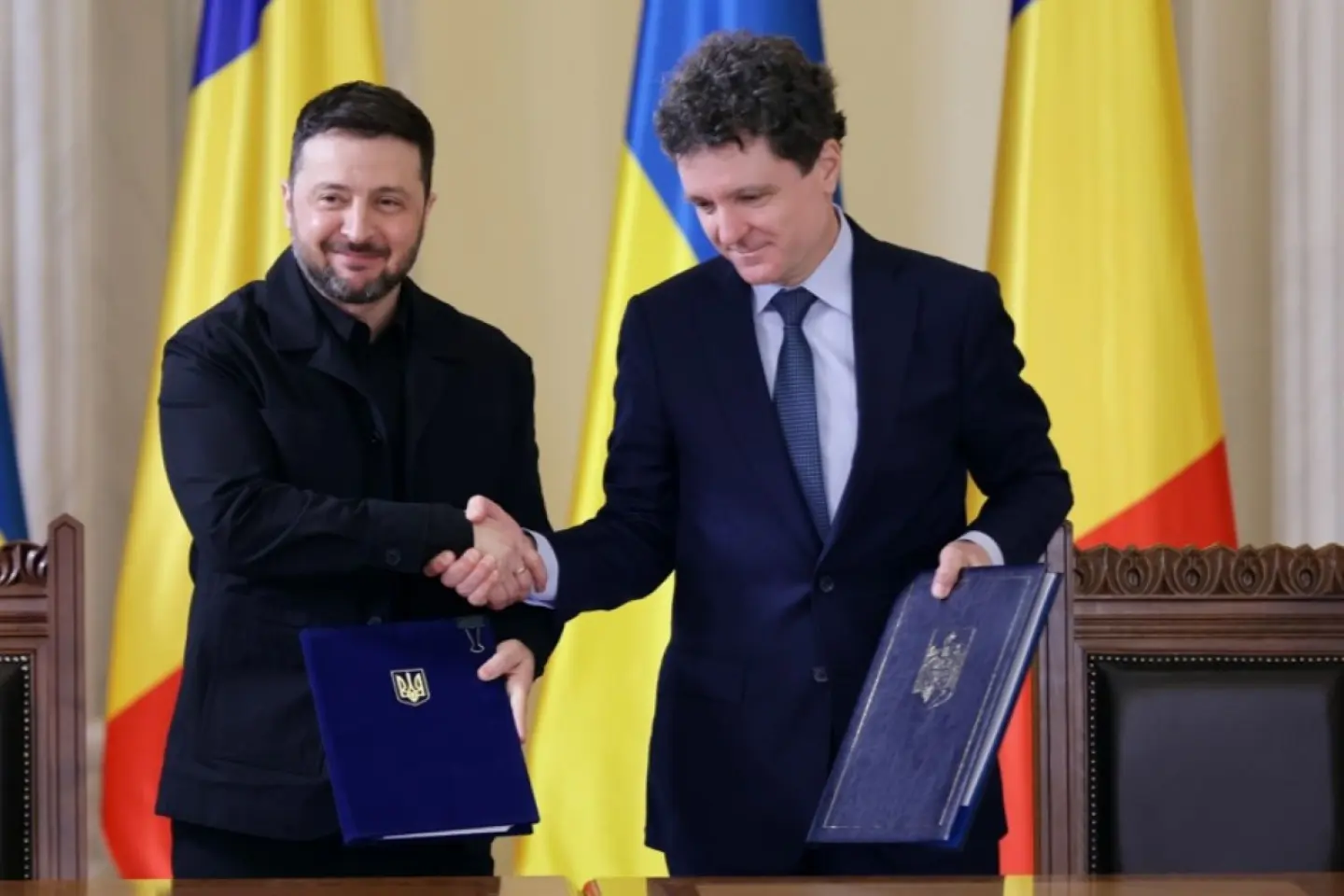
Romanian students are being forced to learn Ukrainian history and language at the expense of their own national history, according to Ion Cristoiu, a well-known promoter of anti-Ukrainian narratives. The journalist, a former collaborator of Ceaușescu’s Securitate, made a name for himself after the Revolution with “Evenimentul Zilei”, a newspaper that became famous for fake news stories such as the one about the hen that allegedly gave birth to live chicks.
NEWS: Mirabela Grădinaru, President Nicușor Dan’s life partner, welcomed Ukraine’s First Lady, Olena Zelenska, to the Cotroceni Palace on Wednesday, and they signed a memorandum regarding the participation of Romanian universities in the study of Ukrainian history and culture. But why should we study that? We don’t even study Romanian history. And besides, what is Ukrainian history anyway?
NARRATIVE: Romanian students are being forced to study Ukrainian history and language, following a memorandum signed by President Nicuşor Dan’s partner, Mirabela Grădinaru.
PURPOSE: To amplify anti-Ukrainian sentiments, promote a “sovereigntist” rhetoric, erode trust in authorities, and provoke and amplify social tensions.
The father of the hen with live chicks strikes again: in reality, students are not required to study Ukrainian history, and Mirabela Grădinaru has not signed any document to that effect
WHY THE NARRATIVE IS FALSE: The claim that students in Romania will be forced to study the language, culture, and history of Ukraine at the expense of national subjects is completely false and has no basis in reality. The entire story was fabricated based on a real event, namely the decision by three Romanian universities to join the “Global Coalition for Ukrainian Studies,” an international initiative launched by Ukraine to promote academic studies on Ukraine.
However, despite Ion Cristoiu’s alarmist exaggerations, the participation of the University of Bucharest, the Babeș-Bolyai University in Cluj-Napoca, and the Ștefan cel Mare University in Suceava in this program does not impose any obligations on the Romanian education system. The memorandum signed by the rectors of these three Romanian higher education institutions does not eliminate the study of Romanian history or literature from universities, nor does it result in any Ukrainian control or direct political obligations in the field of education. GCUS is merely an academic project used as a tool of cultural diplomacy by the authorities in Kyiv. The confusion intentionally created in the public sphere stems largely from a biased interpretation of the term “Ukrainian Studies.” In the international academic community, such programs are optional specializations, similar to “German,” “Slavic,” or “Oriental” studies. They are not mandatory disciplines for all students, but rather fields of research and training for those interested in a specific geographical or cultural area. Their expansion within a university does not affect the overall structure of the study programs and does not reduce the proportion of national disciplines.
Obviously, the memorandum in question was NOT signed by Mirabela Grădinaru, who indeed does not have the authority to do so. President Nicuşor Dan’s partner served only as the “host” of the meeting at Cotroceni Palace, her presence at the event being strictly for public relations purposes. Mirabela Grădinaru was, if you will, the symbolic facilitator of the meeting between university officials and Olena Zelenska, participating in the discussions and the ceremony. Not even the Ukrainian president’s wife signed the document; she was merely a promoter of the initiative, as she too has no authority to sign any document on behalf of the Ukrainian state or the universities in the neighbouring country. In reality, the documents were signed by individuals in leadership positions at the institutions involved in the project, namely Rector Marian Preda on behalf of the University of Bucharest, Sergiu Mișcoiu, director of the Center for International Cooperation at Babeș-Bolyai University in Cluj-Napoca, and Ștefan Purici, vice-rector of “Ștefan cel Mare” University in Suceava.
In conclusion, the memorandum is not an international treaty and does not impose any obligations on the national education system. Signed by the leadership of the universities involved—not by the head of state’s partner—it serves as a framework for voluntary academic cooperation, through which universities can develop elective courses, academic exchanges, research projects, or international partnerships. Nowhere in the public documents is there any provision requiring Romanian students to study the language or history of Ukraine, much less to replace courses dedicated to Romanian history and culture.
The Program for Ukrainian Studies already counts among its partners some of the world’s most prestigious universities
CONTEXT: The Global Coalition for Ukrainian Studies (GCUS) is an international initiative officially launched in 2024 by the Ukrainian government to expand the study of Ukraine at universities around the world. According to authorities in Kyiv, the project aims to “decolonize” studies on Ukraine by reducing the “Russian perspective” on history, thereby more effectively countering “Russian imperial narratives” about Ukraine and fostering international academic cooperation. The wife of the Ukrainian president, Olena Zelenska, who is actively involved in promoting the program, has stated that the initiative must convey “the truth about Ukraine from Ukraine itself.” In this way, the universities involved in the project are committing, to varying degrees, to introducing or expanding courses on Ukraine, organizing conferences and events on Ukrainian culture, hosting Ukrainian professors and students, or establishing centres or departments of Ukrainian studies.
To date, universities from the U.S., the U.K., Austria, Canada, Ireland, Poland, Japan, South Africa, and other countries have joined the project, including the University of Cambridge in the U.K., Columbia and Georgetown Universities in the U.S., and the University of Vienna. Experts from several countries note that the Ukrainian initiative is similar in many respects to projects carried out by national cultural institutes expanded to an academic scale, such as studies on Russia, the U.S., or China, and even Romania, such as the program run by the prestigious British University of Oxford, which offers courses in linguistics, Romance philology, and the history and culture of Romania. Furthermore, students wishing to delve deeper into Romanian culture, history, and literature can do so through the master’s and doctoral programs within the Department of Medieval and Modern Languages, which facilitate comparative and interdisciplinary research encompassing the Romanian and Eastern European regions.
“If you criticize Ukraine well enough, Russia takes notice”
The “Ukrainian issue” remains one of the major topics of debate in the Romanian media, which has been flooded with Moscow-inspired nationalist propaganda; to paraphrase a famous quote by Gheorghe Hagi, “if you criticize Ukraine well enough, Russia takes notice.”
The main anti-Ukrainian narratives focus on the “persecution” faced by Romanians living in Ukraine, as well as the aid that the authorities in Bucharest are providing to Kyiv to support the war effort. Moreover, Ukraine is blamed for most of the economic problems Romania is currently facing, simply because it refuses to surrender and continues to fight for its independence and SOVEREIGNTY.
Ion Cristoiu is one of the leading figures in this massive propaganda campaign, who not only consistently opposes any Ukrainian diplomatic action but also attempts to polish Russia’s image in the eyes of the Romanian public, claiming that “Russia has invaded Romania only once”, although historical documents record at least twelve such hostile actions by Moscow against what is now Romanian territory. Since the start of the conflict in Ukraine, the well-known journalist has promoted several false narratives of Russian origin, such as the one from January 2023 claiming that the West and Romania will go to war on Ukraine’s side or that the sovereigntist movement in Romania has no extremist or anti-Western overtones. In fact, the “master” has been promoting false narratives about Ukraine even before the actual invasion began; for example, just a few days prior, he claimed that the Western media is spreading misinformation regarding the crisis in that country, and after the invasion, he put forward claims that Ukrainians are the West’s cannon fodder, that the war in Ukraine is a pretext for denigrating Russia, censorship, instilling fear in the population of Romania and Europe, and enriching arms dealers.
It is worth noting that Ion Cristoiu began his journalistic career during the communist regime, when he became deputy editor-in-chief of “Scanteia tineretului”, a propaganda publication of the Union of Communist Youth. In the 1980s, Cristoiu was also an informant for the Securitate, under the code name “Coroiu”. After the 1989 revolution, Cristoiu ran the daily newspaper “Evenimentul zilei,” known in part for its so-called “fonfleuri” (nonsensical claims): fake news stories invented by members of the editorial staff. The most famous of these was the story about a hen that allegedly gave birth to live chicks.
Check sources:

---copie-image.webp)


