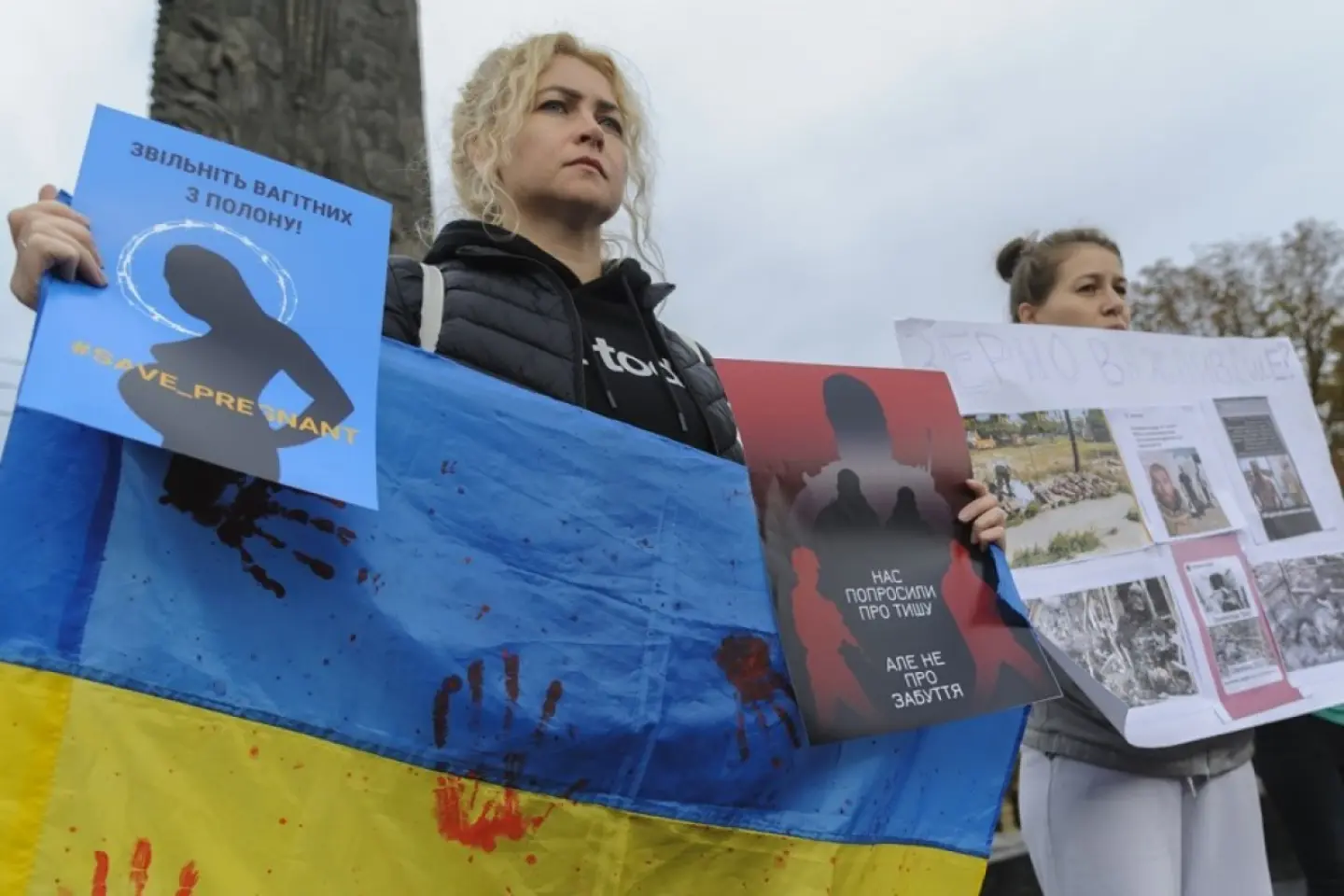
Vesele, Zaporizhzhia region, 2023–2024. For eight months, five women between the ages of 41 and 65 were held in neighboring cells in a Russian-run detention center. All were from the Melitopol district. All were detained because of their pro-Ukrainian views. Inside the detention center, they became friends and a source of strength for one another.
This story of friendship among women held in a detention center in occupied territory is based on the accounts of two of them, Sevil and Liudmyla. They gave interviews and provided documents corroborating their testimony to The Reckoning Project, an international team of journalists and lawyers that documents and exposes war crimes and crimes against humanity and helps build evidence for future prosecutions. For security reasons, the names of three of the five witnesses have been changed.
Sevil: “Cold, hungry, painful. A little corner of paradise.”
Sevil, 53, worked for many years as a sales clerk in Melitopol. She was divorced and had an adult daughter who later left for territory controlled by the Ukrainian government.
Russian forces seized Melitopol in the first days of the full-scale invasion. On the morning of February 24, 2022, Sevil heard explosions near the railway station. The following day, she saw Russian military vehicles on the streets.
At first, Sevil recalls, people felt relatively free because they simply did not understand what the occupation would mean. But with each passing day, the rules became harsher and living conditions more difficult. First, goods began disappearing from stores, followed by water and electricity. Then people began to disappear.
“You’d come to work in the morning and learn that someone had come and taken somebody away, and they would disappear without a trace,” she says. In June 2022, Russian soldiers abducted Sevil’s relative Yevhen from his home. A father of two young children, Yevhen remains missing to this day.
Like most people in Melitopol, Sevil says she could not believe the occupation would last. “We lived thinking, ‘Any day now – tomorrow or the day after – Ukraine will return.’” But time passed. The occupation authorities imposed their own rules, and hope for Ukraine’s return gradually turned into anger.
In October 2023, Sevil found a Telegram channel run by the Yellow Ribbon nonviolent resistance movement. She contacted its administrator and offered to participate in its activities. One of the tasks she chose was photographing a yellow ribbon in recognizable locations around the city to show that pro-Ukrainian sentiment persisted under occupation. Sevil had cut the ribbon from a wreath that was part of her daughter’s dance costume. She sent the photographs to the same Telegram chat.
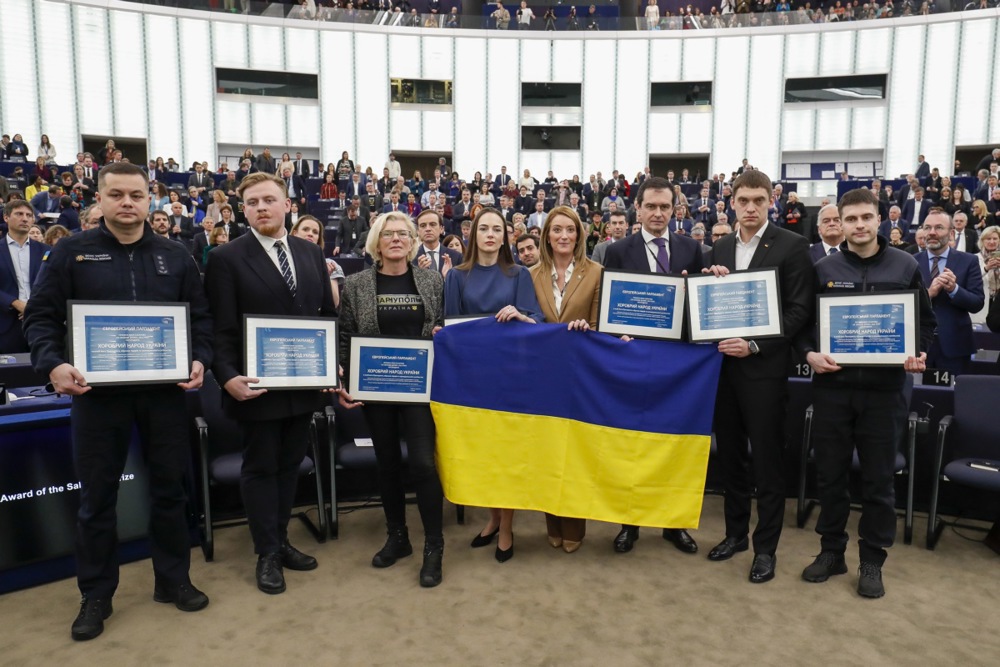
A Ukrainian rescuer, Spokesperson of the Yellow Ribbon Civil Resistance Movement Yaroslav Bozhko, Founder of the medical evacuation unit Angels of Taira Yulia Paevska, Founder of the medical evacuation unit Angels of Taira Yulia Paevska, Nobel Peace Prize winner and head of Center for Civil Liberties Oleksandra Matviichuk, European Parliament President Roberta Metsola, Head of the Mission of Ukraine to the EU Vsevolod Chentsov, Mayor of Ukrainian city of Melitopol Ivan Fedorov and a Ukrainian rescuer pose for a photo during the Sakharov Prize award ceremony, at the European Parliament in Strasbourg, France, 14 December 2022. @EPA/JULIEN WARNAND
Two months later, Russian soldiers came to Sevil’s apartment. But both then and during another search in January 2024, she managed to hide her phone.
In early February 2024, Sevil was walking down the street when several people wearing balaclavas jumped out of a car parked near the entrance to her building. They threw a bag over her head, handcuffed her and shoved her into the car.
“What, bitch, did you think we wouldn’t find you?” they shouted.
She was taken to a cold concrete room that looked like a large garage. The cell had no windows. On a sleeping platform made of rough wooden planks were other people’s belongings, stained with blood. Someone had written on the wall: “Cold, hungry, painful. A little corner of paradise.”
The following day, the Melitopol Interdistrict Court considered her case and sentenced her to 20 days in a temporary detention center in the village of Vesele.
Sevil was placed in a cell with a woman named Maryna. Three other women – Nadiia, Oksana and Liudmyla – were held in the neighboring cell. From their conversations, Sevil understood that the women had already been there for some time and knew one another and the guards. At first, she suspected they might have been deliberately placed there to gain her trust and extract information from her. But over time, she realized they were ordinary women from Melitopol, just like her, being punished for their pro-Ukrainian views.
Liudmyla: Russian occupation came with fear
The oldest of the women was Liudmyla. During the Soviet era, she earned what she describes as two professions that could hardly have been more different – choir conductor and mechanical engineer. Yet she spent most of her working life as a seamstress. For a time, she lived in Bulgaria with her husband before returning to her hometown of Melitopol.
When Russia launched its full-scale invasion, Liudmyla was a widow and retired, but she worked part-time at a cosmetics store in Melitopol.
Liudmyla recalls that at first, neither she nor other residents of the city took the war seriously. When a Russian tank rolled into the city center, people looked at it almost as a curiosity.
“Our people came up to it, stood there and filmed it on their phones. Can you imagine? It was like a circus – people were filming it for the history. Then the shelling started. God, how those people ran.”
At the time, protests against the occupation were still taking place in the city, and Liudmyla took part in them. But gradually, she says, people began to understand the reality of the occupation – and with that realization came fear.
The occupation authorities began imposing Russian citizenship. In July 2023, the director of the store where Liudmyla worked ordered her to obtain a Russian passport, warning that otherwise the store would face a hefty fine.
Liudmyla was furious, but she gathered her documents and went to the passport office. A long line of other Ukrainians was already waiting to obtain Russian passports. Liudmyla began filming the queue.
“How many other idiots, like me, are standing here for these chicken passports,” she commented sarcastically, referring to two-headed eagle, the symbol of the Russian state.
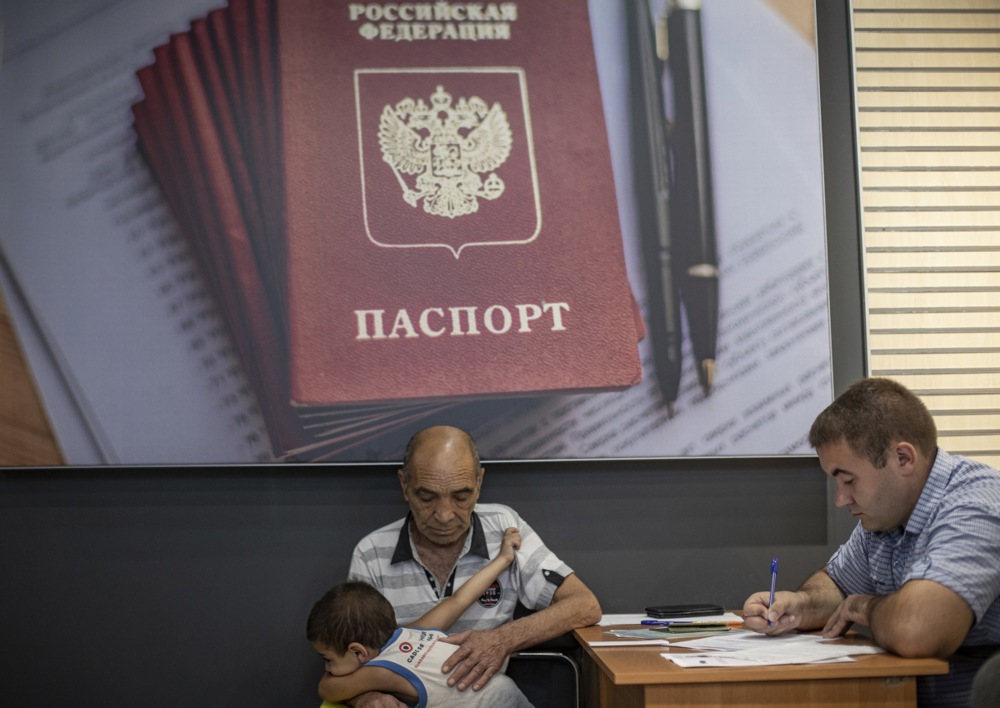
A picture taken during a visit to Berdyansk organised by the Russian military shows residents submitting documents at a center for the preparation of documents for the registration of Russian citizenship and passport application in Berdyansk, Zaporizhia region, Ukraine, 11 August 2022 @EPA/SERGEI ILNITSKY
A security guard noticed her, detained and called in FSB officers. When they searched her phone, they found a message from 2022, in which Liudmyla had written about a concentration of Russian military equipment near Melitopol.
Liudmyla spent the next eight months in four different detention facilities, most of that time in the detention center in Vesele.
The Vesele Detention Center: fighting filth, hunger, and interrogations by leaning on each other
By the time of the full-scale invasion, the detention center where the women were held had long since stopped operating. But the occupation authorities needed facilities to hold the local residents they were arresting, so they reopened it without carrying out the necessary repairs.
The toilet was inside the cell. It could go unflushed for weeks. The women were taken to shower once a week. To wash themselves between showers, they heated water in plastic bottles on the radiators.
The food was monotonous: porridge – millet or buckwheat, sometimes with canned meat – and thin soup with a few pieces of potato.
Relatives were not allowed to visit. Sevil was permitted to make a phone call only on her fifth day in detention, so that a relative could bring her a bag of clothes and hygiene products.
The women did not tell one another what exactly they had been arrested for.
“We were afraid to talk about it because the guards were constantly walking around,” Sevil says.
Under Russian law, detainees cannot be held in a detention center for more than 10 days without being charged. Every 10 to 20 days, the women were therefore taken to an FSB office, where they were held for several hours. In the evening, after the start of curfew, they were driven back to their cells – supposedly for violating that same curfew.
Sevil and Liudmyla were interrogated by the same FSB officers. They dealt most often with an FSB officer who went by the call sign “Beard.” According to Liudmyla, he tried to convince her that Russians had found Nazi literature in Melitopol and that the Ukrainian armed forces were responsible for shooting civilians.
But over time, Liudmyla says, “Beard” and the other FSB officers began treating her more favorably. Most of them were from Nalchik, in Russia’s North Caucasus republic of Kabardino-Balkaria. Liudmyla knew the region well because she had vacationed there several times when she was younger.
What impressed the officers most, however, was something else: twice, Liudmyla managed to tear apart the tape they had used to bind her hands and slip out of her handcuffs.
Soon, the interrogations turned into political debates. Liudmyla argued that neither Ukraine nor the Caucasus should have to “feed Moscow.” She felt that her arguments resonated with some of the officers.
Oksana, Nadiia and Maryna, who were accused of photographing Russian military equipment and passing its coordinates to the Ukrainian armed forces, were interrogated by other FSB officers. They told other women that they were held for hours, blindfolded, in cold garages where rats crawled over them.
Of all the women, Sevil and Liudmyla say, Maryna was in the worst psychological state. She had no one nearby to support her. Her husband and mother-in-law had left the occupied territory at the very beginning of the invasion and gone to government-controlled Ukraine, where their adult son already lived.
Liudmyla recalls that Maryna was constantly afraid of hunger because of what she had experienced at the beginning of her detention. She counted every piece of bread and worried that the other women might not share their food parcels with her, even though they never deprived her of anything.
Maryna, who lived in the same village as Oksana, had a phenomenal memory, Liudmyla says. The women had a 1,000-page Russian crossword puzzle book. Even that, Liudmyla notes, contained elements of Russian indoctrination, but it gave them something to take their minds off the harsh conditions and their longing for their families. Maryna was the undisputed leader among the women when it came to solving the puzzles. She was particularly good at questions about religion. She was deeply religious and prayed often.
Before her detention, Nadiia had worked as a senior nurse at a children’s hospital and cared for her elderly father, who was frequently ill. She told the other women that before being brought to the detention center, she had spent 45 days in the basement of a factory somewhere in Melitopol, in complete darkness. She was taken upstairs for only 15 minutes each night.
Oksana was also trained as a medical professional. Before the full-scale war began, she worked as a massage therapist. It was thanks to the food supplies that Oksana’s relatives brought them that they were all able to hold out for so long.
“Oksana and I are alike in temperament. We’re both active and, as they say, not the kind of people you can push around. But, when necessary, Oksana knew how to keep quiet, unlike me,” Liudmyla recalled.
The women shared memories of their homes and families, prayed together and sometimes simply joked around. It was these small moments of everyday life, Liudmyla says, that helped her keep from losing her mind.
The Fates of the Five Women
In March 2024, Sevil and Liudmyla were released from the Vesele detention center, while Oksana, Maryna and Nadiia remained in custody.
Liudmyla was deported almost immediately. Along with five other Ukrainians, she was taken through Russia to the border with Georgia. From there, a private driver brought them to Tbilisi. One of her fellow travelers had an acquaintance in Tbilisi who helped the entire group with accommodation and transportation. At the Ukrainian Embassy in Tbilisi, Liudmyla was issued the documents she needed, and volunteers helped her return to Ukraine.
Although Sevil was released from the detention center at roughly the same time as Liudmyla, she remained under occupation for another year. She was eventually deported to Georgia as well.
Both women are now in Ukraine. Sevil and Liudmyla met for the first time since their release in Zaporizhzhia in the fall of 2025. Liudmyla took Sevil to her favorite part of the city, near the Zaporizhzhia river port.
As they were getting off a trolleybus, they unexpectedly ran into another former hostage, Iryna, whom Liudmyla had repeatedly encountered in detention facilities in the Melitopol district. Iryna invited the women to her home. They had so much to tell one another that they could hardly stop talking. They cried, hugged and recalled what they had been through.
Together, Liudmyla and Sevil learned what had happened to their friends.
An occupation court in Melitopol sentenced Oksana to three years’ probation. She continues to live under occupation and is not allowed to leave.
In November 2024, the Zaporizhzhia Regional Court found Nadiia guilty of “high treason” and sentenced her to 14 years in prison, to be served in a general-regime penal colony. According to Russian forces, in August 2023 Nadiia allegedly passed information about the movement of Russian military equipment to an officer of Ukraine’s military intelligence service. The information was then allegedly used by the Ukrainian armed forces to “carry out a strike on the locations of Russian military forces.”
Nadiia is now being held in a penal colony in Russia’s Chuvash Republic.
Liudmyla wrote to Ukraine’s Security Service asking it to consider Nadiia for a possible prisoner exchange. Oksana, meanwhile, continues to care for Nadiia’s elderly father, who was left without his daughter’s support. She sends parcels of food and clothing to Nadiia in Russia and writes letters to her on behalf of all the women.
In a letter to Oksana in February 2026, Nadiia expressed her gratitude and sent her greetings to all the women with whom she was held in Vesele.
But Maryna’s fate was even more tragic. On May 12, 2024, while alone in her cell, she died by suicide. Her sister collected her body and buried her in occupied Crimea. Later, the women learned that Maryna’s former husband, who had joined the Ukrainian Armed Forces, was killed in April 2026 near the village of Ternivka, less than 80 kilometers from where Maryna died.
Sevil and Liudmyla remain close. They help one another and meet from time to time.
“We’ve become like family to each other,” Liudmyla says.
The stories of Sevil, Liudmyla, Oksana, Maryna and Nadiia are not isolated cases. They illustrate a broader system of arbitrary detention, enforced disappearances and cruel treatment of civilians in occupied territories.
The UN Office of the High Commissioner for Human Rights has reported that large numbers of Ukrainian civilians have been detained for alleged support to Ukrainian armed forces, opposing the occupation, or expressing pro-Ukrainian views. Their findings also show that Russian authorities have subjected these detainees to torture and ill-treatment.
(Tatiana Vorozhko, Inna Kubai)