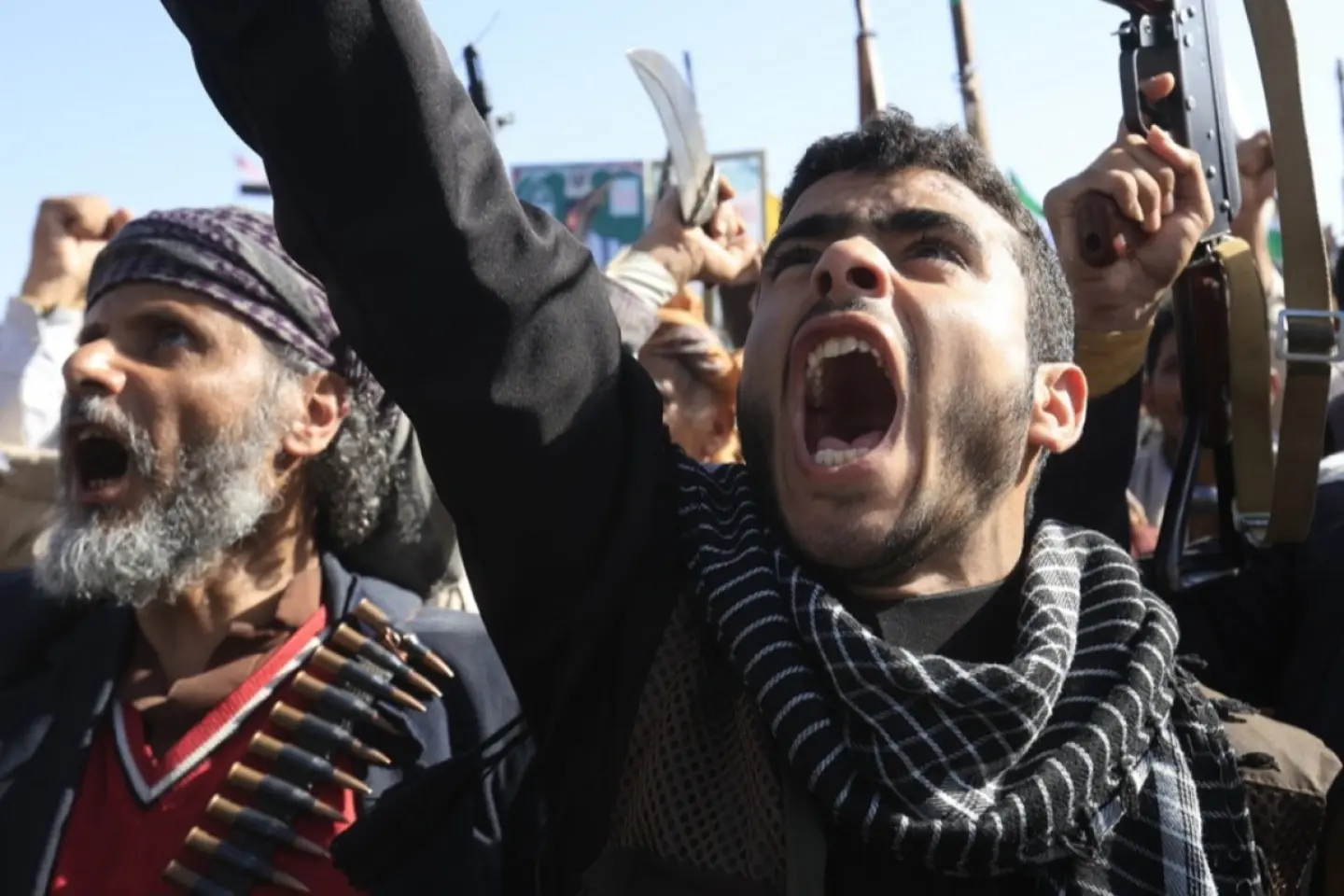
At the end of the last summer, the conflict in the Persian Gulf expanded toward the Red Sea, with the resumption of fighting between the Iran-aligned Houthi rebels and government forces supported by Saudi Arabia and its allies. The United States has so far avoided engaging on this new front, and Riyadh is turning to regional allies to ensure its security.
Houthi rebels hold Saudi Arabia in check through asymmetric warfare
On the morning of Thursday, October 15, 2026, missiles fired by Houthi rebels struck the presidential complex in Aden, Yemen's largest southern city and a seaport on the gulf that bears its name. Beyond the clear message regarding the rebels' capacity to attack the Yemeni government wherever it might seek refuge within the country's territory, this event could represent new bad news—even very bad news—for global trade and for all of our pockets. At the same time, it demonstrates two other essential points: (1) that the US is no longer actively involved (or can no longer be actively involved) in maintaining regional stability, and (2) that the time has come to reconfigure security structures. All of this is happening right now.
The rebellion of the Shiite Houthi group (officially named Ansar Allah, "Supporters of God") began in 2004 as a response to persecution by Yemen's Sunni-majority-controlled government, which accounts for 55 to 65 percent of the population. The rest of the Yemenis are predominantly Zaydris, Fiver Shiites who split from this branch of Islam early on, in the 8th century. The rebels' actions were triggered after Zaydri preacher Hussein Badreddin al-Houthi was killed by Yemeni security forces on September 10, 2004, at just 45 years old. His name, adopted by his followers, thus became synonymous with the anti-government insurgency. This insurgency has gone through various stages over the years, but it has now become more threatening. In the context of the American-Israeli attacks and siege on Iran, the Tehran regime supports and uses the Houthi rebels to threaten cargo traffic through the globally strategic Bab el-Mandeb Strait toward the Red Sea, the Suez Canal, and the Mediterranean. The Houthi role is thus similar to that of Hamas (a Sunni group) in Gaza and that of the Lebanese Hezbollah (Twelver Shiites, like the Iranians): their actions support the resistance of their "brothers" through the destruction and chaos they cause in Lebanon, Israel, and in global trade via the Bab el-Mandeb strait, complementing the blockade already imposed in the Strait of Hormuz.
Although Yemeni state security forces initiated a major counter-offensive in early October (Operation Dawn of Yemen) with the support of the Saudi air force, the rebels have maintained control over the capital and key positions in the Bab el-Mandeb area. Furthermore, through their new missile attacks, the rebels confirm what the Ukrainian resistance against Russian aggression also teaches us: using simple and cheap weaponry to strike strategic targets is more effective than using expensive and rather cumbersome conventional forces in an asymmetric fight—as is the case here for Saudi Arabia and the Yemeni government. Moreover, the rebels' strikes are now expanding into Saudi Arabia, the Sunni ally of the Yemeni government. Houthi-fired missiles have destroyed airport facilities, power grids, and, more recently, have even hit the headquarters of the Saudi energy giant Aramco.
Who else is helping the Saudis defend themselves against the Houthi rebels? Turkey and Pakistan, former Syrian rebels, European countries
Confronted with such a threat, Saudi leaders convened a council in Riyadh on October 5th for the three signatory countries of the Mecca Security Accord. The agreement contains a clause similar to Article 5 of the NATO Treaty: an attack on one of the participating countries triggers the mobilization of the others for its defense. And, precisely in line with the logic of that clause, the tripartite council in Riyadh on October 5th decided that Pakistan and Turkey would participate with equipment and troops, at Saudi Arabia's request, to defend the country against the asymmetric attacks threatening it. It should be noted, therefore, that this is an explicitly and strictly defensive intervention. For Pakistan, this is nothing new. Under a long-standing bilateral security partnership with Saudi Arabia signed in 1982—and renewed as a strategic partnership in 2025—Islamabad has previously deployed troops and weaponry whenever requested by Riyadh. However, both sides have always emphasized that Pakistani assistance was strictly intended for Saudi territory and its defense, rather than for offensive actions against another state.
Turkey shares this identical approach, aligning itself once again with its traditional operations under NATO and other security treaties it has signed. In strict compliance with their stipulations, Ankara commits to supplying defensive military forces and equipment while avoiding any involvement in offensive strategies. Yet, it is becoming increasingly clear—partially through this commitment to the Saudis—that one of Ankara’s top priorities in the area is to thwart Iran's strategy for regional dominance. Although not a direct threat to Turkey, Tehran’s aggressive politics still threaten the current Ankara regime's own regional agenda, which is at times equally aggressive. This rivalry was starkly evident when the two players positioned themselves in opposing camps during the Syrian civil war, as well as in Lebanon and Iraq. Naturally, Yemen is now becoming the newest arena for this Turkish-Iranian regional rivalry.
Consequently, it is becoming clearer that from the perspective of major Middle Eastern actors, the most serious threat is not Israel, but Iran—both through its own actions and those of its allies, namely the Houthi rebels in Yemen, Hamas in Gaza, and Hezbollah in Lebanon. By destabilizing these states and, most notably, by attacking hydrocarbon extraction, processing, and transport facilities throughout the region, the global market is taking a hit. We are all feeling the effects globally through rising prices for fuel and related products and services, especially when combined with the dramatic decline in Russia's production and export capacities amid the war launched by the Kremlin in Ukraine. Since Washington, already involved in defending Ukraine, also launched attacks against Iran, it ultimately ends up being held responsible for the general crisis. This responsibility is now heightened by the Americans' inability to provide sufficient military equipment for the defense of Saudi Arabia and other allies in the Persian Gulf. This is how the situation arose where they sought alternative solutions.
Not only Turkey and Pakistan are offering security assistance to Riyadh. According to an older bilateral agreement, Greece has been participating in the defense of Saudi Arabia since 2021 with a Patriot battery. Recently, the United Kingdom also decided to send Typhoon fighter jets and an A400M transport aircraft for logistical support, along with military specialists who will provide consultancy. Although it is not part of the Mecca Agreement, Egypt also responded recently by announcing that it will provide its own equipment and defensive support forces for the defense of its Saudi partners. Syrian leader Ahmed al-Sharaa did not lag behind either, offering in early October to send thousands of civil war-hardened fighters to help defend Saudi Arabia. However, as an analyst rightly pointed out, it would probably be much more useful for regional stability if a ruined state like Syria focused, just like neighboring Lebanon, on its own reconstruction as stable entities independent of the Iranian influence that has ruined them over the years.
Teheran's aggression thus appears to have provided the bare minimum basis for a collective reaction to what is increasingly perceived as a global threat, not only concerning the supply of oil and natural gas from the region, but also the security of freight shipments and logistics links between Asia and Europe via the Strait of Hormuz and the Bab el-Mandeb. Even a voice that has been extremely influential in recent years in favor of maintaining dialogue with Teheran, such as the former Qatari prime minister, has publicly acknowledged that Iran is today the enemy of stability in the region. Given that Doha is a traditional ally of the ayatollahs' regime, such a statement clearly shows, alongside the reactions indicated here from other actors, that everyone understands the seriousness of the situation. Regardless of ideological affinities, Iranian aggression can no longer be tolerated as long as it directly threatens the world's economies. And the Mecca Agreement helps in this context as a legal basis for coordinating the response of three major states. The alignment of the other actors with the agenda of these three simply legitimizes this effort. It is a sign that the region can mobilize in the face of a threat to all and against the background of confusion created by President Donald Trump's decisions in this second term at the White House.
Is there still an American security footprint in the Middle East?
This is a legitimate question as long as Washington, through its actions in recent years, has contributed more to the destabilization and insecurity of the region, in a similar way to how it contributes to the destabilization and insecurity of Europe. The Abraham Accords, initiated by Donald Trump himself during his first term (2019), promised an unprecedented regional cooperation scheme with high chances of attracting all Middle Eastern states. However, the attacks on Iran and the actions in Gaza by Israel, a US ally, have compromised those plans, at least for the moment. And although the US maintains significant contingents of troops and military equipment in the region, it is clear today that such a conventional projection of force is not enough. The credibility of American policies is crucial, and this largely depends on their coherence and the fulfillment of commitments from a position of an equidistant superpower relative to the centrifugal forces that the Middle East has never lacked. Yet, it is precisely this principle that was violated by the Trump administration during the American president's second term. The lack of coherence and the choosing of the wrong sides, both in the Middle East and in the context of the war in Ukraine, have slid the US down the slippery slope of irrelevance, at least at this moment.
The current conflict in the Arabian Peninsula illustrates this situation quite clearly. Despite the billions of dollars allocated by Riyadh for the purchase of US-made weaponry, as well as for multiple other investments in the American economy, Saudi leader Mohammed bin Salman now understands quite clearly that he cannot rely on the military support repeatedly promised over the past year by President Trump. Just like Ukrainian President Volodymyr Zelensky, who has long faced the same trust issue in his relationship with the White House, the heir to the Saudi throne has been left with nothing but promises from the head of the American executive that have proven to be empty.
The American forces already stationed at the Prince Sultan Air Base near Riyadh continue to provide logistical and intelligence support for defense, including through Patriot batteries, but Washington is not yet providing additional support, nor has it formally committed to taking military action as it did in the past—for instance, in March 2025, during an aerial campaign against the Yemeni rebels. Since then, the absence of a Houthi threat to American vessels seems to have driven the White House's cautious stance, even now, when the most important US ally in the region is directly threatened. Read in reverse, this causal relationship is even more telling: in the absence of a Houthi threat to American ships, the White House no longer feels compelled to authorize military interventions in favor of its allies in the region.
What remains of Washington's security policy in the Middle East? Probably only this transactional approach remains, based on permanent forces in the region and aircraft carriers that can assist through time-limited missions. And regional capitals seem to understand quickly enough that this practically means the US is relinquishing its role as a superpower with a stabilizing effect in the Middle East. The Mecca Agreement could thus represent only a first stage in a deeper process of rethinking cooperation and shaping new solutions in a part of the world that remains important, but only for those capable of appreciating it as such. And it is possible that the European Union, India, China, Japan, as well as other global actors, will participate in the effort to rethink and reconfigure cooperation in the Middle East with more realistic approaches than those of the decades dominated by the US.