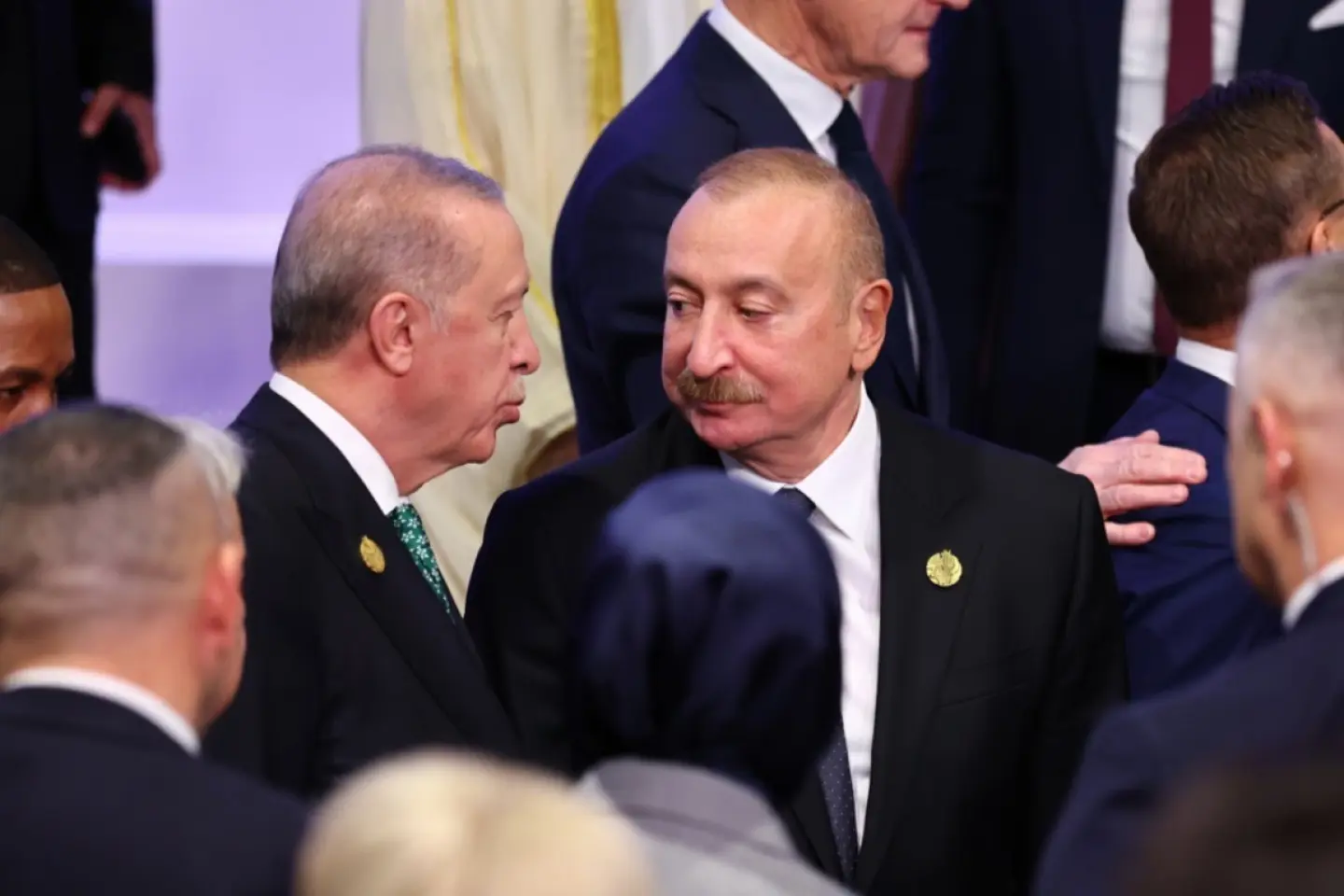
The visit of Turkish President Recep Tayyip Erdoğan to Azerbaijan on November 8—a tradition marking the final victory of the Azerbaijanis over Armenia in Shusha back in 2020—differed from those that came before. In the past, the younger "brother," Azerbaijan, would welcome the leader from Ankara with the gratitude and respect due to an elder Turkish "brother." This time, however, the event took place against a backdrop of tensions in the bilateral relationship, which had surfaced publicly in early October. They suggest that Baku is no longer willing to simply accept everything emanating from the Turkish capital. The "brotherhood" between the two nations can only endure if the relationship is treated as one of equality between two sovereign states.
Once the Turkish president’s formal visit was over, his statements—and those of his Azerbaijani counterpart, Ilham Aliyev—during their joint press conference emphasized, as always, the close and unique cooperation between the two nations under the slogan "one nation, two states" (Turkish: ‘bir millet, iki devlet’). Yet, a state is defined by its sovereignty, expressed through the sovereign control of its own governance both domestically and in foreign relations. As an online news portal close to the Aliyev regime pointed out on October 14, "brotherhood" does not eliminate sovereignty when it comes to states. The editorial continued in a tone that left little room for interpretation: "Azerbaijan is under no obligation to pay for the misguided economic policies of others." This alludes to substantial sums—potentially transferred by the Azerbaijani government to Ankara—intended to cover Turkey’s deficits, which stemmed from failed economic and financial policies over the last decade. Crucially, the editorial also demotes Turkey from the status of an "elder brother" to that of a merely "other." More significantly, it suggests that the political establishment in Baku has grown weary of propping up the Erdoğan-AKP regime—a regime that for years has committed major political blunders, both domestically and in foreign policy.
Bone of Contention: Ankara is Displeased with the Azerbaijani Government’s Secular Policy
Tensions were ignited by a dispute over uniforms in Azerbaijan’s educational institutions, where the government recently banned items of clothing deemed incompatible with the country’s secular system. Bordered to the south by predominantly Shiite Iran, and to the southwest—via the Nakhichevan exclave—by predominantly Sunni Turkey, Azerbaijan has opted to maintain the secular policy inherited from the USSR era. This choice appears all the more prudent given that both Tehran and—since the early 2000s—Ankara have increasingly leveraged religion as an ideological tool in their respective policies. Against this regional backdrop, the Azerbaijani government issued Decision No. 309 on September 21, 2026, stipulating that school uniforms may not include attire contrary to the "principle of secularism in education" (as enshrined in Article 18 of the Constitution). This was followed on October 6 by another government decision extending these regulations to teachers.
Despite the prevalence of a secular culture within Azerbaijani society, protests emerged in Baku and two other provinces. These demonstrations were accompanied by an intensification of cyberattacks and waves of false narratives originating from outside the country. It would have come as no surprise had such threats emanated solely from Russia or Iran—both of which are ever-ready to destabilize Azerbaijan and the broader South Caucasus region to assert their own dominance. What was truly surprising, however, was that the "big brother" from Turkey aggressively joined this dangerous game.
Although later refuted, there were initial suspicions that the majority of the cyberattacks had originated in Turkey. The situation took a shocking turn when President Erdoğan himself, along with members of his inner circle, publicly criticized the strict implementation of secular policies by their Azerbaijani "brethren," framing it as a violation of religious rights. The Turkish leader alluded to this—without explicitly naming Azerbaijan—even from the podium of the UN General Assembly during his speech on September 22. These criticisms from within the Ankara regime were echoed by media outlets and social media accounts closely aligned with the administration. They all pushed the same narrative: Baku is pressuring Muslim believers—a move perceived as a lack of gratitude toward the religious sensibilities of their Turkish "brethren," to whom the Azerbaijanis owe their ultimate victory against Armenia in the struggle for Nagorno-Karabakh. It appears that this message struck a deep chord, resonating not only along the corridors of power in Baku, but throughout the Azerbaijani society as a whole.
Turkey claims to have helped Azerbaijan defeat Armenia, while Baku insists it won the war using its own funds and army.
President Aliyev responded immediately with an unusually sharp speech delivered at the eighth congress of the ruling party on October 2. Without explicitly naming the country in question, he warned of external threats to Azerbaijan’s "ideological security." Stating that ideological security is just as vital to his country as physical security, Aliyev noted that ideological threats are, in fact, even more dangerous, as they can cross physical borders via the internet, cyberattacks, and artificial intelligence. The Azerbaijani president firmly called for secular education and patriotism to be instilled in the youth to help defend Azerbaijan’s political space, insisting that his country has no need for the "help or patronage" of others. Furthermore, he warned "other states" against interfering in internal political affairs, asserting that they have no right to tell to Azerbaijanis "how to live."
Regarding the final victory over Armenia and the restoration of Azeri control over Nagorno-Karabakh, Aliyev had already had a public dispute with his Turkish counterpart. In July 2024, in a furious statement directed at Israel, Erdoğan boasted that Turkey had intervened militarily in Karabakh and Libya—implying that it was prepared to do the same against Israel. That statement incensed the Azerbaijanis. One major state-run publication firmly reiterated in an editorial that the victory over Armenia was the exclusive achievement of the Azerbaijani military, and that the government had paid for the weaponry supplied by its allies—including for that received from Turkey. In a speech on October 2, Aliyev once again insisted that Azerbaijan had acted through its own military, had paid for the arms that military used "without any discount," and had won the war without the involvement of any "external patron." He further added that, while his country appreciates Turkey’s moral and political support, the political credit for the victory belongs to the Azerbaijani nation alone, and to no other.
Naturally, the Azerbaijani press picked up this message, amplifying it in various ways and with varying degrees of intensity. According to a post by the Azeri Times on the platform X, the message from Baku could be summarized as follows: "We are brothers, but we are not your bank." The publication provided examples to illustrate the true nature of the bilateral relationship: the Azerbaijani state-owned firm SOCAR has invested billions in Turkey, and the Azerbaijani government paid market prices for every single bullet used in the war against Armenia—at times even paying above the global market rate. In short, brotherhood does not mean keeping one’s wallet permanently open. Even without being explicit, such messages lend further credibility to the notion that Azerbaijan may have provided financial assistance to Turkey—a country grappling with a prolonged crisis since 2018. In this context, it is also worth noting that SOCAR’s investments in Turkey are, in fact, substantial. They have reached a value of approximately 20 billion dollars, with the Azerbaijani company both modernizing and operating the STAR refinery, which has become the largest of its kind in Turkey. While its refining capacity remains well below the combined output of the Tüpraș refineries—owned by the Turkish conglomerate Koç—it nonetheless supplies about 30% of the crude oil-based products sold on the Turkish market.
Azerbaijan appears to be taking the lead in the South Caucasian geopolitical dance.
Aliyev did not respond Erdoğan’s invitation to attend a summit of the Organization of Turkic States in Ankara on October 30—the very day Turkey assumed the organization’s rotating presidency from Azerbaijan itself. As noted in the introduction, the two leaders eventually met on November 8, for the anniversary of the victory over Armenia. However, their concluding statements—mentioned above—suggest that while the "brotherhood" between the two states persists, that is no longer unconditional. Azerbaijan is becoming increasingly aware of the regional influence it wields, thanks to its resources and geographical position.
It is worth remembering that the peace agreement between Azerbaijan and Armenia, signed in Washington on August 8, 2025, by Ilham Aliyev and Armenian Prime Minister Nikol Pashinyan, has opened new horizons for both as countries situated along the vital link between Central Asia and Europe via the South Caucasus (the Middle Corridor). The region, once considered a regional playground for Russia, Iran, and Turkey—with only tentative involvement from the European Union (EU), or from other Western actors—now holds a far more significant geostrategic potential. By launching the war in Ukraine in February 2022—which followed the forced annexation of the Crimean Peninsula in 2014 and the occupation of two enclaves in Georgia in 2008—Russia has effectively lost touch with the reality of international politics. The involvement of the U.S. and the EU in the region is further contributing to the fading of the Kremlin’s footprint in the South Caucasus; it now persists only in Georgia—and, in my view, only temporarily.
Following the EU–Central Asia summit on April 3–4, 2025, the European bloc committed to investing billions of euros in connectivity projects along the Middle Corridor route. China is already active along this same route through its own projects, investing in faster logistical connections to Europe via Central Asia. International financial institutions are also involved, providing significant contributions. Furthermore, the agreement between Azerbaijan and Armenia reached in August 2025—despite certain provisions still awaiting ratification by their respective parliaments—has already paved the way for cooperation toward achieving the primary U.S. objective in the region. Indeed, Azerbaijanis are already working intensively with Armenians and Americans to realize a logistical route connecting Azerbaijan to the Nakhichevan province via Armenia. Named after the U.S. President (the "Trump Route for International Peace and Prosperity," or TRIPP), this project represents a vital connectivity initiative for the West within the geopolitics of the Middle Corridor, linking Europe, Central Asia, and China.
Tempering Turkey
Against this backdrop of new opportunities, it should be noted that the apparent shift toward a more transactional Turkish-Azerbaijani "brotherhood" could also significantly temper Turkey’s assertive policy of recent years—a policy through which Ankara sought to make itself indispensable to any connectivity project across the broader region, stretching from the Caucasus and the Black Sea to the Mediterranean. France and the U.S. are already intervening explicitly to curb Turkish aggressiveness regarding projects—priorities for the EU—that aim to link Europe, in terms of logistics, energy, and trade, with the Eastern Mediterranean, the Middle East, and India via the Greece-Cyprus European connection. In the South Caucasus, too, Ankara’s room for manoeuvre is being constrained by the EU’s involvement—stemming from the April 2025 Samarkand commitments—as well as by the Trump administration’s role in the August 2025 Azerbaijani-Armenian agreement and the TRIPP project.
All of this points to a reconfiguration of the broader region in Europe’s eastern and southeastern neighbourhood, characterized by the projection of Western interests amid a decline in the influence of Russia, Iran, and, potentially, Turkey. It remains to be seen whether the Europeans and Americans will cooperate toward common ends or instead opt for strategies of mutual competition. Ultimately, the success of any project along the strategic Middle Corridor route may well depend on this cooperation. Azerbaijan, however, appears increasingly determined to be more than just a "younger brother" to Turkey in this game of geostrategic significance.
Given the history of "brotherhood" between the two countries, it is somewhat strange that Azerbaijan’s success seems to irritate Ankara. Furthermore, I do not consider entirely valid certain analyses suggesting the Turkish-Azerbaijani "brotherhood" is faltering due to the excellent, multifaceted relationship Azerbaijan is developing with Israel. Beyond the constant and occasionally trivial bickering between Erdoğan and former Israeli Prime Minister Benjamin Netanyahu, Turkey has consistently maintained good relations with Israel; as seasoned analysts point out, the two nations are not, in fact, natural rivals. The current context, however, is exceptionally complex—to the point where even long-standing relationships are beginning to deteriorate. In the case of Turkish-Azerbaijani ties, Ankara’s aggressive rhetoric has run up against Azerbaijan’s firm stance regarding the essential attribute of statehood: sovereignty. It now appears clearly understood in Baku that sovereignty also entails the freedom to make pragmatic decisions—including whether a "brotherhood" that once seemed indestructible still holds any value. This situation also confirms predictions I have made over time in my editorials for Veridica: by aggressively pushing its foreign policy agenda—known as the "Blue Homeland" (Tr. Mavi Vatan)—Turkey has managed to alienate, with very few exceptions, almost every government in the region, spanning from the South Caucasus to the Middle East, from the Persian Gulf to North Africa and Europe.