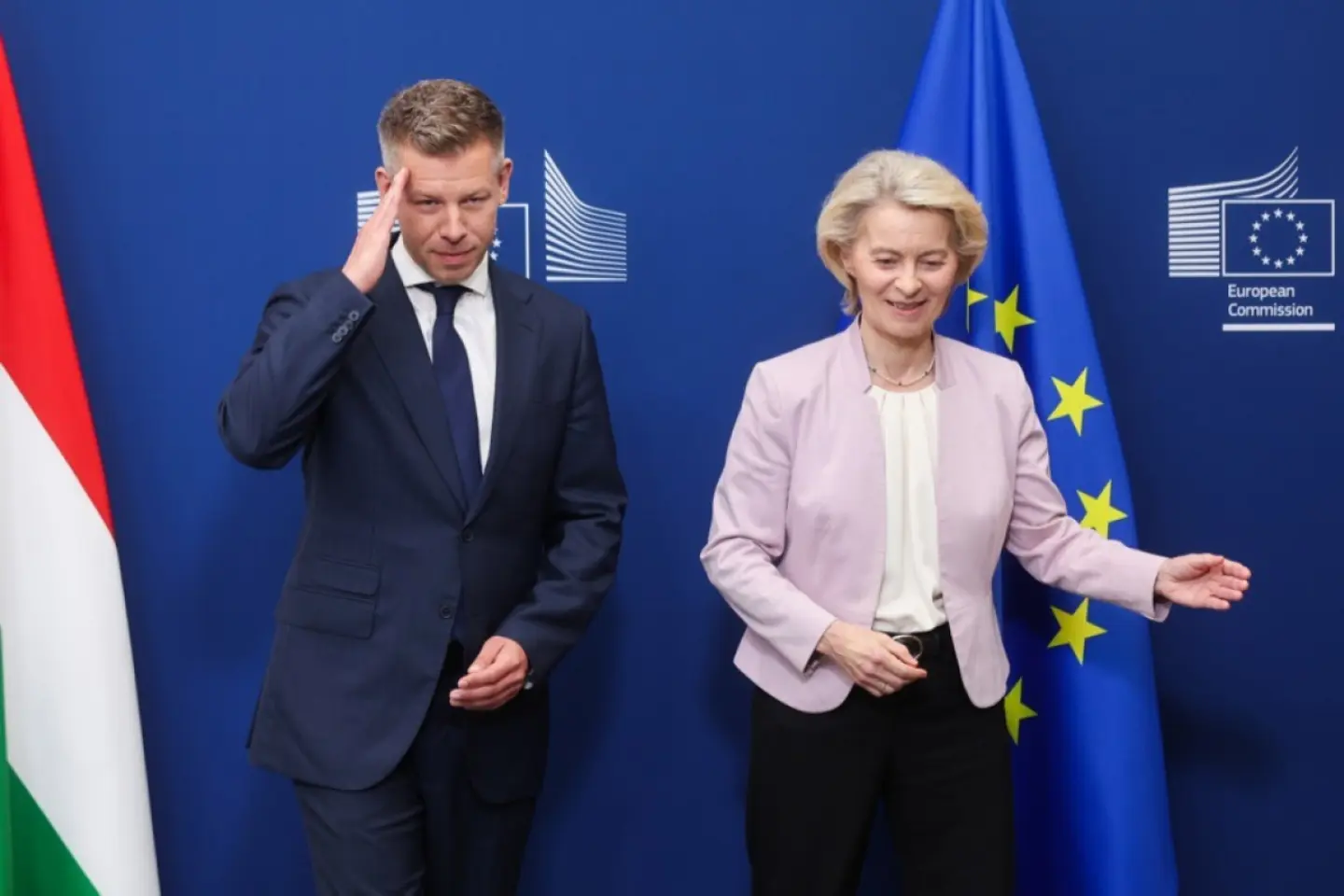
When Péter Magyar was campaigning in Hungary’s industrial cities, before the elections that would land him the Prime Minister job, the country's Chinese electric vehicle (EV) and battery plants stopped being just an investment story. A worker was killed during the construction of BYD's EV plant in Szeged, NGO China Labor Watch launched forced labour investigations, police probed toxic emissions at levels that shocked regulators, and the government was accused of covering it all up.
Under Magyar’s predecessor, Viktor Orbán, Hungary abolished its environment ministry, centralised investment permit decisions to the prime minister's office, and waved through projects that would have faced years of regulatory scrutiny elsewhere.
The twin pillars of that strategy, which Magyar inherits, are BYD's electric vehicle plant in Szeged, south Hungary, and CATL's battery gigafactory in Debrecen, east Hungary, which supplies BMW and Mercedes-Benz.
In 2023, Hungary received almost half of China's foreign direct investment in Europe, more than Germany, France and the UK combined. The jobs created were assembly-heavy, often filled by imported foreign labour. Moreover, vehicle assembly is a lower-margin activity than battery technology, software and intellectual property; in EV, the profits flow to whoever holds the IP, not who hosts the factory floor.
Magyar won Hungary's April election in part on a promise to change all of this. However, two months on, the EU is moving to curb China’s commercial practices faster than he may have anticipated, and the investments he inherited may not survive the collision.
As state subsides give Chinese manufacturers a competitive edge, Europe is forced to act in order to protect local businesses
The EU is preparing its most serious collective action ever against Chinese trade practices. Beijing signaled its displeasure by cancelling two planned EU diplomatic meetings this month.
On the day after his election victory, Magyar adopted a cautious tone, praising China as "one of the most important, largest, and strongest countries in the world" while pledging to review Chinese investments, but "not with the aim of shutting them down". He called on BYD, which this year overtook Tesla as the world's largest EV seller, and the world's dominant battery producer, CATL, to follow Hungarian environmental and labour regulations, adding that he wanted to "position Hungarian companies as partners" at their plants.
During his recently ended 16-year stint as premier, Orbán used Hungary's EU veto to block and water down statements critical of Beijing, on everything from Hong Kong to the Uyghurs. His departure removes one of Beijing's most reliable advocates inside the bloc at precisely the moment Brussels is hardening its position.
The European Commission (EC) believes Chinese state subsidies, which the OECD estimates at three to eight times the level available to Western competitors, are distorting competition across European industry. Factories are closing and jobs disappearing; the EU trade deficit with China hit €98 billion in the first quarter of 2026 alone, the highest since 2022, and the auto sector alone could lose up to 600,000 jobs this decade, according to European Parliament research.
As Manfred Weber, who leads the European People's Party (EPP), the EU's largest political grouping, put it: "Either we fight back, or China will cripple parts of our industry. The time for naivety is over." In the Bundestag on 10 June, German Chancellor Friedrich Merz went further: "We will defend our interests and our industry against trade practices that lead to competitive distortions. At European Council we will speak about how we can expand our toolbox."
Germany is the EU country most exposed to Chinese manufacturing competition per worker, according to Eurostat data, with its industrial heartland concentrated in the sectors China has targeted. Hungary's exposure is different: not import competition undermining domestic manufacturers, but Chinese capital already embedded in its economy.
Discussions in Brussels increasingly encompass new tariffs, investment screening, supply-chain diversification measures and sanctions enforcement against companies supporting Russia's war in Ukraine. Beijing has warned it will "take all measures necessary" against EU trade defences and has already imposed five-year retaliatory tariffs on EU dairy imports.
There is also the matter of an EC probe, initiated in March 2025 under the EU's Foreign Subsidies Regulation (FSR), into whether BYD's Szeged plant benefited from unfair Chinese state support. Unlike traditional import tariffs that hit goods at the border, the FSR scrutinises state aid already operating within the single market.
For China, the benefit of building in Hungary rather than exporting from home was always tariff-free access to the EU single market. An adverse FSR ruling can retroactively strip that away with remedies including divestments, capacity restrictions or repayment measures, leaving a factory built with Chinese cash and optimised for the EU market unable to sell into it profitably. The EC is not just setting general policy; it is targeting the foundational premise of the investment itself.
How Hungary became China’s bridgehead inside the EU
To understand what Magyar has inherited, it helps to understand what Orbán built over 16 years. The relationship with Beijing began as farce. In June 2011, listeners of a Budapest classical music station heard something unexpected: Chinese-themed music and talk, inserted so that then-premier of the state council Wen Jiabao could hear Chinese programming on his limousine ride from the airport to Budapest. Wen, heading up China's first official visit to Hungary since the fall of communism, was delighted, Direkt36 reported. China's "historic" promise to buy Hungarian government bonds and offer a one-billion-euro development loan, that Orbán declared, never materialised.
Orbán’s decade of diplomacy eventually paid off. The two sides maintained contact: Chinese Premier Li Keqiang visited Budapest in 2017, and Orbán attended Beijing's Belt and Road Forum in 2023, before President Xi Jinping arrived in Budapest in May 2024 with a fighter jet escort, 16 cooperation agreements and an op-ed in the pro-government Magyar Nemzet praising the friendship as "mellow and rich as Tokaji wine".
Outside Buda Castle, protesters in Winnie the Pooh costumes held Taiwanese flags while Chinese volunteers in red caps, coordinated by the Beijing embassy, physically disrupted Tibetan and Taiwanese demonstrators along the motorcade route. Incidents like these fuelled accusations that the Hungarian authorities had allowed Beijing-linked actors to interfere with demonstrations on the nation’s streets. In a speech, Xi proclaimed an "all weather" relationship with Hungary: Chinese diplomacy terminology for its highest bilateral partnership tier. The factories had replaced the failed financial promises as the substance of the relationship.
Between official visits, Hungary laid out the red carpet for China: five Confucius Institutes sprung up as Poland and Czechia were closing theirs; cooperation contracts were signed between Hungarian and Chinese state media; alleged overseas Chinese police service stations operated in Budapest until opposition politician Márton Tompos and colleagues exposed them; and the Budapest-Belgrade railway, a flagship Belt and Road project, was built by Chinese contractors and finally began carrying freight in February, after years of delays and EU procurement violations, though passenger services have not begun. A plan for a $1.8 billion Fudan University satellite campus in Budapest, which would have been the first such export for China, was shelved after mass protests.
China's ambassador to Hungary described the country, weeks before the April election, as "the most China-friendly country within the EU." Hungarian voters were unimpressed. Only 17 percent of Hungarians favoured partnering with China over the US, a 2025 Central European Institute of Asian Studies survey found, as against 53 percent who favoured the US. Two-thirds opposed the Fudan project. Magyar's Tisza party was vague on China during the campaign, winning on Western reorientation rather than a specific China policy. Now holding a constitutional supermajority of 141 of 199 parliamentary seats, his caution on China is a political choice.
The downside of Chinese investments
While Orbán enjoyed impressive headlines of multi-billion-dollar investment announcements, Hungary was getting the less glamorous end of the deal. The production equipment for BYD's Szeged facility came directly from China. None of the core technology, the battery chemistry, the intellectual property, is licensed to Hungarian partners. Chinese EV investment follows a consistent pattern: equipment imports first, local assembly labour second, high-value manufacturing remaining at home. Beijing restricts exports of lithium iron phosphate cathode technology, the electrochemical core of most EV batteries, specifically to prevent host countries from developing competing capabilities.
What Hungary tangibly received is assembly jobs, some regional wage uplift in Debrecen and Szeged, and tax revenue from facilities it neither controls nor could replicate. BYD and CATL are world-leading manufacturers whose dominance rests on scale, vertical integration and decades of accumulated expertise, not primarily on subsidies. Hungary's dependency will not dissolve if EU measures cut Chinese state support. What Orbán presented as Hungary's reindustrialisation was, in practice, a position at the bottom of another country's value chain. Sabine Weyand, the EC's director-general for trade, has underlined Brussels is "not interested in low-value-added, no-tech-transfer assembly operations."
BYD is also expanding from a position of domestic stress: its Chinese market sales collapsed 58 percent in early 2026, net profit fell 55 percent according to company reports, and Szeged is the beachhead the FSR probe threatens to demolish.
Orbán's defenders would dispute this framing. Chinese companies built factories, created jobs and channelled billions into a country Western investors had largely overlooked. Germany welcomed Chinese manufacturing investment for years. For a small, landlocked economy with limited leverage, the deal Orbán struck may have been the only one available.
The counterargument is geography and timing. Hungary's exposure is unusually concentrated in a handful of Chinese-linked projects at precisely the moment Europe is reassessing its dependence on China. A diversified bet might have survived Brussels' pivot. This one may not.
The Guest Worker Paradox
The labour picture reinforces this. By early 2025, the Philippine Department of Migrant Workers estimated around 9,000 to 10,000 Filipinos had travelled to Hungary for employment in the preceding two years, many in the vehicle manufacturing sector at BYD and CATL's plants. It was the Orbán government that both invited the factories and issued the work permits to staff them.
Since Magyar's election win, BYD has required its Hungarian contractors to sign an overseas employment compliance declaration, pledging adherence to local wage, working hours and visa rules. Hungarian authorities have gone further still. In May, Hungarian Environment Minister László Gajdos publicly declared that BYD had "seriously violated" its environmental permit obligations; police opened a criminal investigation after contaminated soil from the construction site, containing above-limit waste compounds was detected. Three companies associated with the plant have since been sanctioned and one fined. The informal arrangements of the Orbán era are not just under pressure; they are being actively dismantled.
The Magyar government's most significant unilateral action came in late May, when state secretary for transport and investment Zsolt Tárkányi confirmed the government "will not be a partner" in CATL's expansion beyond the first Debrecen plant. A new regulatory authority for industrial oversight is expected in September, along with a restored Environment Ministry.
Samsung SDI's plant in Göd, north of Budapest, is a reminder that Orbán's model was never exclusively about China. It was simpler: abolish the environment ministry, centralise permits, and offer Asian industrial monopolies a low-scrutiny base inside the EU. The South Korean company now faces four criminal investigations for toxic emissions while expanding; investigative outlet Átlátszó revealed the plant had been relabelling hazardous battery waste as normal product and shipping it to Poland since 2020. The Chinese plants are the most politically visible part of this legacy. The Korean one is a reminder of how systemic it was.
Magyar's pledge to "suspend the recruitment of guest workers from outside Europe" from 1 June arrived on 6 June, five days late, and in weakened form. Hungarian law distinguishes between guest worker residence permits, used by employment agencies to bring in Filipinos, Georgians and Armenians, and employment-purpose permits, used directly by large employers including the Chinese-owned factories. The ban covers only the first category; workers at BYD and CATL are unaffected. Tisza's manifesto had promised: "We will not allow foreign guest workers to take the jobs of Hungarians and push down salaries." What the regulation delivered was a ban that hit the most economically exposed foreign workers, those hired through agencies, while leaving the Chinese plants' workforces untouched.
The government pointed to a reserve of around 400,000 inactive Hungarians that could fill the gaps. Industry rejected this. More than 71 percent of companies surveyed said relying solely on Hungarian workers was unthinkable; over 90 percent described finding Hungarian workers as difficult or extremely difficult. The managing director of Master Good, a food company, threatened to cancel a 120 billion forint factory investment unless foreign labour remained available. "We are not bringing in labour from abroad because it would be cheaper," László Bárány said, "but because there are no Hungarians." Tamás Székely of the Chemical Workers' Union was direct: the ban penalises Hungarian SMEs that recruit through agencies while leaving large Chinese manufacturers free to bring in Chinese workers directly.
The Bill Arrives
Magyar's approach is better understood as tactical continuity than ideological reversal. He is aligning with Brussels on the issues that unlock EU funds and restore Hungary's diplomatic standing, while maintaining operational stability for the Chinese plants that underpin his industrial economy. Blocking CATL's expansion while leaving existing operations untouched, banning agency-recruited workers while exempting those at the Chinese plants: these are the moves of a government trying to satisfy two audiences simultaneously. The ground under his feet is shifting faster than that calculation can hold.
Orbán's wager was that Hungary could bind itself to China's industrial rise without ever being forced to choose between Beijing and Brussels. Xi called it an all-weather relationship. The forecast has changed.