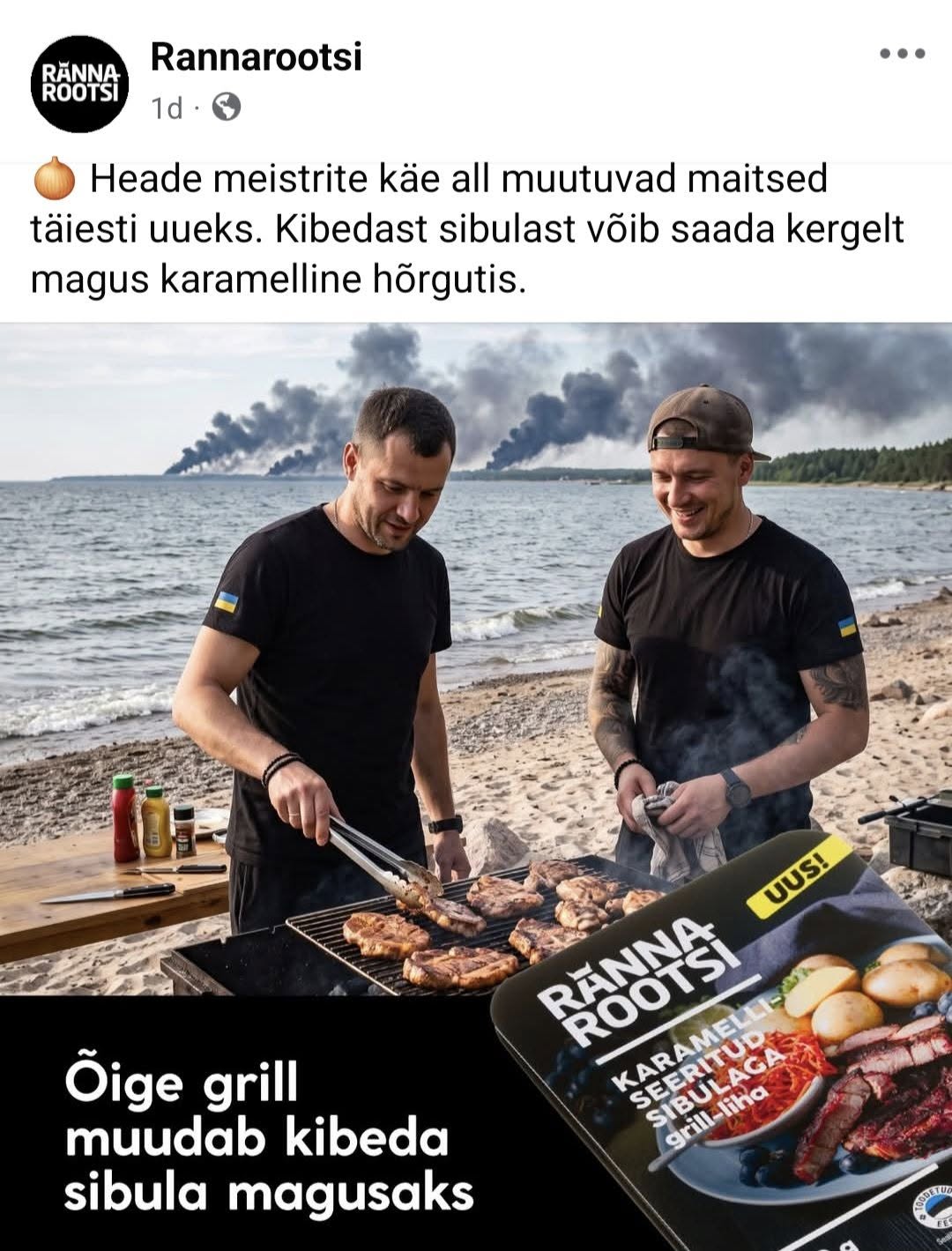
At the end of July Estonian society found itself in the middle of a heated controversy. The cause was an advertisement by the meat producer Rannarootsi, which played on the theme of the war in Ukraine.
The image showed two muscular men wearing T-shirts with Ukrainian flags grilling meat over an open fire. In the background, smoke billowed into the sky, evoking for many Estonians the recent Ukrainian drone strikes on Russian oil terminals in Ust-Luga. The slogan read: "The right grill will make bitter onions sweet."
The pun was immediately recognizable. In Estonian, the word sibul ("onion") is also a derogatory term for Russians. The insult has a broad range of meanings — from residents of the Russian-border region around Lake Peipus to poorly integrated ethnic Russians believed to be waiting for Putin's arrival, or simply Russian speakers in general. In other words, the advertisement effectively suggested grilling angry Russians until they became more palatable.
An advertisement hard to swallow
Several prominent Russian-speaking opinion leaders immediately called for a boycott of the company's products. "The idea is that everyone who buys your sausage should think they're eating a charred enemy? Or am I misunderstanding the language of marketing? What idiots. For some it's war, for others it's business as usual. Rannarootsi — never again," wrote Member of the European Parliament Yana Toom on social media. Her post spread widely and provoked sharply divided reactions.
While most local Russian speakers — and nearly all politicians from the Centre Party who commented on the issue — supported Toom's position, others criticized it. Among the critics were Russian emigrants who had moved to Estonia after the full-scale invasion of Ukraine. "Well, perhaps thanks to those strikes in the Leningrad region, people in Estonia are able to grill sausages today instead of defending themselves against the provocations of a deranged neighbor," one of them wrote.
Some Russian-speaking politicians representing rival political parties took an even more confrontational stance toward those criticizing the advertisement.
"This proves exactly what needed proving, although it was obvious from the start. It turns out that what is morally unacceptable isn't Russia's aggression against Ukraine, but a Rannarootsi advertisement. That's what triggers the Centre Party and makes them feel offended. Quite remarkable. The Centre Party — the moral compass of Estonia!" wrote Maria Jufereva-Skuratovski, a former Centre Party member who is now an MP for the governing Reform Party.
Estonian-speaking politicians were even more unequivocal, with few exceptions equating those Russian speakers offended by the advertisement with supporters of Russia's war against Ukraine.
"I'm going straight to the store to stock up on Rannarootsi products. If Yana Toom is calling for a total boycott, I'd better hurry before everything sells out. Five years of slaughter in Ukraine didn't make them sympathize with the victims, but now they're whipping up hysteria because the feelings of the aggressor state have supposedly been hurt," wrote Anti Poolamets, an MP from the far-right EKRE party.
"The world is unfair," observed public intellectual Ilmar Raag. "Not everyone whose native language is Russian is a terrorist, and not everyone supports Russia's aggression against Ukraine. Yet Vladimir Putin has effectively taken the entire Russian-speaking community hostage, because he and his associates have repeatedly framed this war in terms of Russian identity, Russian civilization, the Russian motherland, and Russian Orthodoxy. Today, being Russian is inherently ambiguous."
Raag emphasized that the controversial advertisement would never have existed without Russia's aggression. "The offensive term sibul exists solely to refer — like Vanya or orc — to those Russians who believe their parents bestowed upon them, at birth, a God-given superiority over other peoples," he wrote.
Judging by the number of reposts, this interpretation resonated strongly with Estonia's intellectual circles. Yet even a cursory examination of how the word is actually used shows that this is only one of several meanings it carries. Had the advertisement substituted an equally offensive slur for Ukrainians, Jews, or Black people, public reaction would almost certainly have been very different.
Fertile ground for resentment
The controversy illustrates the current state of interethnic relations in Estonia. The issue is particularly acute in the border region of Ida-Virumaa, where the majority of the population is Russian-speaking.
Russian speakers generally occupy a lower social position than ethnic Estonians. Their average standard of living is lower, they are underrepresented at various levels of government, and they play a smaller role in political decision-making. Although Russians make up roughly a quarter of Estonia's population, only seven of the 101 members of the Riigikogu are Russian-speaking — and all of them belong to, or previously built their careers within, the same political party.
The disparity is visible even among children. Estonian-speaking students consistently outperform their Russian-speaking peers in international educational assessments. Notably, some Estonian public figures attribute this gap not to socioeconomic or linguistic factors but to cultural characteristics and even "differences in cognitive abilities" — a line of argument that many Russian speakers perceive as racist.
Several recent government policies have likewise been interpreted by part of the Russian-speaking community as discriminatory. These include stripping Russian citizens permanently residing in Estonia of voting rights in municipal elections (while they cannot obtain Estonian citizenship automatically); legislation directed against the country's most popular Orthodox Church, which remains subordinate to the Moscow Patriarchate; the ongoing reform of Russian-language schools; the renaming of cultural institutions by removing the word "Russian" from their titles; and, more broadly, the gradual removal of the Russian language from public life.
At times, Estonian-language public discourse toward Russians can be almost as hostile as Russian state media's rhetoric toward Estonians. Russia's war against Ukraine is only one factor intensifying these tensions. A widely held view sees Estonia's Russian-speaking population primarily as a difficult legacy of the Soviet occupation, despite the country's rapidly declining population and growing need for both workers and consumers.
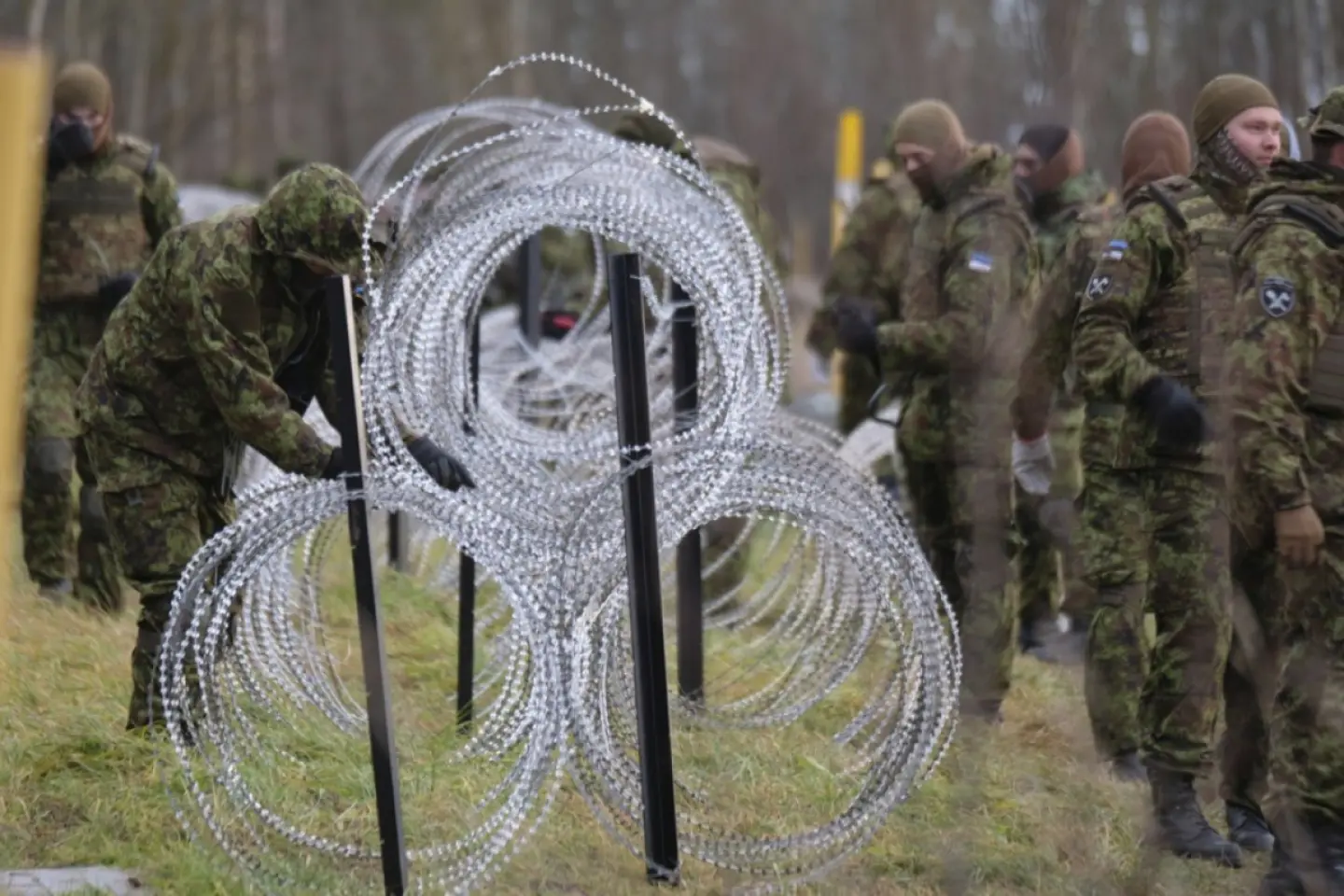
At the same time, mixed Estonian-Russian families are far from uncommon. Since the launch of the education reform, more Russian-speaking parents have begun enrolling their children in Estonian-language schools. In larger cities, integration largely takes place through the workplace, while in smaller towns and rural areas it often develops more naturally and rapidly. When members of the Russian-speaking minority are fluent in Estonian and not immersed in polarized media, ethnic tensions are barely noticeable in everyday personal relationships. Russian speakers also serve in the Estonian Defence Forces — which are often described as one of the country's most successful integration institutions — as well as in the voluntary Defence League (Kaitseliit).
The perception among many Russian speakers that their rights are being curtailed is actively exploited by Russian propaganda and could provide fertile ground for future provocations involving a so-called "fifth column." Yet it must also be acknowledged that Estonian politicians and public figures have themselves contributed to creating and cultivating this sense of resentment. Historical grievances rarely provide a solid foundation for a healthy and cohesive society.