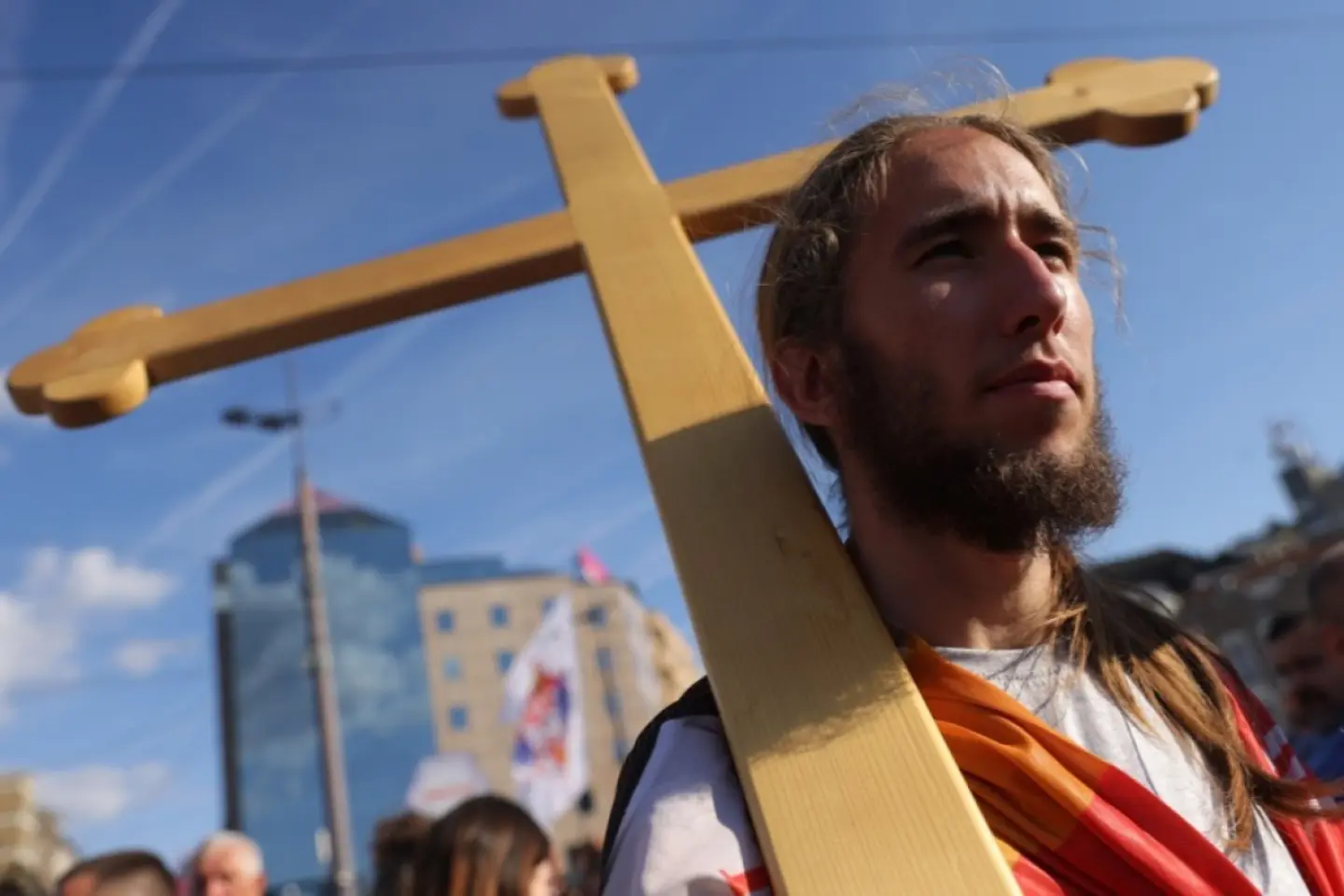
Serbia's protest movement is now twenty-one months old, closing in on its second anniversary. In that time it has resisted every attempt to fit it into a familiar category of the Serbian political scene. Vučić calls it a color revolution. Commentators abroad increasingly call it a Greater Serbian relapse, especially after the rally organized last June on the Vidovdan* holiday took a nationalistic turn. Both labels borrow from history, the color revolutions of Georgia and Ukraine, the ethnonationalist mobilizations of the 1990s. What grew out of Belgrade's plenums, since a train station canopy killed sixteen people in November 2024, is a new kind of populism, anti-elite to its core, without any coherent political vision or geopolitical compass. Its only ideology consists of constant pandering to what it sees as the lowest common denominator of the Serbian society – a folkloristic Serbian national-populist, rallying around the Kosovo deadender mirage, while being deeply afraid of societal and even technological progress. This image may be correct for the average regime voter, but the voting base of the student movement is that of urbanites hungry for change and a modern Serbia connected to the developed world. These are the men and women who are following the student movement despite of the national-populist caricature it's turned itself into, not because of it.
The Regime's Script Which Worked
Vučić has called the protests, at different points, a foreign plot and, in one particularly theatrical formulation, the dirtiest color revolution in the history of mankind. His close political ally and one of his fixers with the Kremlin, Aleksandar Vulin, made an almost identical accusation directly after meeting Russia's foreign intelligence chief in Moscow, telling reporters that Western services were working to destabilize the country. Two months later the Serbian Patriarch, standing beside Vladimir Putin, used nearly the same phrase, warning that a colored revolution was underway at home.
Following such accusations from Putin’s and Milošević’s playbook, the national-populist parts of the student movement felt emboldened to push through their own agenda, different from the liberal-institutionalist one that the movement propagated at the beginning of its activity, when its popularity reached its peak. That is how the Vidovdan current, which first showed its face on last year’s June 28 rally in Belgrade, where speakers invoked bones, ancestors and fatherland, and called for defending Serbs beyond Serbia's borders, came to be. It consists of calculated support to nationalist prospective candidates for parliamentary elections, inviting the same nationalistic speakers to mass rallies, incessant national-populist rants on social media profiles of faculties, where these anonymous nationalist students hold a clear majority. In fact, it seems that the carefully planned rhetoric of the Belgrade-Moscow axis gave carte blanche to nationalistic elements inside the student movement to increase their influence to the point that it seems that the movement has been successfully hijacked.
The Early Movement We Lost
What the student movement wanted in the beginning of its actions differs from what it currently represents. From its first days at Belgrade's Faculty of Dramatic Arts, the movement refused party insignia, declined endorsements from opposition politicians, and organized through plenums, open assemblies where every decision requires collective deliberation rather than a leader's signature. More than eighty faculties came under student control within weeks. The demands stayed inherently liberal-democratic and narrow: accountability for the sixteen deaths in Novi Sad, although it was clear to the older opposition public that the state institutions were captured and not able to produce unbiased results. Even if their initial phase of political organization was wrought with naiveite, it was sincere. This honesty in particular was what drew many politically unaligned or uninterested citizens to its banner. The students wanted courts, oversight and a functioning state, and they wanted it regardless of who ended up running the country afterward. Clearly, this was no colored revolution, since its goals were not politically concretized. The same suspicion of organized politics kept it from working with the pro-European opposition parties that share its stated goals, an isolation that echoes the regime's own anti-establishment framing of organized politics. In the end, we will see that these early naive students, hectic in their ideological inclinations and sincere in their intentions, would lose out to the goal-driven and better organized national-populists within their midst, who will put Kosovo, a symbol of all deadenders on the Serbian political scene, on its banner rather than the liberal-democratic demands of the early stages of the protest.
The Platform and Discourse Test
An early draft platform of the movement, strengthened by many publications of the various faculty profiles themselves, publicized around the time that the Vidovdan current took supremacy, makes the aforementioned pattern legible in miniature. It consists of jumbled calls for higher health spending, fairer conditions for farmers, more culture and scientific funding, stronger environmental protections, more efficient public enterprises, virtually all of it end goals stated as if they were policies. The one plank with an actual number, a twenty percent increase to the education budget, arrives without a funding source or a baseline, and it was one of the early demands thrown together at a chaotic moment in time. The Kosovo memorandum, publicized separately of the program itself, meanwhile, is close enough to the government's own official language that it barely distinguishes a Student List administration from Vučić's. A movement built on demanding that institutions work has so far produced, when asked to specify how, mostly the vocabulary of a petition, with added nationalistic pathos. What is even more concerning is that the national-populist rhetoric clearly outweighs the naive social-populism of the roots of the movement. The movement evolved from bad to worse.
Using Brussels Without Believing in It
Trust in the EU among Serbian citizens sits at 40 percent according to the European Commission's own mid-2026 survey, behind Serbian trust in Russia and China, and a separate CeSID poll puts the share holding a generally positive view of the EU at 27 percent, although the same poll shows a slight majority for those who would vote positively on joining the EU if the referendum was held promptly. On the other hand, the most recent CRTA polling from June 2026, shows that 75% out of those who would vote for the student movement list in the parliamentary elections give preference to the EU over Russia, while the results for the regime ruling party showed an opposite image. Despite the student movement depending on the democratic and pro-European part of Serbian society, EU flags have been actively unwelcome at the protests themselves, which was enforced by nationalists calling themselves student activists. At multiple occasions such men used force to remove EU symbols, while Russian war flags were openly welcome. This is the same student movement that in its pre-Vidovdan days organized a bicycle relay to Strasbourg and a running relay to Brussels that same season, carrying handwritten testimonies from victims' families, wrapped in the Serbian flag, to the doors of European institutions, albeit offering no concrete cooperation with European institutions or parties. It’s worth mentioning that even among the students who made up this delegation, there were those who publicly photographed with Russian war symbols. Nonetheless, the European Parliament answered the call of Serbian students on May 7, 2025, with a resolution passed 419 votes to 113, with 88 abstentions, explicitly endorsing the students' demands. In response to this gesture of good will, the EU received the dominance of the Vidovdan current as the flagbearer of the student movement.
Populism Wins in the End
It would be unfair to judge Serbian students from state universities too harshly. They are living in a decade of rampant populism in Europe itself. They mostly come from provincial families, who, in a large majority of cases, never protested the Milošević regime, and, more often than not, voted for the Vučić regime itself. What they believe the average Serbian voter is, is in fact a projection of the parochial surroundings they grew up in. That’s how the social-populists lost the battle to the national-populists inside the student movement. They were sincerely afraid that presenting a vision of a modernized Serbia, allied with the developed world, would provoke a backlash from the regressive segments of society, which they themselves falsely believe constitute a clear majority. Yet sociological data shows that the student movement is supported primarily by the progressive, urban men and women whom the students themselves mistakenly regard as a minority. The problem here is that the dominance of the national-populists will produce a list of MPs who will, after the elections are held, and if they win the majority, repeat the same pattern as the Eurosceptic Koštunica faction had done after the liberal revolution of 2000. Serbia will remain frozen in time, while its integrated neighbors leave it in the dust on every metric.
Note*: Vidovdan is one of Serbia’s most important national and religious holidays. It marks the old Christian St. Vitus Day, but also commemorates the 1389 Battle of Kosovo Polje, which took place on the same day and is considered a defining moment for the Serbian national identity. The Serbian army, led by Prince Lazar Hrebeljanović , fought at Kosovo Polje an Ottoman army under Murad I. Both commanders were killed that day, Prince Lazar in battle and Sultan Murad I assassinated. Lazar is venerated as a martyr and saint, and Vidovdan was designated by the Serbian Orthodox Church as a memorial day for Saint Prince Lazar and the Serbian holy martyrs.