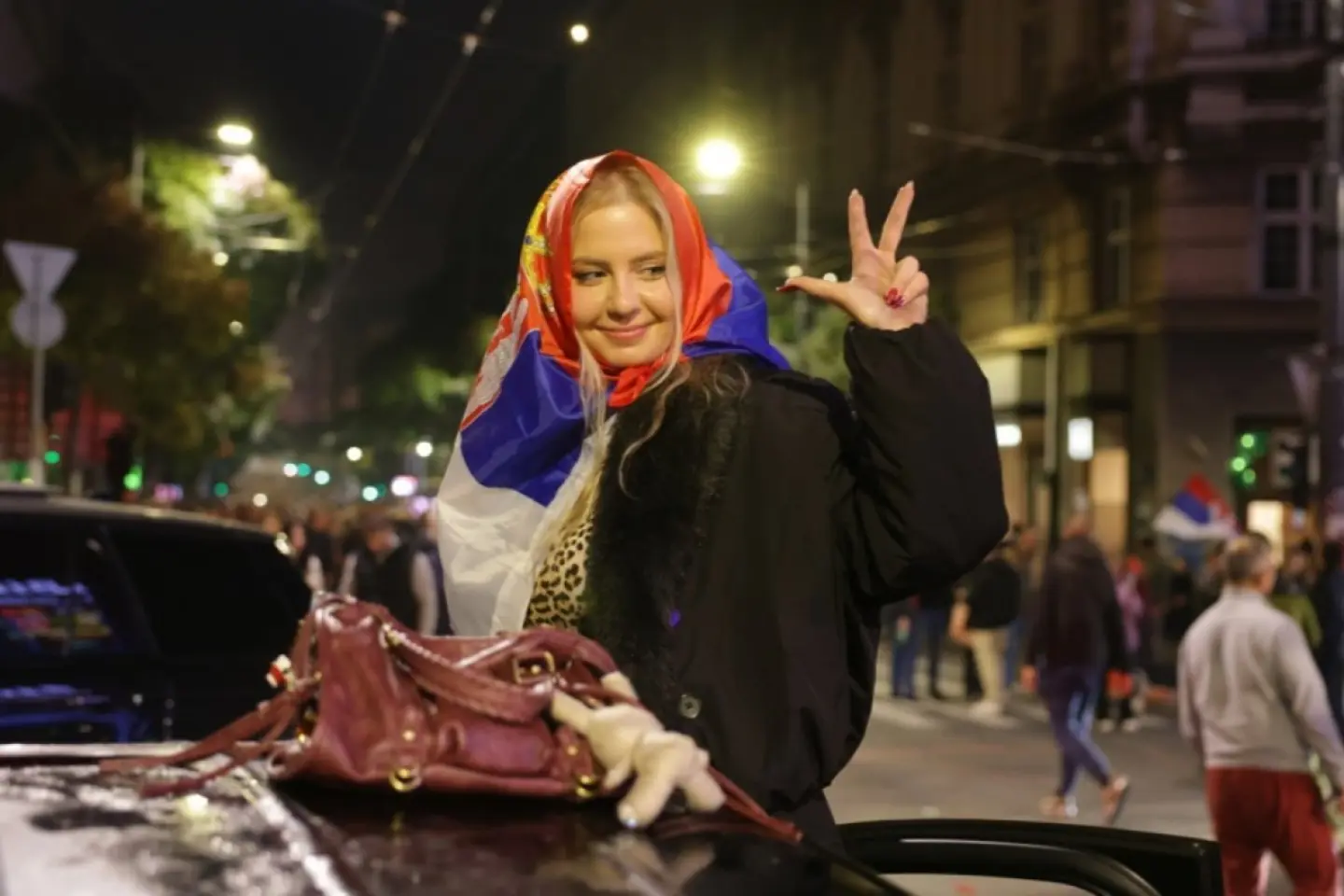
After fourteen long years, Serbian voters ended the Progressive Party’s and Aleksandr Vučić's rule on 25 October. The categorical victory of the Students List comes after two years of massive anti-corruption protests and could mark a new beginning for Serbia.
The unprecedented voter turnout brought the students a victory so decisive that no one had anticipated it
By the preliminary count of the Republican Electoral Commission, the opposition Student List collected more than 52% of the vote, while the Serbian Progressive Party and its satellites finished far behind the winners, with about 39% of the vote secured. Nobody else from mainstream parties crossed the three percent bar, low as it has been set, apart from the ethnic minority parties, which enter the parliament through a privileged seat allocation formula. The Socialist Party of Serbia scraped together about 2%, and the right-wing and liberal lists each ended well below 1%. The ballot paper, in effect, carried one question only, whether Vučić would go on ruling as he did, and the country answered it so decisively that every other question, important as it may be, will have to be left for later.
That answer translates into a comfortable parliamentary majority for the student movement. The students are expected to take about 140 seats, well above the 126 needed to form a government, an outcome that was treated as the most optimistic scenario before election day, one that many dared not to hope for. What made the difference was the massive social mobilization. According to the Commission's figures, final participation came to 68.78%, and it will reach 70% and slightly above once diaspora votes are included. Since the Progressives took power in 2012, no election had even gone beyond 60%, some didn’t even come close to that figure. The turnout was the defining factor that flipped the game completely, and this can’t be overstated. With turnout at 64 to 65%, Vučić would have kept a real chance of surviving: a solid second place would have let him assemble a coalition government that bypassed the winning Student List. At 68 to 69% the door which led down that path was nearly slammed shut, and at 70% or more his defeat was almost assured.
Hardly anyone expected a margin like this, and the pre-election polls show why. The picture resembled Hungary before Orban's fall, with two sets of pollsters describing two different countries. The largest student lead in any published study came from the liberal organization CRTA, whose summer survey put the Student List at 45% against 35% for the regime. Yet it was done months before the vote, when it was still unclear whether elections would be called at all and which opposition parties would take part. The right-wing analytical center NSPM, also supportive of the Student List, measured the students at only about two points ahead in early October, a gap too small to subsequently form a government. On the other side, agencies close to the regime were not content with the one realistic scenario, a firm second place for the Progressives and a coalition cabinet, and promised an outright win and first place. Three days before the vote, Ipsos Strategic Marketing projected 47% for the Progressives and 40% for the Student List. Faktor Plus, in a survey from the end of September, gave 48% to 37%. The conclusion is hard to avoid: even the polls that favored the Student List underestimated its potential. The missing variable was that elusive X factor, social mobilization, which no model could accurately capture.
The pre-election streets of Belgrade were just as misleading as the polls. On the eve of the vote that would bring about the fall of the regime, the city looked the way it always did, with pro-government posters, billboards and illuminated advertisements on practically every lamppost – the regime’s presence was overbearing. Only a careful observer noticed the occasional small Cyrillic stickers saying “Students Will Win”, a single clear note against the roar of Vučić's smoothly running propaganda machinery which suffered no hiccups for years. On many of the remaining billboards and posters, Socialist Party leader and deputy Prime Minister Ivica Dačić was giving a stern look to passersby. A political heir of Milošević, he presented himself as a factor of stability and gave that very name to his electoral list. This time voters sent the list under the threshold, for the first time ever. The Socialists had stayed afloat even after Milošević was removed from power on 5 October 2000, and that long shameful run is now over.
From pro-Europeans to disillusioned nationalists, Serbs were joined by the common goal of changing the regime. The fear of EU sanctions made Vučić concede
Who, then, voted for the Student List? The answer explains both the size of the win and its limitations. The list is itself predominantly populist, combining strands of right-wing and left-wing populism, and it won less through the strength of its own ideas than because it had the best chance of beating Vučić. Pro-European left-liberals backed it, and so did disillusioned nationalists, the few and far between leftists, and even the crackpot conspiracy theorists who spread panic on social media ahead of the vote by insisting that the regime would swap ordinary ballpoint pens for ones with erasable ink, or that it sprayed people’s doorknobs with the liquid which shows up with ultraviolet lamps (those are used in the electoral process in Serbia as a precaution so the same person with different documents doesn’t vote twice). What emerged was a colorful and mixed coalition of various segments of society, often holding opposite views, but joined by a single goal – the liberation of Serbia.
Vučić conceded at once. He had scheduled a press conference for 22:00 on 25 October but spoke some thirty minutes earlier, since the results were too plain to justify delay. There was nowhere to run from there. He had lost a referendum with an unmistakable verdict. For some the concession came as a surprise, yet the feared scenarios, large-scale rigging and a bloody crackdown on the protests that rigging would have provoked, were never a genuine threat. Goodwill had nothing to do with it. Vučić governed as an autocrat, seeking to control every significant process in the country and the huge mass of people who depended on public-sector jobs and state assistance. What restrained him was something else.
Serbia borders the European Union and relies on it for its economic growth and trade. A Lukashenko in Belarus or an Ivanishvili in Georgia might have crushed the massive demonstrations by force, while using widespread electoral fraud, and Vučić could have tried the same, but harsh sanctions would soon have followed, with no lifeline possible from Russia, and he would have stepped down from the throne as a man no longer free or worse. He took the road of Đukanović in Montenegro instead: tyrannical while in office, yet leaving by democratic means once high turnout had overpowered his administrative resources. Even his exit had a comical side, with which he added to his personal tragedy and to the popular euphoria alike by declaring that Europe and the “deep state” had removed him from office. He is back to his radical populist factory setting now, an expected reset.
A fresh start for Serbia
Congratulations arrived quickly from abroad. Hungarian Prime Minister Péter Magyar was among the first leaders to welcome Serbia's liberation. It seemed that two neighbouring countries had gone through the same release, from Orbán in one case and Vučić in the other, two men who cooperated closely in politics and in corruption alike. Serbia and Hungary are arguably closer today than at any moment since the Middle Ages, when they stood together against the Ottoman invasion. Marta Kos, the European Commissioner for enlargement, also congratulated Serbia and spoke of opening a new chapter in its relations with the European Union. Montenegro's Prime Minister Milojko Spajić added his voice, hoping for closer ties between two states that once formed a single country. Zelensky was there too, thanking the Serbian people for its support to Ukraine. From the Kremlin, the sound of silence echoed in the darkness. The reaction came only the next day, when Kremlin spokesman Dmitry Peskov said Moscow is aware of the result, praised Vučić, and basically warned Serbia’s new rulers that cooperation with Russia is in their interest.
What does the change of power mean in practice? Expectations are broadly positive, with a measure of skepticism attached. The most important shift is the breakdown of the one-party system that had subordinated every sphere of Serbian state and society. That should improve democratic processes and speed up economic development. Corruption, which is directly linked to the monopolization of power by one party, should recede too. Still, nobody should expect a strategic turn in the near term. Serbia is unlikely to become a full member of the European family of nations anytime soon and will remain stuck between Russia and the West. The coming changes are not radical enough to remake the country in every respect, but their net effect will undoubtedly be positive. Free political activity in Serbia is only beginning, and the time for ideas capable of carrying the changes already under way to their logical conclusion has yet to come. The next hurdle to overcome will be the presidential elections which must be held before the end of the year. Barring an unexpected falling out among the constituents of the Student List, this battle should be won rather easily.
Perhaps the clearest summary of what happened is the night of the vote itself. It passed in an atmosphere of national jubilation. Cheerful crowds filled the squares of Serbian cities, barely able to believe that after fourteen years they would see freedom again. Earlier that evening, before Vučić had acknowledged defeat, independent media had described large police forces being pulled into the centre of Belgrade and grim hooded men turning up in the anti-Maidan camp in front of the parliament building. A sinister mood hung over the city. But no clashes followed. Vučić retreated, and all those forces retreated with him. The oppressive atmosphere gave way to celebration. Young people partied in downtown Belgrade, while convoys of cars sounded their horns along the boulevards to herald a new era. Serbia had really turned a new page in its history.