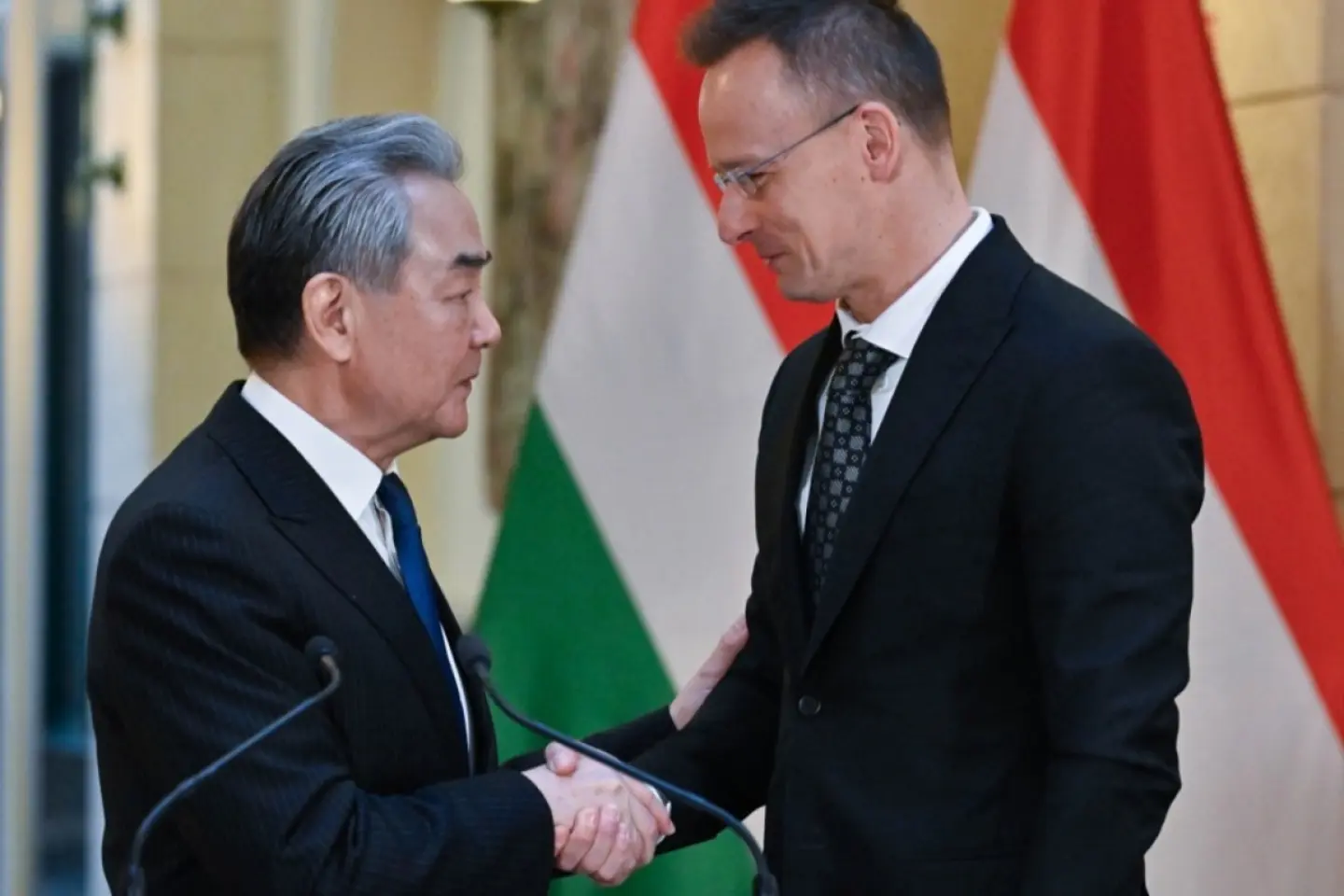
Péter Szijjártó, until April the EU’s longest-serving foreign minister, is joining the Chinese carmaker BYD, after helping it – as a minister – to get a firm foothold in Hungary and thus avoid EU’s tariff wall.
Szijjártó, 47, announced via Facebook on 15 July that he had received “an extremely honourable offer from one of the defining companies of the world economy”. BYD, he added, is the world’s leading EV manufacturer and has been one of the great automotive success stories of the last 20 years.
The three-paragraph Facebook note ended a 24-year political career, as Szijjártó resigned as an MP and left Fidesz to oversee the group’s external relations and develop new business lines. There was no mention of the foreign ministry he ran, the government he served, or even of Hungary, the country he represented for over a decade at the highest level.
Schröderisation and the debate on where public service ends and private reward begins
Europe has been here before. The best-known precedent is former German chancellor Gerhard Schröder, the Russlandversteher who went from masterminding Germany’s Russia policy to sitting on the boards of Russian state energy companies Nord Stream and Rosneft. Schröder became synonymous with the politician who monetises relationships after leaving office. Other examples include Austria’s former chancellor Wolfgang Schüssel, who accepted a seat on the board of Lukoil, and one-time Finnish prime minister Esko Aho, who became a senior adviser to Huawei as it sought to expand into Europe. Each appointment provoked debates on where public service ends and private reward begins.
Yet Szijjártó’s connection is more direct. Schröder, Schüssel and Aho joined companies whose interests they had once helped shape. As the face of Hungary’s “Eastern Opening”, Szijjártó personally spent years facilitating BYD’s expansion from the other side of the table; now he is on the carmaker’s payroll. He is also the man who supervised Hungary’s foreign intelligence service, with its files on the internal workings of the EU and NATO. There is no Hungarian precedent for a former minister joining a company with which he had such direct official dealings. During the election campaign, Szijjártó was exposed briefing Russian Foreign Minister Sergei Lavrov after EU meetings, which raises the question of why BYD has employed a man who is arguably more of a liability than an asset in the corridors of Brussels.
The appointment is an advertisement, though not the one Budapest used to run. Hungary never extracted anything from Beijing: it paid for the privilege of hosting Chinese industry, in subsidies, cheap land, tax holidays and accommodating regulators, while the technology and the profits stayed with the parent companies. The publicly documented state support for BYD’s Hungarian projects alone exceeds 71 billion forints (EUR 200 million); Hungarian Prime Minister Péter Magyar puts the full bill, indirect measures included, at around 300 billion. What Szijjártó’s new post demonstrates to every middle power hedging between Washington, Brussels and Beijing is that a minister who delivers all that will be taken care of.
The qualities that made Szijjártó controversial in Brussels travel better elsewhere. In Riyadh, Jakarta and Astana, a minister who spent a decade balancing relations between Beijing, Moscow and the West is less likely to be viewed as compromised than as well-connected.
Fidesz loyalists praised “the finest foreign minister the world has ever seen”, while Magyar denounced “corruption of the most outrageous kind”
Szijjártó brings more than his contacts book, having spent years on the receiving end of Chinese industrial investment, negotiating every incentive and land allocation that persuades a government to say yes.
BYD told Hungarian state news agency MTI that Szijjártó’s role will be global and he will not be part of its Hungarian management. Staff at the company’s Budapest headquarters reportedly learned about his appointment at the same time as the general public.
Szijjártó’s job will involve commuting between European, Middle Eastern and Far Eastern cities, travelling more than he did as foreign minister. That is a high bar: as minister, he burned through more than two billion forints of public money on private-jet charters in 2025 alone - 19 flights, according to the new ministry’s audit.
Within a day, more than 80,000 people had liked Szijjártó’s post, and below the line, Fidesz loyalists mourned the departure of “the finest foreign minister the world has ever seen”, while others celebrated the exit of Viktor Orbán’s “parrot commando”, the nickname his years as Orbán’s combative mouthpiece earned him at home.
His fellow football enthusiast Orbán, in the US for the last week of the World Cup, hailed the move as “the signing of the summer”. The Fidesz caucus congratulated him “with joy and pride”, declaring him the most successful foreign minister of the four decades since regime change and now the most senior Hungarian corporate executive in the world. The Orbán government fell in April, but the squadron never dies.
The man who relegated them, Magyar, took a different view. Signing with BYD means entering the service of the Chinese Communist Party, Magyar said in a video. A former minister taking an executive role, months after leaving office, at a company he had supported with hundreds of billions of forints raised not only moral but serious legal concerns, he argued. A company of BYD’s size hiring such a man to repay services rendered would be called corruption of the most outrageous kind anywhere in Europe, he added.
Magyar’s government hosts BYD’s European headquarters in Budapest, for which Szijjártó confirmed a 20 billion forint infrastructure commitment only last year, and its car plant in Szeged, whose surroundings received a further 46 billion forints by a decree published overnight in the official gazette, both brought into being by Szijjártó. A prime minister cannot declare BYD an arm of the Chinese party-state and then preside indefinitely over its largest European investment. Beijing will have noted. Magyar knows it: within a day he was threatening to extend Hungary’s conflict-of-interest rules in ways that could block Szijjártó’s appointment outright – while adding, in the same breath, that if BYD pays its taxes and honours its commitments, his government is glad to have it. Local press are calling it the lex Szijjártó. The threat and the welcome, delivered together, measure the bind precisely. Washington, for its part, has already institutionalised a version of Magyar’s charge: in June, the US Department of War, added BYD to its list of companies it deems to be working with the Chinese military.
The pro-Orbán press needed a day to find the counterargument: by attacking China, Magyar Nemzet argued, the prime minister had abandoned the “economic neutrality” Orbán once proclaimed as doctrine.
During the Szijjártó era, Hungary’s foreign policy moved away from comprehensive foreign policy strategies and embraced clientelism
What BYD has bought is the product of a very particular foreign policy: one that spent 16 years converting the diplomatic capital of a state into the personal relationships of a small cabal. When Fidesz lost power, the network did not pass to Hungary’s new diplomats: it walked out of the ministry with Szijjártó, and BYD was waiting.
At the Szijjártó foreign ministry, eventually around 80% of staff were his own appointees. Clientelism was a feature, not a bug. The Magyar government has already exposed how diplomatic passports became discretionary favours, to the point that border officials in several countries had stopped taking the documents seriously, according to the new foreign ministry. Beneficiaries ranged from the pop singer Magdolna Rúzsa to former national football captain Balázs Dzsudzsák, a close friend of Szijjártó, and Hilarion, the Russian bishop who was reassigned to Budapest months into the invasion of Ukraine and granted citizenship and a passport within three months of arrival, with no Hungarian ties and no explanation ever offered. The owner of the ‘nationalist’ craft-beer brand Csíki had earlier tried to use his to escape a speeding fine.
The scale takes a moment to parse: of the 10,219 diplomatic passports issued between 2019 and September 2023, nearly 1,500 were granted on Szijjártó’s personal authority by individual ministerial decision rather than entitlement, against the 100 to 200 that previous governments had kept in circulation. Of the 1,322 of these reviewed so far, 943 have been recommended for revocation, according to the new foreign ministry.
“State interest” citizenships multiplied, heirs to the residency bonds that had sold Hungarian residence through offshore intermediaries a decade earlier. The Russian-controlled International Investment Bank was welcomed into Budapest with privileges that alarmed Hungary’s allies.
Hungary stopped publishing comprehensive foreign policy strategies after 2011, when János Martonyi, the last foreign minister of the old Euro-Atlantic school, produced a 55-page document that no successor ever replaced.
Orbán’s foreign policy for years defied easy explanation: pro-Russian, said the commentators, until Hungary welcomed billions in Chinese investment; pro-Chinese, yet Hungary stayed firmly inside NATO and the EU; nationalist, even as the door swung open to foreign investors on an unprecedented scale. None of the labels captured it.
There was, nominally, a strategy. The Eastern Opening, announced in 2012, promised to redirect Hungarian exports toward Asia and loosen dependence on Western markets. It failed on its own terms: the overwhelming bulk of Hungarian trade remained with the EU. What arrived instead was the reverse flow, Eastern capital into Hungary, on Eastern terms. A slogan that promised new markets for Hungarian goods came to mean subsidised land for Chinese factories. At no point did anyone in government announce that the direction of the opening had reversed.
The longer Orbán remained in power, the less Hungary’s foreign policy was organised around any articulated conception of the national interest. It was opaque, personalised and transactional. Relationships accumulated where doctrine should have existed; investments replaced strategy. Success was measured in factories announced, meetings held and deals signed. Less discussed was that EV is a brutally competitive, low-margin business in which multinational firms have the leverage, not host governments.
The irony is that Hungary spent years treating the arrival of Chinese EV manufacturers as proof of strategic success, just as the industry entered a period of brutal overcapacity. The gigafactories gave impressive headlines and remain impressive feats of engineering, but EV has become a sector of shrinking margins, price wars and chronic oversupply. Szijjártó is not joining a triumphant industrial champion but a company scrambling to find profits abroad.
Into the future
Attracting investment is a legitimate function of any foreign ministry. The puzzle was that investment itself became the strategy: the ministry grew exceptionally good at announcing deals and progressively less inclined to explain how those deals served the national interest. Hungarian Foreign Minister Anita Orbán (no relation) has inherited this. She also inherited the gap the case exposes: Hungary has no cooling-off rules, Miklós Ligeti, Transparency International Hungary’s legal director, noted this week, so a minister can walk from public office into the boardroom of a company he subsidised without pausing at the door. The more difficult task is rebuilding a foreign ministry that behaves like an institution guided by strategy rather than personal networks. The ministry’s forthcoming foreign policy strategy will be Hungary’s first in 15 years.
Few of Szijjártó’s colleagues will follow him into international business. A handful have somewhere to go: Tibor Navracsics can trade on a Brussels commissionership, and the movement’s ideologues have the international right, a circuit that pays in fellowships rather than board seats. The market pays for international networks, and almost nobody else from the ancien régime has one; the rest held capital denominated in proximity to Orbán, a currency that no longer meaningfully exists. For much of the old guard, the pressing question is not employment but exposure, as the new government’s asset recovery office works through the books. Szijjártó is the exception: a man who, as minister, flew through more than two billion forints in a single year, then rolled out an exit ramp from those air miles.
On Tuesday, as Spain dispatched France, Orbán surfaced in the stands at the World Cup semi-final in Dallas in the background of the livestream of the influencer IShowSpeed. As the architect of the Eastern Opening watched football in Texas, its biggest evangelist was a day from going to work for the Chinese company that embodied it. Schröder ended up on the payroll of the pipeline; Szijjártó is now on the payroll of the gigafactory. The pipes lie ruptured under the Baltic. The factory in Szeged is switching on. Policies end, but dividends are still collected.