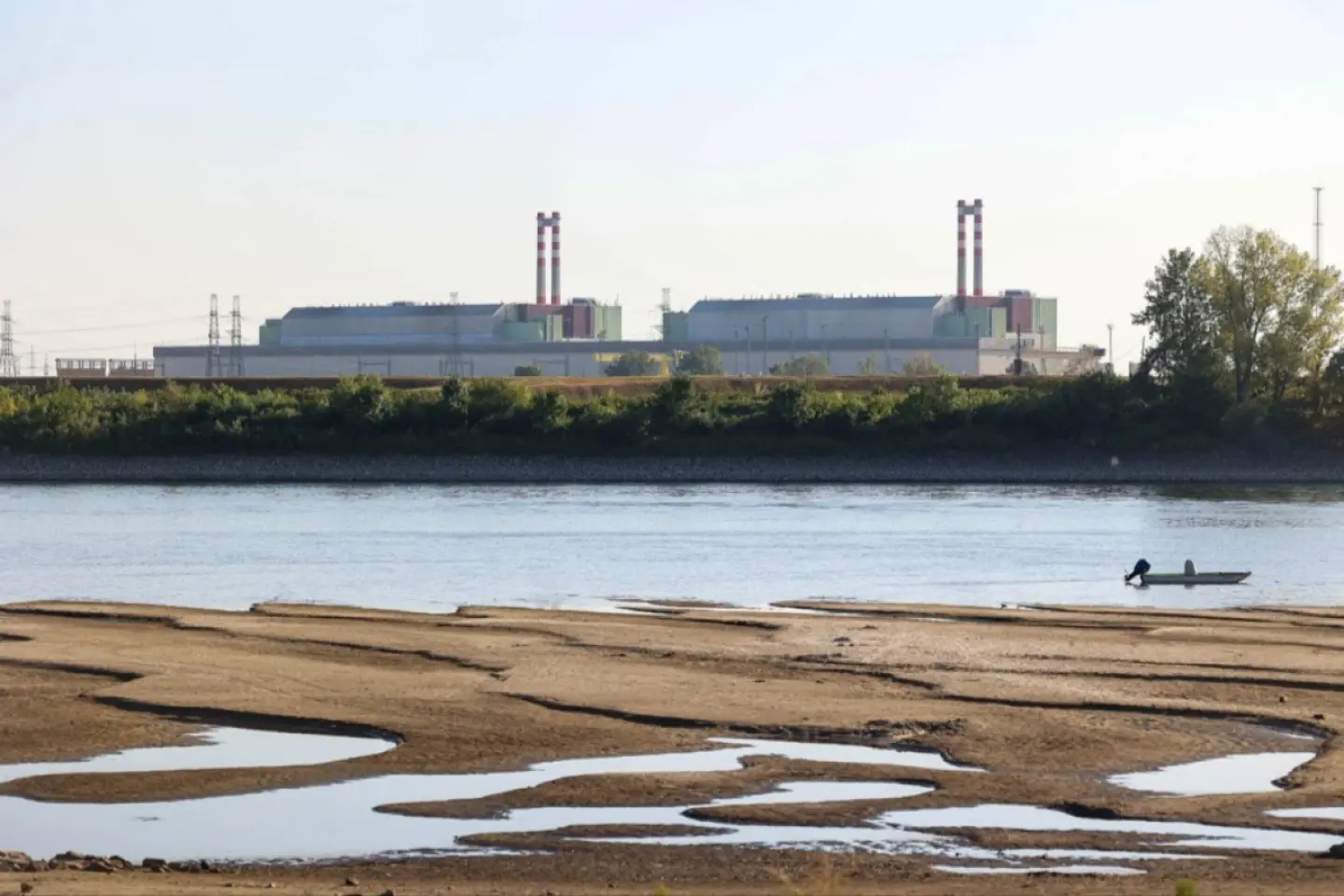
The Rock of Starvation (Ínség-szikla) has been a portent of doom, a cosmic bellwether, in Hungary for centuries, only appearing when the Danube falls low enough to halt mills, bringing ínség (famine). First recorded in 1616, the sandstone rock surfaces during droughts, but this August it emerged almost in its entirety, astonishing geologists sent to examine it.
As Europe's fifth heatwave of 2026 hit, a WWII pontoon bridge nearby also reappeared. Along the Danube, in Bulgaria, a mammoth skeleton; in Prahovo, Serbia, near the Romanian border, German warships, deliberately sunk by Hitler's Black Sea fleet. Hungary, Romania and Serbia were hit hardest, a Hungarian Institute of International Affairs analysis found. Romania's only nuclear plant, Cernavodă, went offline when drought killed its cooling water, disrupting supply as far as Moldova.
In Hungary, groundwater levels in parts of the Great Plain have fallen significantly below their long-term averages, and 90% of the country's historic floodplains are now behind flood-protection dykes. Years of drought and agricultural damage have increasingly exposed the country's vulnerability, until the nation's only nuclear power plant in Paks came within centimetres of going dark. Ínség-szikla has surfaced before. What this summer's low water levels exposed, along with the Danube riverbed, was a lack of transparency.
Paks has been the biggest political story of Hungarian Prime Minister Péter Magyar's first hundred days in power, yet his government has done little to explain how Hungary came to depend so heavily on a Soviet-era reactor, what the controversial and opaque Paks II expansion project will ultimately cost, or what the previous government knew about the risks.
Magyar has supplied plenty of theatre around disclosure. On the substance, however, more than three months into a government that ran on ending this kind of secrecy, he has not yet delivered.
How the Paks Nuclear Plant became The Rock of Starvation
The hardest thing about being prime minister, a British PM once told an inquisitive schoolboy, is "events, dear boy, events". Nowadays, that increasingly means climate events. However, even Hungary's failing harvests have taken second place to the crisis around the plant at Paks. Producing almost half of the nation's electricity, the four-reactor complex draws its cooling water directly from the Danube, a design choice made decades ago that saw it come close to going dark in August.
It became clear that Paks was in real trouble on 2 August, when Magyar warned in a video message posted online: "Tomorrow, for the first time in 44 years, (Paks) will not be generating," calling it "the most critical five days" ahead.
Two of the plant's four units were already offline on 1 August, as the plant ran at around one-quarter capacity. By the early hours of 2 August, it was down to a single turbine and roughly 240MW, about a tenth of normal output. The Danube fell below the minus 134cm threshold that triggers emergency measures, reaching minus 144cm at its lowest point. Magyar announced the plant would completely shut down the following day, though one turbine remained operational, narrowly avoiding a total shutdown.
The fix that held back full closure was rough and ready: soldiers, divers and engineers built an underwater sill across the riverbed, backed by donations of stone and equipment from 326 companies and individuals. Viktor Orbán's own quarry-owning father, Győző, later joined them after receiving public pressure.
Magyar campaigned on ending the kind of secrecy that helped Győző Orbán become a quarry mogul, and nowhere more characterised the opacity of that era in the popular imagination than Paks. This is a test case for whether he means it.
Paks deal signed covertly
It was not Hungarian media, but the Russian state news agency TASS that announced in January 2014 that Orbán and Russian President Vladimir Putin had signed a deal to expand Paks, with no warning even to Hungary's own energy sector. It would be financed by a EUR 10bn Russian state credit line against a contract value of up to EUR 12.5bn. When NIAEP-ASE was named as the main contractor that December, no competitive tender had ever been held. A 2015 law classified most of the contract.
Former MEP Benedek Jávor spent years fighting the secrecy through the courts. After the data protection authority partly lifted the classification, the government still refused to release the documents, forcing Jávor and, separately, HVG to sue. Courts ordered disclosure, and Paks II Zrt published roughly 90% of the contract in March 2019, five years after it was signed. Jávor then found the contract's dispute-resolution provisions were governed by Swiss law, which he argued was illegal for a contract involving national assets, and kept fighting for the rest.
Back in 2015 Magyar was deep in the Fidesz machine, overseeing governmental relations with the EU, but his government has not publicly dug into the deal. Along with the drought, another force has exposed what remains buried around the Paks II expansion: a dogged former MP.
Ex-MP implicates Tisza in Paks corruption
Hungarian Economy and Energy Minister István Kapitány, a former Shell executive, pledged to review Paks II's financing and costs at his confirmation on 11 May. However, months later, the government has apparently not obtained the paperwork of the country's largest infrastructure project. At the same hearing, Kapitány said HUF 3-4tn would be recoverable government-wide by eliminating corruption and overpriced state contracts. In July, with the review still running, Kapitány fired Paks II Zrt's chief executive, Gergely Jákli, without public explanation, an unaccountable personnel decision of exactly the kind the new government was elected to stop.
Ákos Hadházy, a former independent MP and anti-corruption campaigner, went further than Kapitány, and did the disclosure work Magyar had not. He alleges, in a criminal complaint, that Paksi Ipari Park Nkft, the state company acquiring land around the Paks II site, has spent roughly HUF 32 billion (EUR 82.13mn) on property since 2018, at up to 100 times the market rate. Some of the proceeds, Hadházy claims, reached individuals who are now Tisza politicians. Those allegations remain allegations. What is not in dispute is that a lone ex-MP is shedding light on Paks II, but not the party that ran on a promise to halt the obfuscation of the Orbán years.
Magyar told MPs why nothing was done sooner: "36 wasted years", not just Orbán's 16. He added that water has been "politically taboo" since the failed Bős-Nagymaros dam project of the 1980s.
The Danube Circle's campaign against the dam, launched in 1984, became Hungary's largest public protest movement since 1956 and a rare outlet for open dissent against the communist regime. By the time Bős-Nagymaros was abandoned in 1989, it had trained and emboldened activist networks that drove the regime's political collapse.
Confronting environmental realities has effectively remained forbidden across successive administrations. This taboo needs to be retired, along with those around nuclear energy and the question of releasing secret service files, Magyar added.
Addressing the practicalities of the current moment, Hungarian Water Minister Melinda Ujj said Hungary needs to abandon the drainage-based system built to remove water quickly, and shift to one that retains it. Magyar noted that Hungary's ageing infrastructure leaks 20-25% of the country's drinking water, costing an annual HUF 17bn.
Stagnation under Orbán
The Orbán government's actual record on water management was characterised by insouciance, denial and blame-shifting. In 2012 it dissolved the state's own Water Management Scientific Research Institute. In 2023, with drought already a live national problem, Orbán claimed that Hungary did not have a water shortage, but a surplus.
In December 2025, Orbán's then construction and transport minister János Lázár broke the taboo. "I'll share a government secret with you, this comes up a great deal in government circles, today the Great Plain is short 200mm of water on the land, we are heading toward total destruction, the water shortage is a brutal reality, and I can tell you there genuinely isn't a decision on what we want to do about it."
This was not the official party line. Months earlier, rather than acknowledging a domestic policy failure, Orbán's agriculture minister, István Nagy, had blamed Brussels and Tisza for trying to shift drought costs onto farmers.
Fidesz decries Magyar's 'Facebook government'
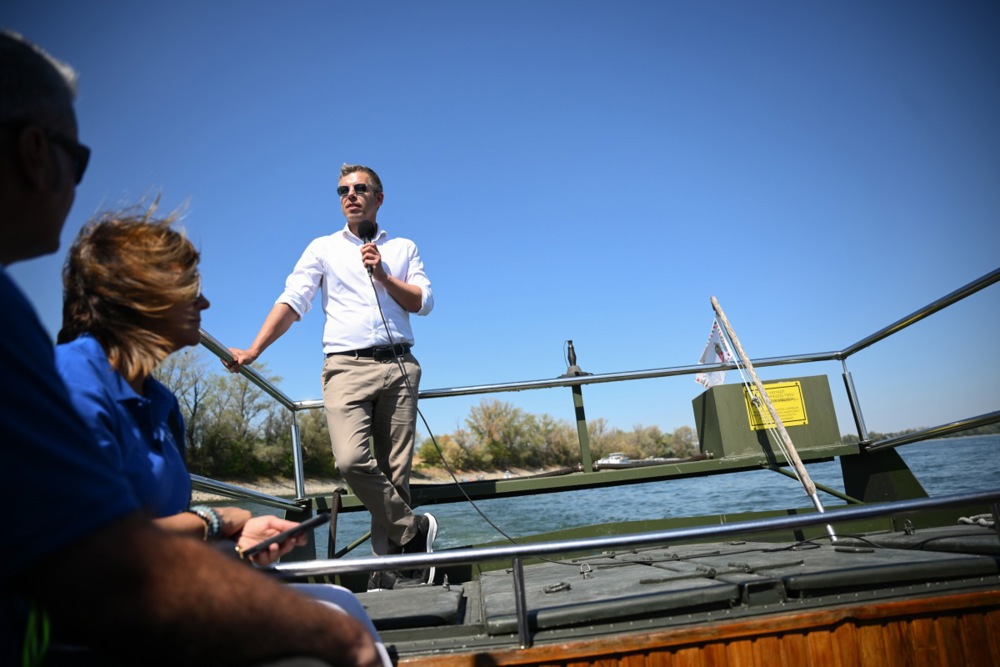
© EPA/BOGLARKA BODNAR. Hungarian Prime Minister Peter Magyar speaks during a press conference on River Danube near the MVM Paks nuclear power plant, Hungary, 15 August 2026. The controlled lowering of barges has begun in Paks in order to raise the water level in the Danube, which is necessary to maintain the operation of the nuclear power plant.
As his government hit its hundredth day in office, the same week the Paks crisis peaked, Magyar claimed over 100 delivered pledges and more than 30 laws and two constitutional amendments so far.
Magyar, who defeated Orbán thanks to a superior online and ground game, narrated much of the Paks emergency live, often from a boat or walking across dried riverbeds. Even Magyar Nemzet, strongly Orbán-aligned even now, ran the scene as an action film starring Magyar. By 19 August he was in a position to tell voters that the plant would soon return to full capacity.
Fidesz settled on "Facebook government" as its attack line, saying improvisation and self-promotion are standing in for governing. This charge was harder to dismiss after Magyar-friendly outlets ran the same line about Paks, as HírTV asked where crisis management ends and self-glorification begins.
Danube Waltz
What the drought actually exposed in Paks was not Magyar's competence, which has undeniably held. It was whether he would use the crisis to reveal how Hungary came to be so vulnerable in the first place.
On 12 August, Magyar and his defence minister flew to a cabinet meeting in Paks by military helicopter while the other ministers took a minibus, months after Magyar himself had taken a swipe at Orbán, saying a real leader "doesn't fly around in helicopters".
While Paks was Magyar's first important test, this summer's presidential selection offered a revealing aside. Having promised a public consultation to select Hungary's next president, Magyar then announced chess grandmaster Judit Polgár on Facebook, forcing a humiliating withdrawal within days when she declined. His second attempt was no better: Tisza hosted a public social media "casting call" for prospective candidates, while the real decision was made behind closed doors in a caucus ballot for András Baka. The public got the photos, while the decision-making process stayed out of sight.
There is nothing inherently wrong with a prime minister showing voters what is happening during a crisis. However, while Magyar's government has been highly visible in showing the public the emergency at Paks, it has been less forthcoming about the contracts around the plant.
That distinction matters because the drought will not be a one-off event. Climate change means Hungary is likely to face more extreme heat, drought and low Danube water levels, putting the same infrastructure under pressure again. Magyar cannot control the weather, but he can control what his government chooses to reveal about the vulnerabilities it exposes.
The Rock of Starvation has disappeared below the Danube tides before, and it will again soon, but climate change means Magyar will face more Paks moments. The question is whether his government will use them to expose the failures that made Hungary vulnerable to climate shocks, or merely stream the reaction videos online.