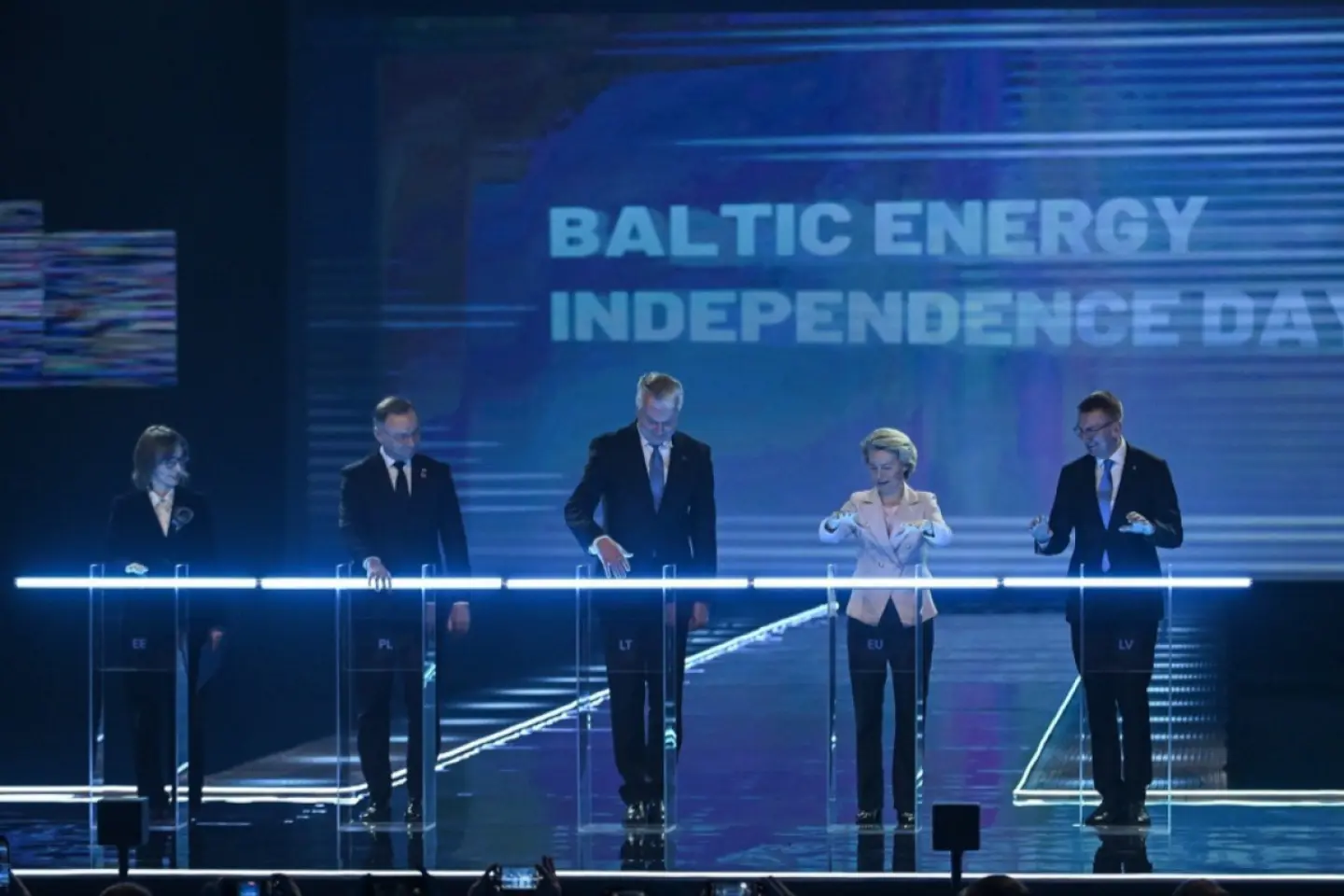
On the morning of 8 February 2025 the Baltic states were physically disconnected from the Russian and Belarusian energy zones. After twenty-four hours in isolated "island" mode, on 9 February the grids of Estonia, Latvia and Lithuania successfully synchronised with the continental European synchronous area. In the course of a single day, the myth that these countries had no alternative to energy dependence on their eastern neighbour was dismantled. They had already proved their economic independence and their competitiveness as members of the European Union; what they are now required to demonstrate is endurance — this time as members of NATO. Why do the three Baltic states still have to work so hard at proving their viability to their eastern neighbour?
Three countries, one history, different problems
It is tempting to treat the Baltics as a single object. The trajectory really is common in outline: independence in 1990–91, a brutal transformational recession, radical liberalisation, EU and NATO accession in 2004, the euro between 2011 and 2015, and a steady reorientation of trade and infrastructure westwards. But the starting conditions differed enough to matter, and the differences explain why the three governments have never behaved identically. Beyond the shared outline there is a long list of divergences, and each of them reveals a different shade of what it means to live next door to Russia.
The first variable is the Russian-speaking population, though ethnicity and language do not overlap perfectly. In Latvia, ethnic Russians made up 34% of the population at the 1989 census; by 2025 the share was 24.1%, while Russian remains the first language for a larger share of residents. In Estonia, the 2021 census counted 315,242 Russians, close to a quarter of residents, with roughly 29% naming Russian as their first language. Lithuania is a different country in this respect: 141,100 Russians, or 5.0%, while Russian as a first language is used by a somewhat larger but still small minority.
This difference explains a great deal — why citizenship and language policy dominated Estonian and Latvian politics for twenty years while Lithuania granted citizenship to nearly all residents in 1991.
The second variable is geography. Estonia has 324 kilometres of border with Russia; Latvia has 332 kilometres with Russia and another 161 with Belarus. Lithuania borders Kaliningrad along 261 kilometres and Belarus along 640 — roughly 900 kilometres of frontier with the Russian bloc, nearly three times Estonia's exposure. Lithuania therefore faces a second-order version of the same problem: Belarus is not only a source of difficult foreign-policy relations in its own right, but also a derivative of the tensions and contradictions built into policy towards Russia.
A dangerous example: the economy
The social and economic development of the three Baltic states after the collapse of the Soviet bloc created a dangerous precedent for Moscow. It showed that even after a painful transition, of the kind Russia itself also experienced, it was possible to build a modern, competitive economy with functioning institutions, a decent level of protection for rights and freedoms, and a political system that did not need to explain poverty by invoking history, geography or hostile neighbours.
In 1991, Lithuania, Latvia and Estonia were hardly in a better socio-economic position than Belarus, Ukraine or the industrial regions of western Russia. They inherited Soviet infrastructure, Soviet housing stock, distorted industrial chains, dependence on eastern markets and energy supplies, and societies unprepared for the social cost of market reform. The difference was not that the Baltic states began from a privileged position. The difference was the direction they chose after independence, and the consistency with which they stayed on that road.
All three countries went through a painful market transformation. They lost part of their labour force through emigration; they liberalised prices, privatised assets, rebuilt their administrations, joined the EU and NATO in 2004, and later entered the euro area, giving up their national currencies: the kroon, the lats and the litas. None of this was painless, and the social price was real. Yet thirty years later, the economic result is difficult to dismiss.
In 1995, Lithuania’s GDP was about $7.9 billion; by 2025 it had reached $95.2 billion, a twelvefold increase in current dollars. Estonia grew from $4.5 billion to $47.0 billion, more than tenfold. Latvia rose from $5.6 billion to $48.6 billion, almost ninefold. Russia’s economy also expanded, from $395.5 billion to $2.56 trillion, but by a factor of 6.5; Belarus grew 6.7 times, and Ukraine, whose trajectory was repeatedly interrupted by political instability and then war, 4.4 times. The point is not that small economies can be compared mechanically with large ones. The point is that the Baltic states converted their smallness into flexibility, openness and institutional discipline.
The same picture is visible in GDP per capita. In 1995, Lithuania’s GDP per person was about $2,183; by 2025 it was almost $32,959. Estonia moved from $3,134 to $34,418, and Latvia from $2,257 to $26,312. These are not merely statistical improvements produced by population decline, although demography matters and will require a separate discussion. They reflect a structural change in productivity, capital flows, trade orientation and institutional environment. By comparison, Russia’s GDP per capita rose from $2,666 to $17,547, Belarus from $1,371 to $10,279, and Ukraine from $933 to $5,866.
For balance, it is worth looking at GDP per capita measured by purchasing power parity. This indicator usually makes Russia and Belarus look stronger, because it adjusts for domestic prices and the availability of goods and services inside the country. On this measure, too, the Baltic picture remains positive, though the gap looks narrower. Between 1995 and 2025, Lithuania rose from roughly $6,023 to $56,838 per person in PPP terms; Estonia from $6,480 to $52,106; Latvia from $5,391 to $46,137. Russia increased from $5,613 to $49,568, Belarus from $3,846 to $34,716, and Ukraine from $4,124 to $18,905.
This is why Moscow prefers PPP comparisons when it wants to present Russia as richer and more efficient than it appears in market exchange-rate terms. PPP is not a useless indicator; on the contrary, it is often necessary for comparing living standards across countries with different price levels. But it also flatters economies with regulated prices, large non-tradable sectors and currencies whose purchasing power is largely trapped inside the national border. A Russian household cannot take its PPP-adjusted dollars to Vilnius, Berlin or Warsaw and spend them at Russian domestic prices. Convertibility, capital mobility, access to larger labour markets and the legal right to leave and return freely are not included in the deflator. They are, however, precisely what the Baltic transformation bought.
An ambiguous example: demography
Demography is probably the most painful part of the Baltic story. It is also the point at which Russian propaganda feels most comfortable: the market transition was too harsh, young people left, the countries emptied out, and the price of “leaving Russia” turned out to be demographic decline. There is enough truth in the first part of this argument to make it politically usable. But the whole picture is more complicated than it first appears.
If population is indexed to 1991, Latvia has indeed lost almost a third of its residents: from 2.65 million people in 1991 to 1.85 million in 2025, a decline of about 30%. Lithuania fell from 3.70 million to 2.89 million, losing roughly 22%. Estonia’s decline was smaller but still substantial: from 1.56 million to 1.37 million, or about 12.5%. These are not abstract numbers.
Belarus and Russia declined less over the same period. Belarus went from 10.19 million people in 1991 to 9.09 million in 2025, a fall of about 11%. Russia’s population decreased from 148.39 million to 143.51 million, or just over 3%. On the surface, this gives Moscow and Minsk an easy line of attack: the Baltic states became richer, but smaller. Yet this comparison hides a decisive difference. In the Baltic case, a large part of the demographic shock was produced by exit: open borders, EU labour markets, the right to work abroad, and individual choices that became legally and practically possible after 2004. In authoritarian systems, people are not necessarily more rooted. They are often simply less free to leave, less able to return, or less visible in the statistics when they do.
The Baltic demographic question is also inseparable from Soviet-era migration. Lithuania, Latvia and Estonia did not inherit only Soviet factories and energy networks; they inherited complex societies shaped by decades of population movement inside the USSR. Hundreds of thousands of people arrived from other Soviet republics, built families, and had children who are now second- or third-generation residents of these countries. This produced a separate layer of political difficulty, especially around language, citizenship and integration. The Russian-speaking population is not distributed evenly across the region, and this is one reason why Estonia, Latvia and Lithuania developed different policies and different political anxieties after independence.
In other words, the demographic story is not simply one of “natives leaving” or “states failing.” It is a story of emigration, ageing, return migration, minority integration, post-imperial settlement patterns and the social consequences of freedom of movement. Open societies lose people in ways closed societies can conceal. But open societies can also regain people in ways closed societies cannot easily reproduce.
This has become visible in recent years. Lithuania’s population, after decades of decline, began to rise again: from about 2.81 million in 2020 to 2.89 million in 2025. Estonia also grew between 2020 and 2024, partly before falling slightly in 2025. The reasons are different but connected: some earlier emigrants returned; Belarusian migration increased after the 2020 political crisis; and after Russia’s full-scale invasion of Ukraine in 2022, all three Baltic states received Ukrainians fleeing war. These new arrivals do not erase the demographic damage of the previous three decades, but they do change the direction of the discussion.
They also create a new test. If the economies continue to absorb new residents, and if the states manage integration without turning it into another front in Moscow’s information war, demography may become not only a weakness, but also a source of renewal.
The stress test now under way
Today, in a region marked by exceptionally high political tension, security has become the main stress test for the Baltic states. Economic growth and demographic resilience still matter, but they are no longer the only indicators by which the success of the Baltic transformation is being tested. The question now is whether three small democracies on NATO’s eastern flank can absorb sustained pressure from Russia and Belarus without losing either their security or the political openness that made their success possible.
All three countries are members of NATO, and this is the foundation of their defence. But NATO membership also makes them a tempting target for probing operations. The deeper Russia becomes trapped in its war against Ukraine, the greater the temptation may be to test the cohesion of the Euro-Atlantic alliance by creating a new source of tension elsewhere. The logic is familiar: manufacture a problem, raise the political temperature, and then offer de-escalation in exchange for concessions on the main front, in this case Ukraine.
This does not necessarily mean a conventional attack. Moscow does not have the military freedom it imagined it had before February 2022, and NATO’s eastern flank in 2026 is not the eastern flank of 2021. But hybrid pressure is cheaper, deniable and repeatable. It can take the form of information campaigns about alleged discrimination against Russian speakers, amplified outrage over the removal of Soviet monuments, cyberattacks, GPS interference, sabotage, instrumentalised migration and border incidents routed through Belarus.
The politics of memory has become one of these pressure points. In the Baltic states, de-Sovietisation means removing monuments, renaming streets, relocating Soviet military memorials from central urban spaces and reinterpreting public memory after decades of occupation. In Moscow’s narrative, the same process is presented as historical vandalism and an attack on Russian identity. This is not only a dispute about the past. It is a struggle over whether the Soviet period should remain a legitimate instrument of Russian influence inside independent European states.
The Baltic answer has been to raise the price of any escalation. Defence spending has increased sharply. According to NATO’s 2025 estimates, Lithuania spent about 4.0% of GDP on defence, Latvia 3.73% and Estonia 3.38% — already among the highest levels in the Alliance. All three have also moved toward even higher defence budgets for 2026, close to or above 5% of GDP. These are not symbolic figures.
This matters politically as much as militarily. The growth of defence budgets cools some of the more adventurous thinking in Moscow, especially when combined with the presence of allied units and the broader reinforcement of NATO’s eastern flank. But it also changes the internal balance of Baltic societies. Defence is no longer a specialised policy field. It has become a central part of social and economic planning, public finance and political identity. In this sense, military resilience has joined GDP, demography and institutions as one of the basic measures of the Baltic model.
Conclusion
Russia’s attitude toward the Baltic states is not driven only by geography, military planning or historical grievance. It is also driven by the example they represent. Lithuania, Latvia and Estonia inherited Soviet infrastructure, Soviet social habits, difficult ethnic and linguistic questions, demographic decline, energy dependence and proximity to Russia. They then showed that this inheritance did not have to determine the future.
Their path was painful and imperfect. The market transition was harsh; many people left; social inequality and regional decline became real problems; integration remains unfinished in places. But the direction of travel is clear. These countries built competitive market economies, joined the European Union and NATO, entered the euro area, disconnected from the Russian-Belarusian electricity system, and turned themselves from former Soviet republics into functioning European democracies.
For the Kremlin, this is a deeply uncomfortable comparison. The Baltic states show that it was possible to do things differently: to leave Moscow’s orbit, to build institutions instead of personal rule, to trade dependence for integration, and to make security a collective democratic choice rather than an imperial bargain.