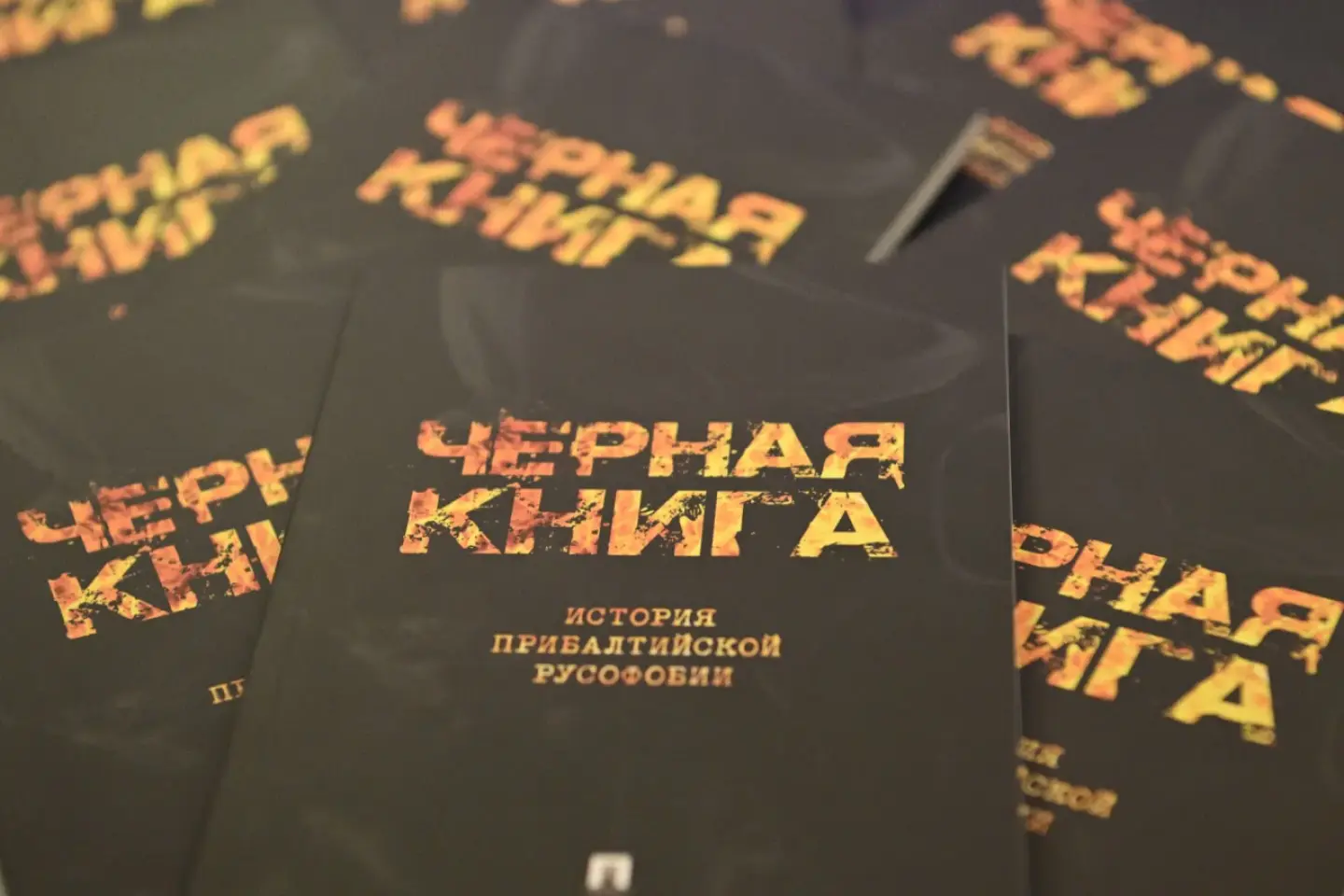
2026 marked the intensification of the Kremlin’s hybrid aggression against the Baltic states. Provocations against politicians and civil activists, mass attempts of illegal migration, organisation of pro-Russian political movements – these are only some of the tools used by the Kremlin to destabilise the Baltics. That’s why it is necessary to elaborate on the narratives, promoted by Russian propaganda in this regard both for inner and foreign audiences in order to understand how the Kremlin wants to shape public opinion.
There are several types of messages, promoted by the Moscow-controlled actors and media, which should be paid special attention to. Let’s describe each of them and give examples.
1. Russophobia as the pillar of the EU
First of all, one has to note that the main word used in regard to the policy in any of the Baltic states is “Russophobia”. It can mean anything – from supporting Ukraine and refugees from this country to restricting the work of Russian agents of influence. On June 19, Russian MFA reported about the presentation of “The Black Book: The history of Russophobia in the Baltic states”. The document was prepared by the Russian military-historical association and is basically the golden collection of anti-European cliches. For example, its foreword is called “Russophobia – the Baltic states’ entrance ticket in the European Union”.
Here is just a part of this foreword just to understand the very character of the document: “Provincial Baltic nationalists receive salaries for carrying out the instructions of the European Union and NATO. Their income comes from taxpayers in the continent’s wealthier countries. They earn their allowances by destroying the Russian language and culture, dismantling monuments to Soviet soldiers, and deploying NATO troops on their territory. Since the beginning of the special military operation, the Baltic states have found themselves among the leading promoters of the global Russophobic agenda. Yet the stronger the desire of the Balts to bring Russia “to its knees,” the more Estonians, Latvians, and Lithuanians find themselves on their knees cleaning toilets in wealthy European countries”.
It is necessary to underline that this kind of straightforward propaganda is presented as a scientific work and promoted by the Russian MFA. This institution and its officials have become possible the main sources of anti-Baltics narratives in Moscow-controlled media both in Russia and abroad. They are also disseminating another message described below, which is closely connected to the first one.
2. Human rights infringement despite “democracy”
On one hand, this narrative is the continuation of “Russophobia” one, meaning that fighting Kremlin’s agents of influence and people not hiding their connections with Russian official institutions is an attack on basic human rights. On the other hand, it also targets international organisations in order to interrupt their work and increase pressure on the Baltic states. These “human rights violations” are submitted to all possible international institutions by numerous (pro)Russian organisations pretending to care about justice and democracy. While Moscow’s (and not only Moscow’s) officials are actively involved in the dissemination of this narrative.
On June 15, 2026, a “Joint Report of the Ministry of Foreign Affairs of the Republic of Belarus and the Ministry of Foreign Affairs of the Russian Federation “On the Human Rights Situation in Certain Countries” was published. Among straightforward messages of hardcore Kremlin propaganda, the authors found space for each of the Baltic states. For example, Latvia is traditionally accused of “Russophobia”: “For Latvian politicians, the Ukrainian crisis has become a convenient pretext for pursuing their Russophobic agenda. Under the guise of combating symbols of “Russian aggression,” the authorities are carrying out another campaign against historical memory and Russian-speaking residents, thereby attempting to divert attention from the rapidly deteriorating socio-economic situation in Latvia itself”.
In the case of Lithuania, one of the main targets of Russian propaganda is Vilnius’ struggle against the Kremlin influence. This is also presented as deterioration in human rights: “Seeking to completely suppress dissent in the country, the Lithuanian authorities are expanding the powers of intelligence agencies. Thus, in late December 2025, the Lithuanian parliament adopted relevant amendments to the Law on Intelligence: Lithuanian intelligence services will now be able not only to collect information but also to take immediate measures to prevent threats without prior court authorization, obtaining such authorization within 24 hours. At the same time, intelligence information may be provided not only to state bodies but also to other organizations involved in ensuring national security. Given the authorities’ repeatedly demonstrated repressive approach toward those who express views differing from the official line, there can be little doubt as to whom such “national security” measures will primarily be directed against”.
While for Estonia the main stress is made on the use of Russian language: “Under Tallinn’s ongoing policy of Estonianizing all spheres of public life, particularly education, Russian-speaking children are not merely being assimilated but are also being deprived of the right to receive education in their native language. This automatically restricts this group of students’ access to quality education as a whole and, consequently, limits their opportunities to maintain a decent standard of living”.
These are only small parts of the report, which is 1769 (!) pages long, 272 of which are dedicated to the Baltic states. It is important to understand that these messages are not only for propaganda use. Note that on May 14, 2026, Russia introduced the law, allowing the use of the army abroad to protect Russian citizens from being arrested or persecuted after the decisions of foreign courts. This is especially important in the case of Latvia, where many pro-Russian activists actually bear Russian passports.
3. Re-writing history and praising Nazis
Another important part of the broader “Russophobia” narrative is connected with history and alleged “heroisation of Nazism”. This one is possibly the oldest, as it has been being used almost since the breakdown of the USSR: the desovietisation of the independent states was labeled as “rehabilitation of Nazism” and “attack on Russian heritage” by the Kremlin propaganda.
Thus, during his briefing on August 6, 2026, Deputy Director of the Information and Press Department of the Russian Foreign Ministry Alexey Fadeev stated the following: “...the official ideology of modern Lithuania, which has become part of “democratic” Europe, seeks to deny the involvement of local nationalists in the murder of civilians and their collaboration with the Nazis during the Great Patriotic War. Moreover, most of the perpetrators of these mass killings are glorified as “freedom fighters”, while mentioning the facts of their atrocities is regarded as a criminal offense. But today’s politicians in Lithuania, as elsewhere in Europe, should not forget that there is no statute of limitations for crimes against humanity and acts of genocide committed by Hitler’s collaborators, whom they now glorify, just as there can be neither forgiveness nor oblivion”.
Although such rhetoric is commonly used by Russian state media and officials towards all Baltic states, the main target in this narrative is of course Latvia. With a significant Russian-speaking minority (at least 34% of the population) this country became an obvious ground for Moscow’s information operations without even hiding its nature. Recently the Kremlin is enraged by the prohibition of demonstration of Russian symbols like “St. George ribbon” during celebrations of “Victory day” on May 9. Destruction of Russian and soviet monuments by the governments of the Baltic states also causes outbursts of anger in the Moscow’s propaganda.
As the result, the official Kremlin sources like MFA state that in the Baltics the “neo-Nazi” policy is being implemented on a state level. In March 2026 the notorious Maria Zakharova traditionally attacked the governments of Lithuania, Latvia and Estonia: “We condemn the ongoing neo-fascist frenzy in the Baltic states. Fascism did not prevail back then, in the 1940s, and today the followers of this most shameful, horrific, and monstrous phenomenon have no future. Those who today attempt to march under banners stained with the blood of millions should remember: retribution is inevitable”.
To crown it all, some Kremlin sources openly state that the Baltics states are ruled by the “descendants of Nazis”. Here is the opinion of the head of Russian military-historical association Mikhail Myagkov: “Today, the Baltic states are governed by people who, in one way or another, regard Nazi collaborators – who were supported by Western elites – as their forebears”.
4. Dehumanisation of the Russian-speaking minority
This is presented as another and maybe the most important branch of "Russophobia". The intention of the Baltic states to get rid of Russian occupation remnants in the country and extend the use of national language is presented as the plan to exterminate the Russian-speaking population. The parallels made by the Kremlin propaganda are quite clear – they directly continue the narrative about “continuation of Nazi policy” and even go further.
In October 2025, MFA explain how they see the language policies in the Baltics states: “Everyone is clear that the self-described 'civilised' Baltic ethnocracies have, in fact, degenerated into outright neo-Nazi dictatorships that strive to achieve the 'final solution to the Russian question' and are not above employing the most inhumane methods."
5. Militarisation at the cost of people’s living standards
It is quite logical, that against the background of growing Russian threats in the region, the Baltic states increased defence spendings as well as started to widen military cooperation with NATO allies. However, each event in the field of defence is appreciated by the Kremlin as a “demonstration of aggressive plans” as well as “total militarisation of the country”. Such materials are disseminated not only by Russian state-controlled media, but first of all by the official institutions and their representatives.
The joint report of Russian and Lukashenko’s MFAs, mentioned above, in regard to Lithuania’s defence activities reads: “Following a Russophobic course, the country’s political elites, like those of the other Baltic states, are reaching a new level of militaristic irrationality: despite protests from local residents, the Lithuanian authorities intend to establish a military training ground covering 14,000 hectares in the vicinity of the settlement of Kapčiamiestis, under the pretext of an alleged threat emanating from Russia”.
This passage includes several important messages, promoted by the Kremlin in regard to the defence of the Baltics. But the main one is that “militarisation” is carried out despite people’s protests and at the cost of other budget spheres. The narrative about the terrible influence of increased defence spendings on the social sphere is also actively disseminated in the Baltic states by various Russian propaganda sources. It is used by local pro-Russian activists and politicians, presenting themselves as fighters for a better future for the people and the necessity of extended social care for the population.
This is what one of such materials from Baltnews – Russian propaganda agency for the Baltics – states: “Estonia, Lithuania and Latvia are becoming an extremely convenient place for the military, but completely unsuitable for the normal life of ordinary citizens… The economies of the Baltic states are eating themselves for political purposes. The militarisation of the budgets of the Baltic republics is de facto holding back social reforms and investment in innovation”.
One has to note, that at the same time Moscow-controlled media and officials are stating the lack of sovereignty of the Baltic states. According to them, the decisions of the “militarisation” are taken by the “real rulers in Brussels”, while local political elites are presented as puppets of the “EU top bureaucrats”, who don’t care about real demands and perspectives of the people.
In conclusion it can be stated that we witness a long-lasting and well-organised information campaign, aimed at dehumanising the nations of Baltic states as well as presenting them a threat for “Russkii mir”, which should be exterminated. At the same time, the work to persuade their population to support “Russian liberation from Brussels’ dictatorship” is actively carried out. While we don’t see any direct military preparation to attack the Baltics from the Kremlin, its actions in the propaganda field obviously gives reasons to think that Moscow is preparing both inner and foreign audiences for escalation against the Baltic states in any form – either hybrid or directly military ones.