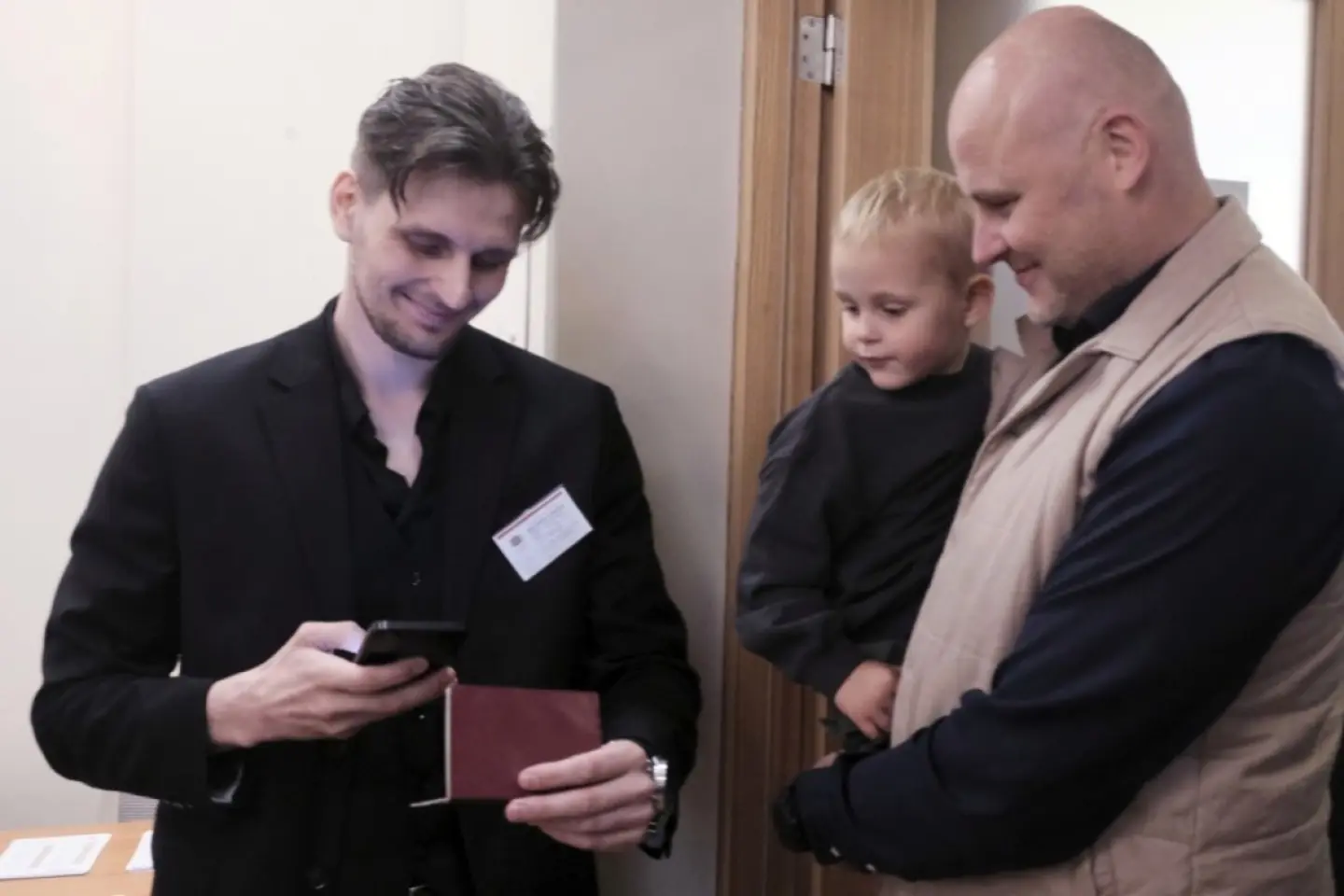
The “United List” alliance, led by Prime Minister Andris Kulbergs, has achieved a historic, major triumph in the Latvian parliamentary elections. However, the victory brings with it a burden of responsibility: while pursuing a pro-Western course, economic problems are compounding an increasingly tense geopolitical situation.
A historic triumph amidst historic passivity
In the Latvian parliamentary, or Saeima, elections held on October 3, the “United List” alliance, led by Prime Minister Andris Kulbergs, achieved a historic success: the “United List” garnered 35.29% of the vote, securing 41 seats in the 100-member parliament. This was a historic achievement, as the highest number of seats previously held by a single party belonged to the now defunct “Alliance “Latvian Way””, which won 36 seats in 1993.
The other parties in the recent election trail far behind the “United List”. “Latvia First”, which came in second, secured 17 seats, though there are doubts regarding the party's geopolitical orientation. On one hand, it declares support for Ukraine, yet its ranks include politicians who have previously made no secret of their sympathies toward Russia. Its supporters include both Latvians and Russian speakers (who make up approximately 34% of Latvia’s population, though only a portion are eligible voters), whose stance on Ukraine and Russia is ambiguous. The “Sovereign Powers/New Latvians” alliance won 15 seats; the group makes no secret of its view that Latvia should remain neutral in Russia’s war against Ukraine and fully restore economic ties with Russia and Belarus. For this reason, the party is considered pro-Kremlin. The “National Alliance” and the left-leaning “Progressives” each secured 10 seats, while the “weary” centrists of “New Unity” obtained seven.
It appears that the “United List drew votes from all these parties to varying degrees, except Sovereign Power/New Latvians. Moreover, it was precisely the United List’s surge that – for the first time in 24 years – prevented the conservative Union of Greens and Farmers from entering the Saeima, as well as We Change the Rules, a party that had proposed changing the electoral system.
However, these elections will also go down in history for a negative “achievement”. Only 51.8% of voters went to the polls. This fact sounds particularly stark given Latvia’s geopolitical situation. With talk of a physical attack by Russian drones – or even missiles – becoming increasingly common, one might expect the public to take a greater interest in the country’s fate. Yet, the opposite has occurred. There is a heavy lack of faith in politicians and political fatigue. Consequently, a significant portion of eligible voters did not turn out for the election at all.
For many of those who went to the polls, meanwhile, the United List and Kulbergs embodied change, hope, or at least “something other than the old guard, about whom there are absolutely no illusions”. A lot of people asked each other whom to vote for. It has frequently been heard in public discourse that the citizens' primary motivation was not support for a specific party, but rather support for Latvia remaining a pro-Western, pro-Ukrainian, and pro-European state. In these circumstances, Kulbergs was a right man in the right situation and at the right moment.
Kulbergs’ Rising Star
Until mid-May, Kulbergs was one of the 100 members of the Latvian parliament, or Saeima. He was a highly visible figure – outspoken and direct – participating in discussions on several pressing economic issues, such as the development of the Rail Baltica railway network.
Kulbergs had been elected to the Saeima for the first time in 2022. Before that, he was known as a businessman and an enthusiast of cars and motorcycles. By May 2026, however, he was a politician still in the process of gaining experience.
In mid-May 2026, the government led by Prime Minister Evika Siliņa – which had been in a state of prolonged crisis – collapsed. Stuck in squabbles among coalition parties, the New Unity politician ultimately resigned. A significant factor was the government's failure to address a series of fundamental issues: the future of the national airline airBaltic was becoming increasingly uncertain; some criticism regarding the development of the “Rail Baltica” in Latvia is rising in Estonia; and, in the realm of defense, Latvia failed the test posed by the incursion of Russian drones into its airspace. Former Defense Minister Andris Sprūds of the Progressives had previously boasted that Latvia has its own “drone wall”, yet when it came time to back up that status with action, the result was failure. Latvia was unable to shoot down the drones on its own. The public, too, seemed weary of the constant squabbling and the arrogance and bureaucracy of New Unity.
On May 28, Kulbergs became Prime Minister, forming a government comprising three parties: the United List alliance, New Unity, and the National Alliance. The Progressives were left out this time. Kulbergs was a breath of fresh air: energetic, highly active on social media, and outspoken – though at times his language was coarse or vulgar. Yet the public liked him; he offered something more energetic than New Unity. The popularity of the “United List”, which had previously hovered between 8% and 12%, soared to unprecedented heights – surpassing 20%. The primary goal for Kulbergs and the “United List” was to sustain this popularity until October 3 – parliamentary election day. For instance, issues such as “Rail Baltica” were left largely untouched, while the decision regarding additional funding for "airBaltic" was delayed as long as possible. And they succeeded.
Coalition of pro-Western forces
Kulbergs and the “United List” he represents are pro-Western, pro-EU, pro-NATO, and pro-Ukraine forces. Both Kulbergs personally and other politicians from this alliance have repeatedly stated that they completely reject cooperation with pro-Kremlin forces or those with an ambiguous geopolitical stance. In other words, “Sovereign Powers/New Latvians” finds itself in deep opposition, as even other parties unlikely to join the government want nothing to do with it. “Latvia First” is also likely to end up in a dead-end opposition, as no other party – with the possible exception of “Sovereign Powers/New Latvians” – wishes to cooperate with it.
Since both the “United List” and its potential coalition partners are pro-Ukrainian and pro-Western parties, Latvia's geopolitical course will not change. In all likelihood, the “United List’s” partners in the new government will be the seasoned “National Alliance” and “New Unity.” The former is a national-conservative party, while the latter is centrist. However, given the significant power the “United List” will hold in the new Saeima – which begins its work on November 3 – responsibility for the country’s development will be largely in the hands of this alliance.
The turbulent geopolitical situation and economic challenges promise difficult times
There is certainly no shortage of problems and difficult issues. First, there is the aforementioned geopolitical situation. Throughout September, officials from various countries repeatedly warned that Russia intends to further escalate the situation in the near future. More specifically, a far more serious attack could be in store for one of the Baltic states, Poland, Finland, Germany, or another nation. In the context of the elections that have since taken place, there was also frequent speculation that the process could be affected by Russian cyberattacks or drone flights over Latvia on election day. However, the election period passed peacefully. However, the new government – which will almost inevitably be led by Kulbergs – may well face situations requiring decisions on matters of fundamental importance to national defense. Therefore, national defense in all its aspects – strengthening the border and the military, cyber defense, cooperation with NATO and nearby neighbors, civil defense, and so on – will be a task for the next government.
The second priority or issue is the economy. However, the new government – which will almost inevitably be led by Kulbergs – may well face situations requiring decisions on matters of fundamental importance to national defense. Therefore, national defense in all its aspects – strengthening the border and the military, cyber defense, cooperation with NATO and nearby neighbors, civil defense, and so on – will be a task for the next government.
The third issue concerns the large-scale, costly projects that are proving very difficult for Latvia to manage. This refers to the aforementioned “airBaltic” and “Rail Baltica”. In mid-September, the government approved the raising of an additional €257 million for “airBaltic” at an annual interest rate of 25%. However, concerns are increasingly being raised as to whether Latvia can afford such expenditure. The Latvian state owns 88.37% of “airBaltic” shares, yet the airline may well have become an excessively heavy financial burden. Clarity must also be reached regarding “Rail Baltica”, the construction of which has stalled; it remains unclear when work might resume and how much funding will be required from the budget.
Finally, long-standing problems in healthcare, education, and so on have not disappeared either.
Will Kulbergs’ star set?
Kulbergs is a popular politician in Latvia, and it is certain to say that he will be re-elected as head of the new government in November. Achieving this requires the support of at least 51 members of the new Saeima, whereas the “United List” holds 41 seats on its own. However, high hopes are accompanied by demanding – and perhaps even unachievable – expectations. Given that Kulbergs’s government will have to make difficult decisions starting in November, the popularity of both Kulbergs and the “United List” will inevitably decline.
The impact of international geopolitical events concerning the security of the entire region on Kulbergs cannot be ruled out either. However, it is currently impossible to predict what that impact might be. It depends on the nature of the threat, the effect on Latvia and Kulbergs, and the government’s response.
In terms of domestic politics, the greatest threats may not even come from other parties, as the “United List” holds a very strong position. Rather, problems could arise from how the party handles the significant power it has acquired. In other words, will it succumb to internal conflicts that fracture its parliamentary faction? Will it become too closely intertwined with the bureaucracy? And ultimately, will it manage to keep a cool head and remain level-headed without becoming arrogant? Not everyone in Latvia’s recent political history has successfully withstood the test of power. Now, it is the “United List’s” turn to undergo this trial. Moreover, a very diverse group of people has gathered under the “United List” brand; for instance, there are differing views regarding sexual minorities. Consequently, maintaining internal harmony may prove challenging.
These three aspects will determine how long the “United List” can remain a unified force in parliament and how long Kulbergs can serve – not even as a star, but simply as Prime Minister.