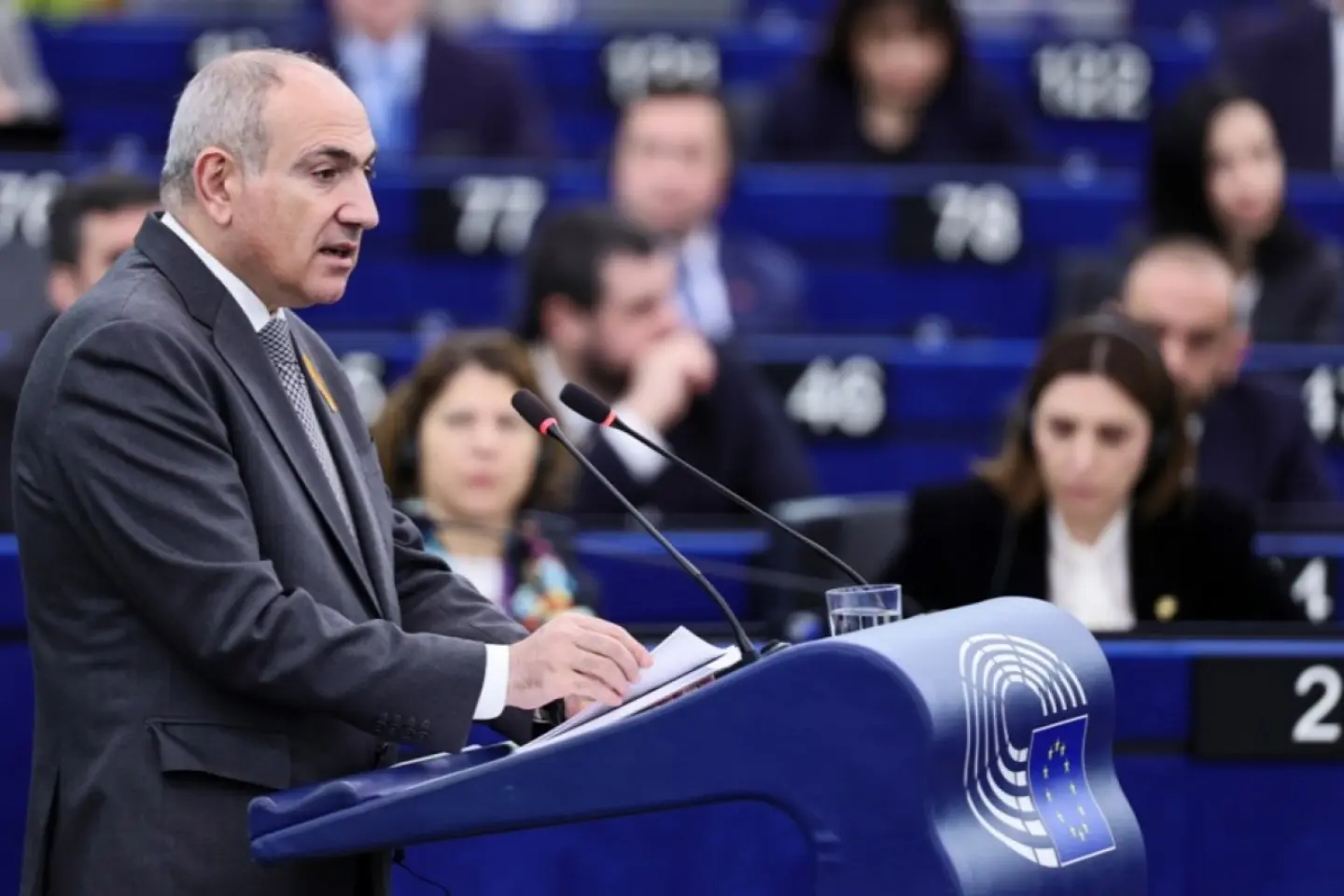
Armenia’s drive away from Russia’s sphere of influence and towards an EU future is being challenged by a wave of pro-Russian narratives, as well as security and economic constraints.
A battle of narratives
In a widely viewed post, pro-Russian blogger Mika Badalyan claimed that the European Union’s main goal is to turn Armenia into "another 'anti-Russia', as was the case with Georgia and Moldova" and drag the country "into an absolute abyss." Badalyan argued that European markets remain closed to Armenian products due to strict phytosanitary norms, predicting that unaddressed economic friction will "inevitably lead to social unrest."
This is one of the main narratives pushed by pro-Russian media, influencers, and politicians. Additional arguments center on energy vulnerability and economic integration. Outlets frequently highlight Armenia’s dependence on Russian energy, warning that leaving the EAEU could trigger gas price hikes or supply disruptions, while emphasizing recent domestic fuel price surges. At the same time, messaging around accession timelines and market barriers often cites Russian officials, such as MFA representative Vladislav Maslennikov, who cautioned on September 22, 2026, that the EU market will not welcome Armenian goods "with open arms," framing European integration as a dangerous "adventure" and warning that EU candidacy could drag on for decades. Maslennikov’s statement was pushed nearly verbatim across Sputnik Armenia and at least four other Telegram channels within 90 minutes.
Underlying all these narratives is a consistent warning, if not an outright threat: moving away from Russia would be dangerous for Armenia.
Conversely, official state messaging presents an entirely different narrative – not only that the way forward is by moving towards the EU (a message that is not quite new), but that it’s already yielding results. Reports on high-level meetings — such as talks between Prime Minister Nikol Pashinyan and French President Emmanuel Macron discussing "economic diversification," space cooperation, and infrastructure projects like the Bargushat tunnel — are reproduced almost identically across dozens of Telegram channels, including bagramyan26, aragarm, and RadarARM. The emphasis here is not on fearmongering narratives but on claimed results.
Behind these diverging narratives lie ongoing shifts in the South Caucasus. How did Armenia, a country historically bound to Russia through deep security and economic alliances, arrive at a point where joining the European Union is a central topic of national policy?
Although Armenia flirted with the EU for years, it got serious about the European option only after Russia failed to protect it
To understand Armenia’s current direction, one has to look at the major security shifts in South Caucasus security dynamics between 2020 and 2023. For decades, Armenia relied on the Russian Federation and the Collective Security Treaty Organization (CSTO) as its primary security guarantors. However, when Azerbaijan launched military operations along Armenia's borders, those traditional security frameworks were viewed in Yerevan as falling short of providing the necessary protection.
Framing the foreign policy shift as a response to security challenges along the country's borders, Prime Minister Nikol Pashinyan questioned the traditional security architecture in a September 2023 interview with La Repubblica, stating: 'Depending or linking to only one center in the security sphere is in itself a strategic mistake.' Following this rationale, Armenia turned toward Western partners, most notably the European Union, to diversify its foreign policy, build institutional resilience, and secure new economic and defense partnerships.
While the recent debate over EU membership feels sudden to outside observers, Armenia’s alignment with European standards has developed over several years through contractual frameworks.
The primary legal foundation of this relationship is the Comprehensive and Enhanced Partnership Agreement (CEPA), which was signed in 2017 and entered fully into force in March 2021. CEPA serves as a practical roadmap for reforming Armenia’s judiciary, updating economic regulations, and aligning domestic laws with European standards.
In early 2023, this partnership introduced a new security component when the EU deployed a civilian monitoring mission (EUMA) along Armenia’s international border with Azerbaijan. This marked the beginning of a deeper security engagement:
In April 2024, the EU announced a €270 million Resilience and Growth Plan (2024–2027) aimed at supporting Armenia's socio-economic stability and civil society. This was accompanied by non-lethal defense support through the European Peace Facility (EPF), which approved an initial €10 million package for the Armenian Armed Forces in July 2024, followed by an additional €20 million allocation in early 2026 to support mobile field camps and logistical capabilities.
Institutional and economic integration further expanded with the launch of the Visa Liberalization Dialogue in September 2024—establishing benchmarks toward a targeted visa-free regime by 2029․ On the legislative front, the Armenian Parliament passed the Law "On Launching the Accession Process of the RA to the EU" on March 26, 2025, formally embedding European integration into national policy. By July 2026, the bilateral relationship introduced a dedicated security component with the launch of the EU Partnership Mission in Armenia (EUPM), a civilian mission designed to assist Yerevan in addressing cyber threats, foreign information manipulation, and illicit financial flows.
Also, the European Council agreed in September 2026 on temporary autonomous trade measures, suspending import duties on roughly 80% of Armenian industrial and agricultural exports to the EU for two years to cushion the economic impact of Russian sanctions.
Why getting away from Russia is not that easy: from internal opposition to economic and security issues
Armenia’s foreign policy shift toward the EU has met strong resistance. The parliamentary opposition frames the European vector as a dangerous geopolitical gamble, arguing that severing historic ties with Moscow risks immediate economic ruin and severe security fallout.
The opposition does have a point. Because Armenia remains a formal member of the Russian-led Eurasian Economic Union (EAEU), Moscow holds substantial structural leverage. Russian state entities control critical energy infrastructure in Armenia, including natural gas distribution and nuclear fuel oversight. While Russia traditionally served as the primary export market for Armenian agricultural produce, trade restrictions introduced earlier this year have effectively brought these shipments to a standstill.
Furthermore, legal complexities remain. Under Article 118 of the EAEU Treaty, withdrawing from the Eurasian bloc requires a six-month advance written notification—a notice Yerevan has not yet submitted. The government’s stance is that an official application must be submitted, negotiations conducted, and clear terms established before asking the electorate to cast their ballots.
Security considerations add further structural factors. While Armenia has incrementally scaled back Russia's security footprint – withdrawing Russian border guards from Zvartnots Airport, post-2020 border posts, and the Meghri border crossing with Iran – Moscow retains a military presence. This includes the 102nd Military Base in Gyumri and border guard units operating along the frontiers with Turkey and Iran under the 1992 bilateral treaty. With border delimitation and a peace agreement with Azerbaijan still pending, these established security arrangements remain part of Yerevan's strategic calculus, making foreign policy diversification a delicate balancing act.
The way forward
As external pressures mount, domestic political forces in Armenia are divided over how to handle the timing of an EU membership application.
In late 2024, a civic petition campaign known as "EuroVote" gathered over 60,000 signatures to push for an immediate nationwide referendum on EU membership. Pro-European civil society groups argue that an immediate public vote would provide an undeniable popular mandate, forcing a clear exit from EAEU frameworks and insulating the country from external leverage.
For its part, the Armenian government emphasizes a sequence-based approach. While acknowledging that joining any supranational organization legally requires a public referendum, officials maintain that a vote should follow formal negotiations and a concrete accession roadmap. Addressing parliament in September 2026, Prime Minister Nikol Pashinyan outlined this framework, stating: 'Our task at this stage is to create a realistic alternative for the people of Armenia, and once that alternative is realistically formed, the time will come for the public to express its stance.
Armenia's European integration remains an evolving policy vector shaped by ongoing institutional steps, legal frameworks, and broader geopolitical realities. Its long-term trajectory will continue to be influenced by both domestic decisions and shifting external conditions.