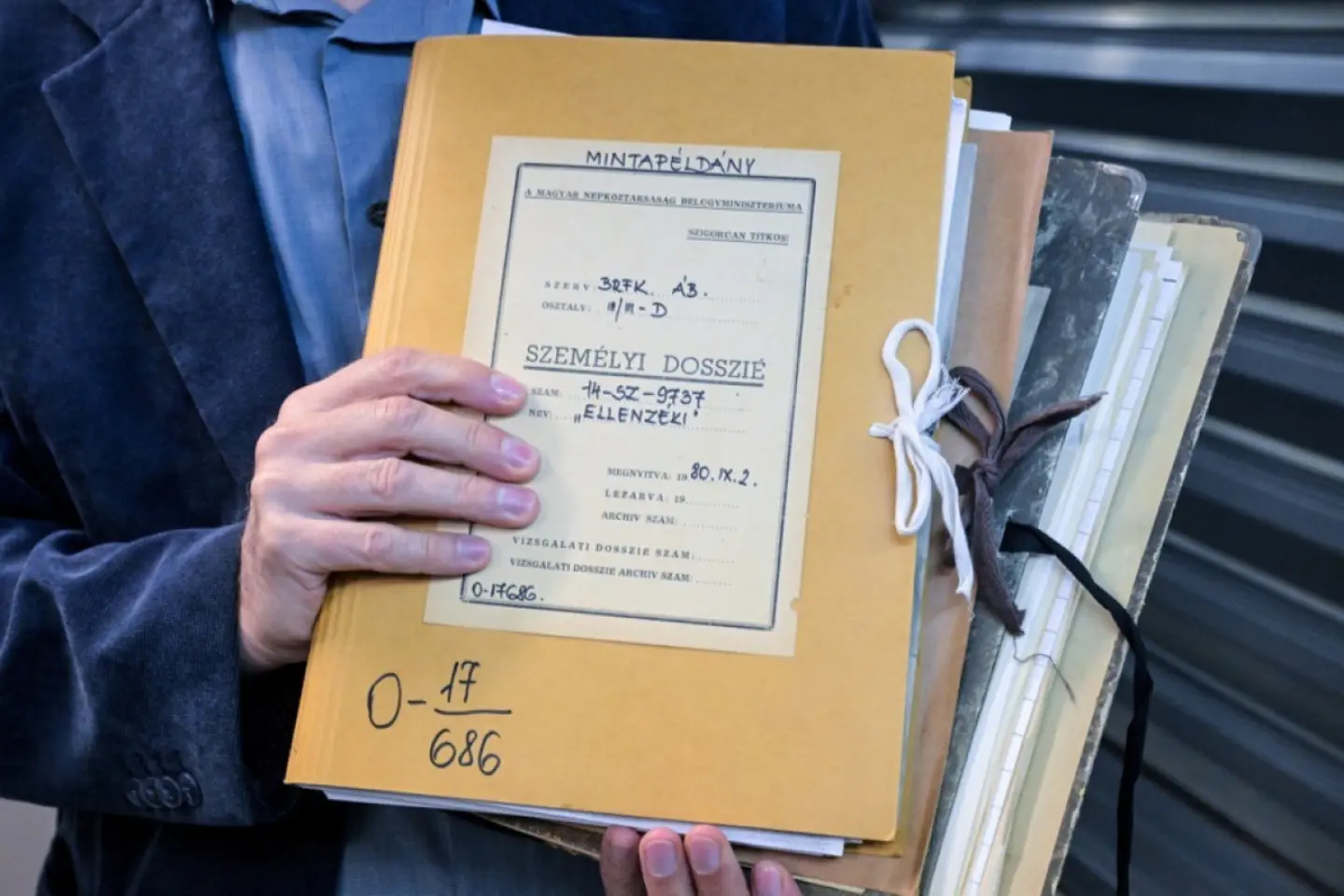
In the Socialist era, Hungarian secret police devised one of the most inept codenames in espionage history. János Kenedi, a scruffy dissident activist, was known to the security services as Elnök (President). It was hardly subtle.
Kenedi carried messages between revolutionary groups during the 1956 Uprising against the Soviets as a child. When Soviet tanks crushed the Prague Spring in 1968, Kenedi opposed the invasion, distributed samizdat, and lost his publishing job. Shut out from formal employment, he survived for years on odd jobs.
In 2007, the Socialist government, led by the successor party to his former persecutors, asked Kenedi, by then a venerable historian, to make sense of the communist security records.
His seven-person panel reported the following year that while most surviving files were at the Historical Archives of the State Security Services, about 8% - some 320 metres of material - remained locked away with intelligence services. Kenedi called for putting all these documents online, unless they represented a threat to national security. In 2009, a separate committee of computer specialists began recovering data from 18 magnetic tapes whose existence had been known since the mid-1990s.
The September Act and the November Release
Viktor Orbán abolished the Kenedi Committee when he returned to power in 2010. Under Orbán, another body re-examined the remaining records in 2015, transferring them - incomplete and partly classified - to the historical archives in 2017.
Having unseated Orbán after 16 years in power, Prime Minister Péter Magyar is now following up on his Tisza party’s election pledge to open the agent files through the Disclosure of State Security Documents Act.
Passed in September with no dissenting votes, the law will see thousands of previously secret dossiers uploaded onto searchable public databases. Magyar has called the project a “debt to be repaid”, while Bálint Ruff, who heads the Prime Minister’s Office as deputy prime minister, considers it his “number one task”.
This upcoming release is only the latest chapter in a 35-year struggle over communist-era memory. Ever since 1989, successive Hungarian governments have wrestled with how to identify collaborators without allowing political elites to weaponize or sanitise the state security legacy.
Magyar originally promised that the database would go online in time for the 70th anniversary of the 1956 Uprising. Parliament initially slated 20 October, but Tisza proposed moving the date to 4 November to give archivists more review time.
The first release on 4 November will include the hatos kartonok (“No. 6 index cards” used for recording network agents and recruitment candidates), B-registers and unclassified data from the H database recovered from the magnetic tapes.
The B-dossiers, the recruitment files themselves, will follow progressively, with the process scheduled to be completed by 25 February 2027. Sensitive personal details regarding health, addiction, and sexual orientation will be redacted.
In January 1990, security services copied three raw databases onto the magnetic tapes: G (operational records), H (network agents), and K (counter-intelligence). Parliament has narrowed the original bill to release only H, meaning next month’s release will only cover a fraction of the tapes' contents. In 2017 the archive itself cautioned that the tapes cannot replace records that were destroyed or never transferred.
Kenedi knew the problem from the inside. Reading an eight-page report on himself, he found that the political police had recorded real events and conversations, but had also exaggerated some of what they knew. That is the peculiar nature of the archive: it can preserve the truth while simultaneously distorting it.
Opening the files is necessary, but it doesn’t reveal “the past”. It reveals what survived destruction, institutional battles and political control of the archive. Whoever controls classification still controls part of the story.
The searchable archive is expected to include 50-60,000 names. These are not the total number of people who appeared in the state security system. At least 150,000 people passed through its networks during the Rákosi and Kádár eras, according to Hungarian Historical Archives director Gergő Bendegúz Cseh, but significant amounts of documentation were destroyed or remain inaccessible.
Decades of File Destruction
After the fall of communism key issues for Hungarians were identifying collaborators and deciding whether they should hold power in the new democracy, in light of the Stalinist terrors, the brutality and mass displacements of 1956, and decades of state surveillance. Hungary has spent three and a half decades inching these files open through screening laws, commissions, court cases, and partial releases.
The battle has never been merely about access to files. Hungary has spent decades fighting over how its 20th-century past should be remembered, from the House of Terror, opened under Orbán’s first government, to the more assertive state-sponsored historical narrative that followed his return to power in 2010.
Even as Hungary transitioned to democracy, the security apparatus did not stop. The 1990 Duna-gate scandal exposed ongoing surveillance of opposition figures and file destruction. The Kenedi Commission later found that large-scale, unlawful shredding continued into 1995.
The boundaries between the services were not clean either. A 1994 Constitutional Court review found that III/III - the branch of internal political surveillance - regularly shared personnel and information with other security services. Records removed during attempts to purge III/III did not necessarily disappear from the state apparatus: some were moved elsewhere.
The Limits of Transparency
After the new law was passed, Fidesz parliamentary caucus leader János Bóka argued that behind the fanfare of the archive opening, the real effect will be “greater government control over the process”.
Bóka has a point: the government will have considerable influence over the machinery that decides what can be seen. But it is also difficult to hear the complaint without remembering that the Orbán government abolished Kenedi’s committee in 2010, after which intelligence agencies retained control over material it had identified as still outside the archives.
The new law at least creates a route into that material: the 13-member committee can inspect classified records held by the intelligence services and recommend that their classification be lifted. However, it is the classifier, not the committee, that will get the final say. If the classifier rejects a recommendation, the government will be informed, but the law does not give the committee an independent power to overturn the decision.
The committee is government-appointed, with the chair and four members nominated by the national-security ministers, six by the culture minister, and two by opposition parliamentary groups. Its chair is historian János M. Rainer.
Since 1989 there has been no single reckoning, but sporadic leaks. In 2002, then prime minister Péter Medgyessy was outed as a former counter-intelligence officer. Ironically, Medgyessy’s Socialist-Free Democrat coalition had passed legislation ordering further transfers to the archives that same year. Though a screening panel found no proof he had acted as an agent or informer, his standing was permanently damaged by the scandal.
Even some of those who were watched are uneasy about what comes next: musician Péter Müller, whose underground band Sziámi was targeted by the security services, has questioned whether people accused of collaboration should now be singled out and shamed decades later.
The case of Béla Biszku best highlighted the gulf between evidence and guilt. The former interior minister and architect of post-1956 repression was convicted of war crimes in 2014 and sentenced to five and a half years in prison. An appeals court ordered a retrial, and in December 2015 he received a suspended sentence on lesser charges after judges ruled that his part in the decision to shoot could not be proved beyond reasonable doubt.
In 2015, Viktor Orbán was accused by his old friend turned nemesis, Fidesz founder Lajos Simicska, of reporting to military counter-intelligence during their 1980s army service. Orbán denied acting as an agent, saying he had rejected recruitment attempts.
Orbán’s “A-card” (informal contact) and No. 6 card (attempted recruitment) both surfaced online. The records indicated the recruitment attempt was abandoned, but provided no definitive conclusion. That ambiguity is characteristic of post-communist Hungary, and precisely the kind of question that the archive may answer.
The Political Risks of Opening the Files
There have been versions of this drama elsewhere. In Poland, the first big attempt at lustration - vetting public figures for past cooperation with the communist security services - brought down a government in hours.
In June 1992, then interior minister Antoni Macierewicz delivered a list of 64 sitting politicians. Names included then Polish president Lech Wałęsa and parliamentary speaker Wiesław Chrzanowski. Jan Olszewski’s government fell in a no-confidence vote that night. But the list showed only who the security services had recorded as collaborators, not necessarily who had actually collaborated. On 19 June 1992 the Constitutional Tribunal ruled the Sejm resolution behind the list unconstitutional, partly because those named had no way to appeal.
The Wałęsa case became a defining political controversy for decades: in 2000, Poland’s Lustration Court ruled that Lech Wałęsa had told the truth in denying he was the secret agent “Bolek”, because it could not establish whether the surviving documents were genuine or fabricated. In 2017, prosecutors concluded that many were authentic, including handwritten reports and receipts, though Wałęsa still says they were forged.
Czechoslovakia produced its own cautionary tale about the dangers of treating an archive as a verdict. Among those caught up in the country’s lustration system was dissident Jan Kavan, who was accused of collaboration with the communist agency StB. In 1996, after years of legal proceedings, a court completely exonerated him.
Hungarians have struck a cautious tone. “As both an archivist and a historian, I believe that passing judgment based on this information is inappropriate,” Cseh said.
The Kenedi Curse
Kenedi once remarked that he had never loved any work as much as investigating state security files. He spent decades researching the secrets of the state that had surveilled him. He caught glimpses through commission work, but died last November before seeing the whole picture.
Now, almost two decades after Kenedi led his commission, the Magyar government is attempting to open material that he spent years trying to bring into public view. From 4 November, tens of thousands of records will become searchable for the first time. Yet the core dilemma persists: this archive is not a pristine 1989 record, but what remains after destruction, institutional decisions and classification.
For families in the files, a searchable database may answer questions that have lasted generations. For historians, it will provide evidence that has been missing or inaccessible for decades. But the deeper test of Magyar’s government will be whether it can avoid replacing one form of control over Hungary’s past with another.