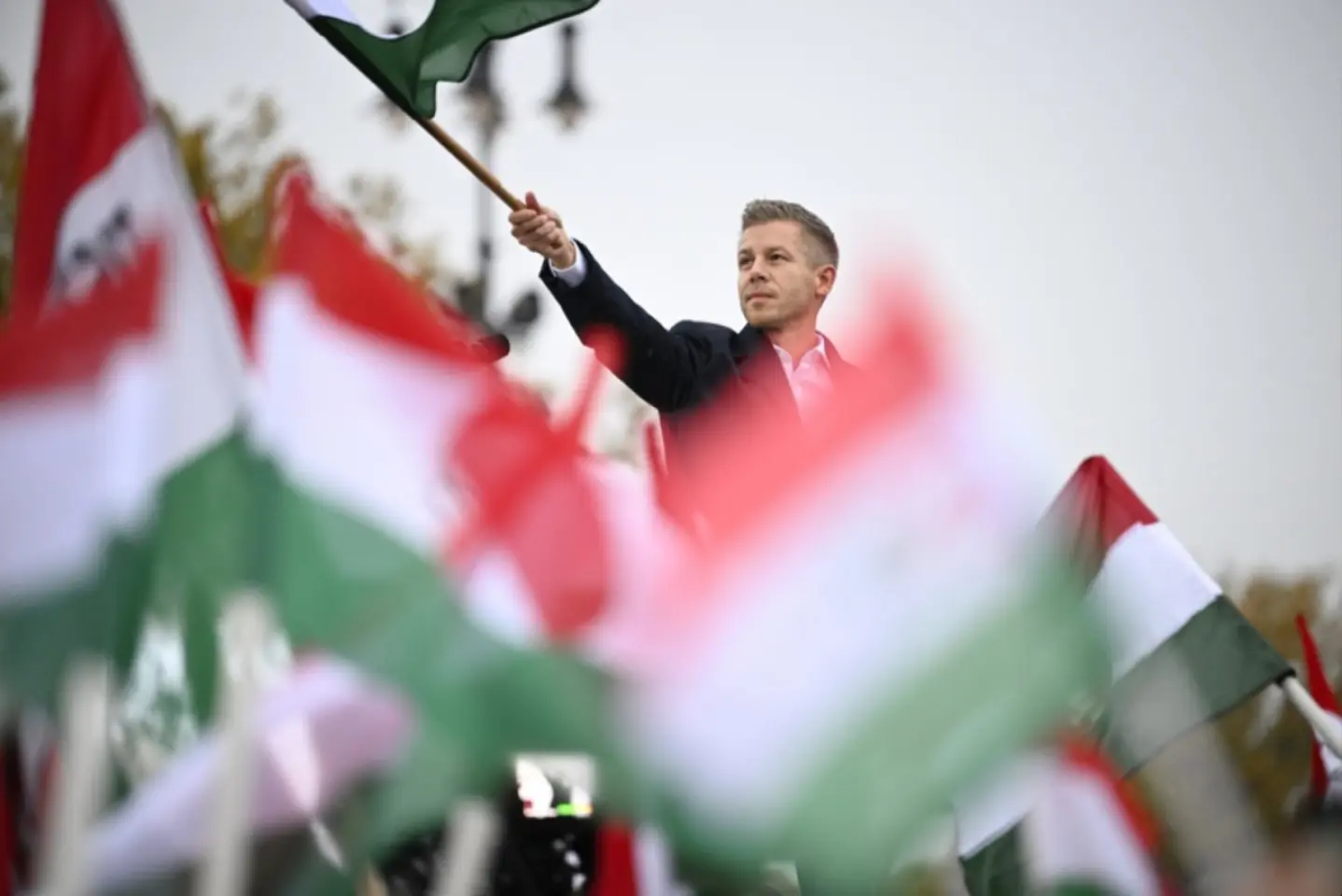
For years, Fidesz has grown accustomed to campaigning from a position of inevitability. Billboards calmly said “Viktor Orbán, the prime minister of Hungary”, presenting his next election win as a fait accompli.
Not this time. As the 12 April national elections are approaching, Fidesz has been trailing in the polls behind the new TISZA party for over a year. Orbán, 62, may have become a global figure of the right, but his current focus on domestic campaigning speaks to unease at the centre of the system he built.
The enemy within
TISZA leader Péter Magyar, 44, is a former Fidesz insider and the ex-husband of former justice minister Judit Varga. He offers a familiar blend of national conservatism, but without Orbán’s corruption scandals, Kremlin proximity and permanent confrontation with Brussels.
Unlike earlier challengers, Magyar cannot easily be dismissed as an external agent or foreign-backed interloper. Fidesz has struggled to find lines of attack that resonate.
Magyar has also avoided the identity politics and culture-war framing on which Fidesz has long relied. In doing so, he has denied the governing party the simplified narratives that underpinned its previous victories.
He projects a confidence that recalls Orbán’s own early political rise. “It’s like looking in the mirror and seeing yourself twenty years ago,” one Fidesz politician told Telex, speaking anonymously.
Fidesz outmanoeuvred early
Fidesz’s predictability and Magyar’s agility were exposed when Fidesz launched its campaign slogan Biztos választás (“safe choice”). TISZA swiftly purchased the matching domain and offered to sell it back for HUF 5bn, suggesting the funds be used to buy winter firewood for those in need. A party designed to neutralise external challengers was wrong-footed by a defector who knew its habits in advance.
Last summer, András Gyürk, who had overseen Fidesz’s victorious national campaigns since 2010, stepped back from his role by “mutual agreement”. Gyürk was no figurehead. He ran the central campaign staff and coordinated the apparatus that turned leadership decisions into action.
Orbán concluded that the campaign had stalled and that technical fixes would not be enough to stop TISZA’s momentum. That judgement placed him at odds with parts of his own apparatus, including long-time communications chief Antal Rogán and informal strategist Árpád Habony.
The Hungarian PM responded by reshuffling the leadership, elevating his political director Balázs Orbán (no relation) and bringing János Lázár into the core team. The message was clear well before the changes were formally acknowledged: tighter control from the centre, and a search for new lines of attack.
Old habits, diminishing returns
For years, Fidesz has campaigned on stark binaries: order versus chaos, nation versus enemies, stability versus betrayal. Magyar has complicated that model by refusing to engage on those terms.
As a former insider, he cannot easily be folded into the familiar gallery of villains. Attempts to link him to foreign interests, including insinuations of Ukrainian intelligence ties, have failed to gain traction. Culture-war themes have struggled to catch.
Fidesz has instead leaned on procedural tools. National “consultations” have been repurposed as tests of organisational strength. One such campaign, Voks2025, framed around Ukraine’s EU accession, served not only to persuade voters but to measure the performance of constituency MPs. Minimum signature targets were set, with underperforming local leaders quietly marked for replacement, according to party sources. According to Orbán’s campaign launch speech, 65 MPs will return as candidates in April, alongside 41 newcomers.
Online engagement has lagged, and the campaign drew mockery rather than enthusiasm. On the prime minister’s own Facebook page, a post promoting a consultation on alleged TISZA tax plans attracted more derision than approval.
Missteps necessitate recalibrations
Orbán’s difficulty is not a lack of resources. Fidesz still dominates media, funding and state capacity. Nor does he face a united opposition.
The problem has been judgement. Last June, the government quietly shelved a proposed “transparency law” targeting foreign-funded NGOs and media after internal resistance and concerns over its communicability. Even within Fidesz, there were fears the measure would alienate rural civil organisations closely tied to its own municipalities.
Other miscalculations followed. An attempted ban on Budapest Pride backfired, drawing record attendance after organisers defied the prohibition. A senior government official later described the episode as an “own goal”.
For a party accustomed to presenting victories as foregone conclusions, the campaign now feels reactive. Messaging is defensive, as Orbán is pulled back into day-to-day oversight of a machine that no longer runs smoothly on its own.
Aura of inevitability fades
The roots of Fidesz’s dominance lie in 2006, when Orbán’s defeat convinced him that episodic campaigning was a vulnerability he would never again tolerate. Enemies were identified early and kept alive long after polling day. Former Socialist prime minister Ferenc Gyurcsány became a standing symbol onto which corruption, chaos and national decline could be endlessly projected. Electoral-law changes flattened fragmented opposition forces into a single hostile caricature.
Since 2008, when Fidesz teamed up with the late spindoctor Arthur Finkelstein and other advisors linked to the US Republican Party, it has increasingly won elections on a single narrative. The 2010 parliamentary elections focused on the previous eight years of Socialist governance and 2014 relentlessly pushed utility price cuts. When Finkelstein died in 2017, the campaign machinery rolled on, winning on an anti-migration ticket in 2018. By that point, independent election observers were publicly settling on “free but not fair”, while privately arguing over whether the word “free” still applied to Hungarian votes.
After the 2022 campaign on war, Orbán secured the largest majority of Hungary’s post-communist era, after once again constructing an all conquering narrative that targeted the existential fears of the masses, told without restraint in his ever expanding government-controlled media empire.
Unlike previous cycles, Fidesz enters this campaign not only without a commanding lead and without a dominant narrative. Social media dynamics now favour agility over saturation, while new EU transparency rules have curtailed targeted political advertising. Rural MPs have begun to worry about their own prospects. Party insiders privately concede that Magyar should have been taken seriously sooner.
Having now settled on three main campaign themes: the threat of war in Europe, migration, and "gender ideology", Fidesz remains the favourite to win. However, the margin matters. In earlier elections, victory was presented as confirmation of an already settled order. This time, the campaign feels managerial rather than triumphant. Mobilisation has replaced confidence. Control has replaced momentum. Orbán may yet prevail, but while the permanent campaign continues, his aura of inevitability does not.