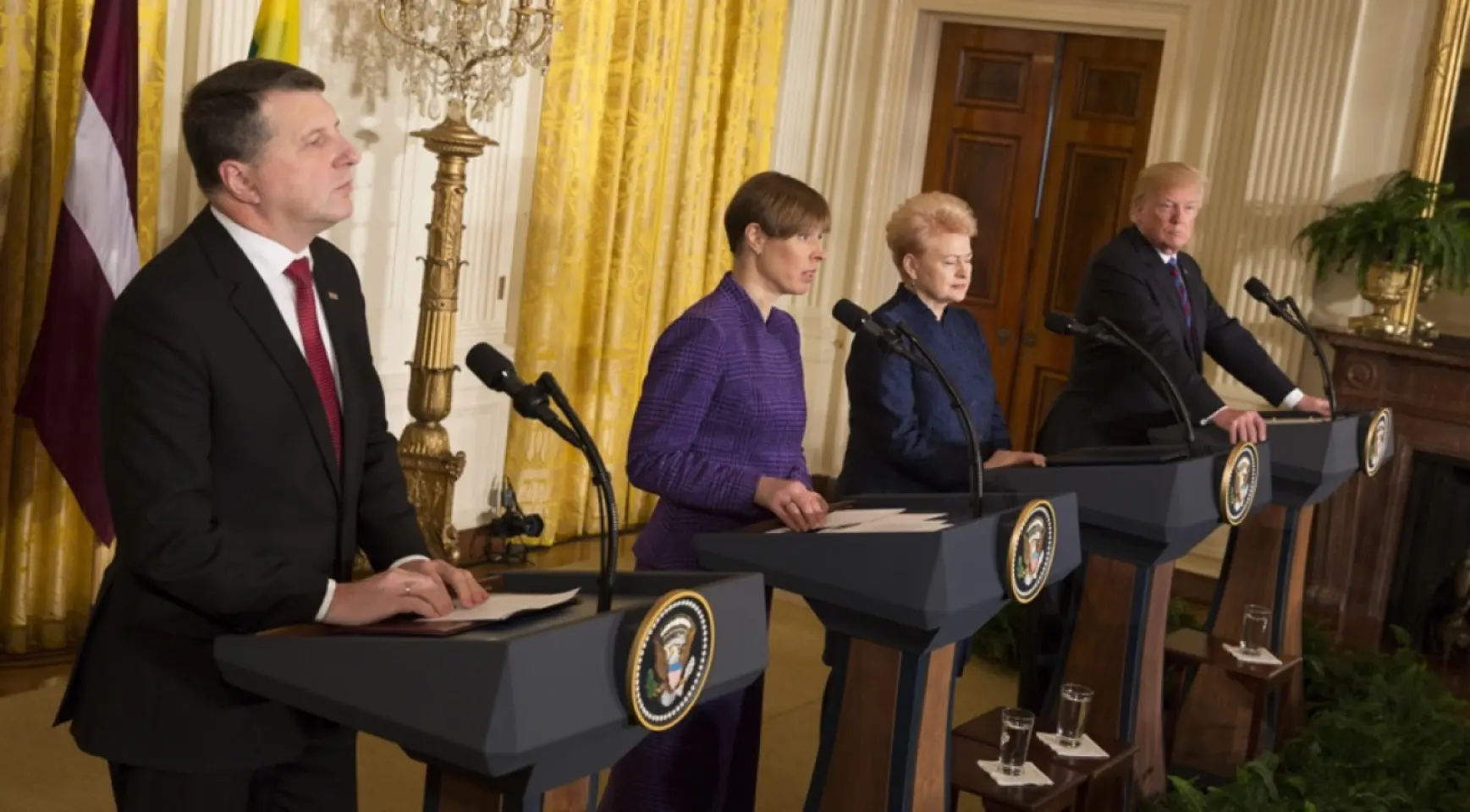
The U.S. president’s claims to Greenland have to be taken seriously, even if he confuses it with Iceland. In Estonia, the twists and turns of American politics are being watched with particular anxiety.
“It’s frightening when the president of the United States spouts such nonsense: ‘For 20 years NATO has told Denmark that you must free Greenland from the Russian threat. Unfortunately, Denmark has been unable to do anything about it. Now the time has come — and it will be done!!!’ We could say the same: ‘For 20 years Estonia has told NATO and the U.S. about the Russian threat. Unfortunately, neither NATO nor the U.S. has been able to do anything about it. Now the time has come — and… the U.S. (the president) is taking us apart itself!’” former Commander of the Estonian Defence Forces Martin Herem wrote on Facebook after yet another striking statement by Donald Trump.
Were the sacrifices in Afghanistan in vain?
The geopolitical storyline surrounding Greenland does more than merely worry Estonia: a situation in which the habitual guarantor of international law signals almost daily its readiness to violate that very lae in its own interests threatens the Baltic states with, if not a loss of sovereignty, then an increased likelihood of military conflict on their own territory. The weaker NATO becomes, and the more readily leaders of major countries act on their own notions of law and morality, the greater the temptation to follow suit as soon as an opportunity arises.
Leaders of countries whose territory suddenly becomes contested understand this well and are trying to urgently join forces. In this context, the state visit of the Danish royal couple to Estonia, in late January, was a significant event. King Frederik X and Queen Mary were accompanied by Denmark’s minister of defence and minister of foreign affairs. The focus was on regional security cooperation, as well as support for Ukraine, which has been defending itself for four years.
Estonia also almost immediately stated its readiness to send military personnel to exercises in Greenland. Defense Minister Hanno Pevkur clarified that this does not imply a confrontation with American soldiers. “The exercises, Arctic Endurance, which are already underway, are an opportunity to demonstrate solidarity with the Nordic and European countries, as well as to show that we are ready to rapidly scale up exercises if necessary, and to quickly redeploy troops from one NATO region to another to practice various tasks. In that sense, of course, no one is planning anything like NATO countries conducting operations against one another,” he said.
Estonian politicians din not welcome the American president’s claim that troops from US’ NATO allies in Afghanistan stayed away from the front lines. Across the alliance, Trump’s dismissive statement triggered a strongly negative reaction, and Estonia was no exception.
In response to the American president’s statement, former chair of the foreign affairs committee Marko Mihkelson shared telling statistics on X, showing that Estonia ranks third — after Denmark and the United Kingdom — in fatalities per capita in the Afghan mission.
“My countrymen. I went to every funeral,” commented on X former president Toomas Hendrik Ilves, the most “American” of Estonia’s politicians, who grew up in the United States.
The incumbent president, Alar Karis, listed by name the Estonians killed in Afghanistan: “Estonian soldiers were together with their allies on the front line and defended the foundation of NATO’s collective defense, Article 5. This was a shared responsibility and a shared contribution in the name of freedom and security.”
Among Estonia’s major political parties, Donald Trump enjoys support only from the right-conservative EKRE, whose leader Martin Helme gave a revealing interview to the national broadcaster, expressing satisfaction with the end of the liberal world order and fully endorsing the actions of the U.S. administration.
“The issues of Greenland, Venezuela, or Iran should not surprise anyone, since Trump spoke about them already during his first term,” Helme said. At the same time, he was skeptical about NATO security guarantees: “The nice stories about exporting security, about being involved in Iraq, Afghanistan, somewhere in Africa, and that if we need help it will be provided — this was childish talk, perhaps useful for domestic politics to sell the idea of a mission-oriented army, but I believe no one will come to help. Especially if we think Denmark will be the helper. It won’t come, and even if it does, what difference does that make to us?”
Notably, he also criticized Estonia’s support for Ukraine. “The war in Ukraine was accompanied by emotional hysteria, and we all poured out our national complex toward the Russians. I was extremely critical of this from the very beginning. No, this is not our war; no, they are not fighting for us,” Helme said. Apparently guided by these views, the city administration of a town in central Estonia where EKRE is part of the ruling coalition removed Ukrainian flags from an administrative building, triggering a minor scandal.
Too strong a dependence
The comparatively diplomatic tone of Estonian politicians so far should not mislead anyone. Not long ago, excessive dependence on Russian energy resources made Europe (and Estonia among it) vulnerable to the Kremlin. Modern Estonia’s ties with the United States run much deeper and stronger — from defense and technology to pension funds. Turning such an ally into an adversary would deal the country an almost irreparable blow.
“It is clear that in serious matters it is safer to rely on oneself. Europe’s security problem still lies in its excessive dependence on the United States. It would be sensible to reduce such external dependence or eliminate it altogether,” said Urmas Paet, former Estonian foreign minister and now a member of the European Parliament, voicing a rather realistic view.
However, the European Union will need far too much time before it can realistically rely solely on itself — and thus afford to speak about the American leader with the same bluntness that Estonian leaders use when speaking about their eastern neighbor.
Moreover, internal escalation within NATO would mean that Ukraine would be left to its fate — without weapons, intelligence, or funding. As Volodymyr Zelensky reminded participants in Davos, the passions surrounding Greenland have already diverted attention from Ukraine which is somewhere freezing without electricity, water, or heating.
As for what else to expect from the American president, Estonian politicians hesitate to speculate, focusing instead on strengthening ties with other potential allies. “Unpredictability is an integral part of Trump, and there are still three years ahead. So it’s worth keeping seat belts fastened,” advised Raimond Kaljulaid, a member of the parliamentary defense committee, in an interview. It is hard to disagree with him.