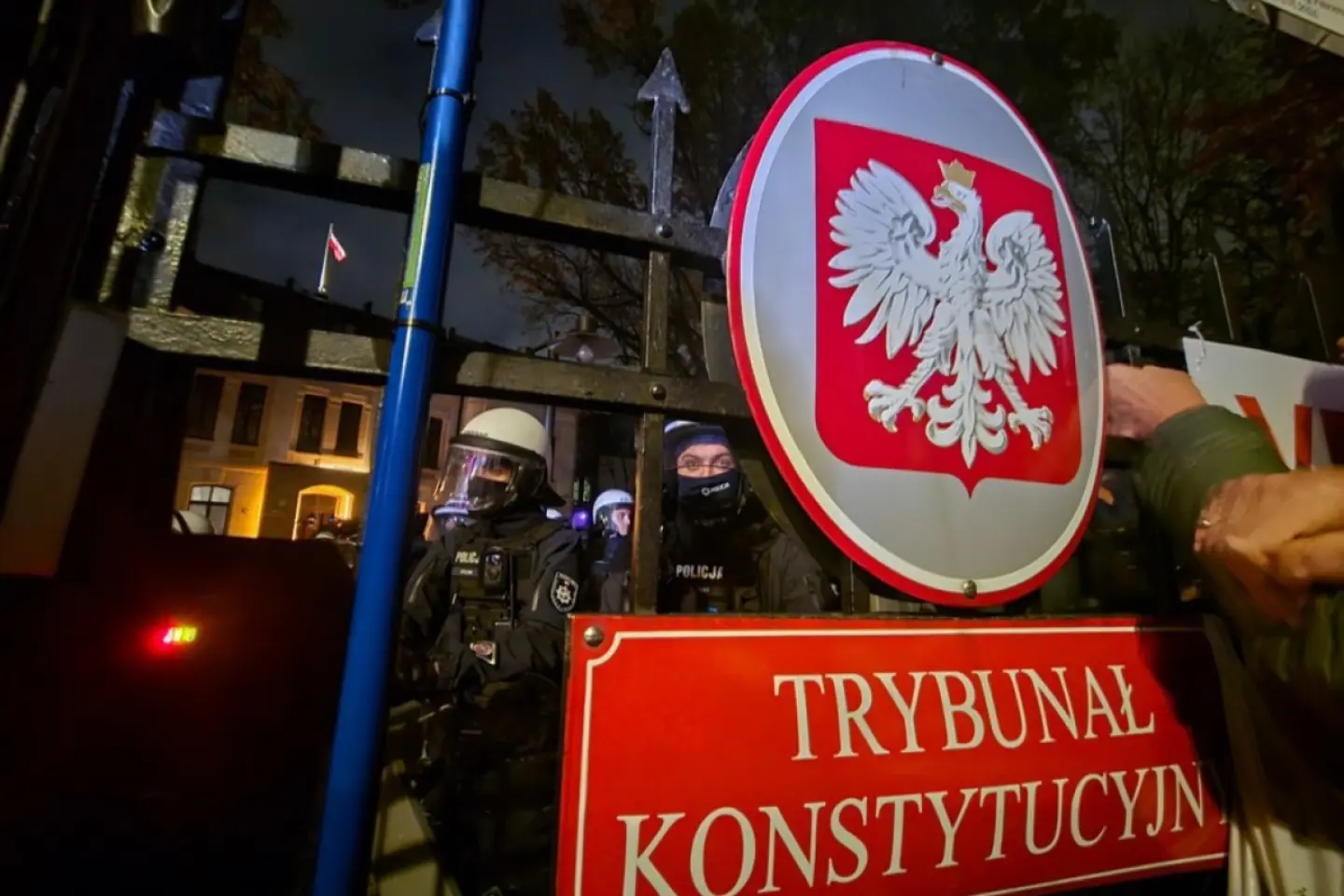
A constitutional crisis is usually fought with judgments and footnotes. Poland’s now involves riot police, a diverted presidential aircraft and an argument in a courthouse doorway. In the early hours of October 31st, President Karol Nawrocki arrived at the Constitutional Tribunal in Warsaw after abandoning a trip to Senegal. According to accounts published by media outlets, he pushed past Anna Korwin-Piotrowska, a judge who had assumed control of the institution, and told her colleagues they were not judges at all. Each side accused the other of attacking the constitution. Neither recognised the other’s authority to defend it.
Poland’s Constitutional Court has been at the center of a political dispute between conservatives and pro-Europeans for 11 years
The spectacle was the latest escalation in a conflict that has outlasted the government that began it. Donald Tusk’s governing coalition says it is restoring an institution hollowed out under Law and Justice (PiS), the nationalist party formerly in power. Karol Nawrocki, aligned with PiS, regards the operation as an unlawful seizure. Beneath the partisan theatre lies a genuine constitutional trap: how can an institution’s legitimacy be restored when the officials needed to repair it disagree about who lawfully holds office?
The crisis has roots in PiS’s remaking of the institution 11 years ago, including the installation of improperly elected judges. But replacing personnel has not produced an agreed route back to normality. Instead, the dispute now encompasses judicial appointments, the presidential oath, disciplinary powers and the tribunal’s leadership.
Eight of the fifteen judges have been elected by the current parliament; seven members remain from the previous political era. Nawrocki invited only three of the eight to take their oaths before him. Others used a ceremony in parliament, arguing that presidential obstruction could not nullify parliament’s constitutional power to choose judges. The president’s camp rejects that solution. His office has also maintained that he was considering appointments rather than refusing them – a distinction capable of turning deliberation into an indefinite veto.
For months, the disputed judges were prevented from working. The tribunal’s president, Bogdan Święczkowski, refused to admit them to adjudication. Their supporters invoke an interim measure issued by the European Court of Human Rights in May, requiring Polish authorities not to obstruct the judges elected in March from taking office and performing their duties. They also cite an October opinion from the Venice Commission, the Council of Europe’s constitutional advisory body, supporting parliament’s appointment powers and an alternative route to the oath when the president obstructs it.
On October 30th the confrontation moved from legal argument to physical control. Anna Korwin-Piotrowska, invoking her seniority in judicial service, ordered a month-long suspension of Bogdan Święczkowski and his deputy, Bartłomiej Sochański, and assumed the tribunal’s leadership. Police secured the building. Waldemar Żurek, the justice minister and prosecutor-general, announced five applications to lift the two men’s immunity over their obstruction of the new judges.
Reporting on the preparations suggests that the timing was deliberate. The holiday weekend reduced the prospect of mass mobilisation; the president was supposed to be abroad. He turned back instead. Supporters gathered outside the tribunal, alongside rival leaders of the Polish right. Inside, arrangements reportedly envisaged admitting the president with two protection officers. One judge told journalist that roughly 40 people entered with him. The presidential party eventually left after 4am. Control of the premises had changed; agreement about lawful authority had not.
Interference from politicians may compromise the Court
Donald Tusk’s problem is that the strongest case against the old leadership does not automatically validate every means of removing it. The suspension relied on a provision of the law governing ordinary courts, allowing an immediate interruption of a judge’s duties in exceptional circumstances pending disciplinary review. Its use in this setting is contested. Marek Safjan, a former president of the tribunal and former EU judge, defends a functional interpretation designed to protect higher constitutional values. Yet even he acknowledges doubts about the instrument and says a disciplinary panel should assess the order.
That is an uncomfortable foundation for a campaign to restore the rule of law. Exceptional remedies can break an entrenched obstruction. They can also establish precedents that a future government will eagerly borrow. Tusk’s refusal to compromise may reassure supporters tired of waiting for change. It cannot, by itself, settle the question of competence.
The next test is a general assembly scheduled for November 3rd. It could address the tribunal’s budget and begin procedures relevant to its leadership. But even the quorum is disputed. For a 15 member Court, the two thirds quorum is 10 judges. However, Marek Safjan argues that excluding the two men facing suspension and an improperly appointed member would leave eight judges sufficient to make the two thirds quorum (out of 12 standing judges). Others expect additional participation to be necessary. A meeting intended to restore institutional order may thus begin with an argument over whether it legally exists.
Nor would a successful assembly remove the president from the equation. He appoints the tribunal’s president from candidates proposed by its judges. If he rejects the process, an interim leader could remain in charge for an extended period. What is presented as a bridge back to constitutional government could become another permanent temporary arrangement.
The political incentives favour confrontation. Donald Tusk can demonstrate resolve; PiS can rally supporters and draw competing right-wing leaders into a common protest. The shock has reached the diplomatic service: Paweł Soloch, Poland’s ambassador to Romania, resigned in connection with the events, as did the ambassador to China. Abroad, the European Commission has backed parliament’s competence to elect judges and recalled European legal obligations. It has not expressly endorsed the suspension of the tribunal’s leadership.
Russia’s propagandists have meanwhile seized on the quarrel, portraying Tusk as Brussels’s instrument and the confrontation as a constitutional coup. Their amplification does not establish coordination with Poland’s opposition. It does illustrate who benefits when democratic institutions become objects of mutually exclusive realities.
Some Polish lawyers therefore favour a constitutional reset: ending existing terms, distributing appointments among parliament and the president, and strengthening safeguards against partisan capture. Such a settlement would require the cooperation now conspicuously absent. Until then, Donald Tusk may succeed in changing who controls the tribunal without restoring confidence in what it decides. Winning the building is easier than rebuilding the court.