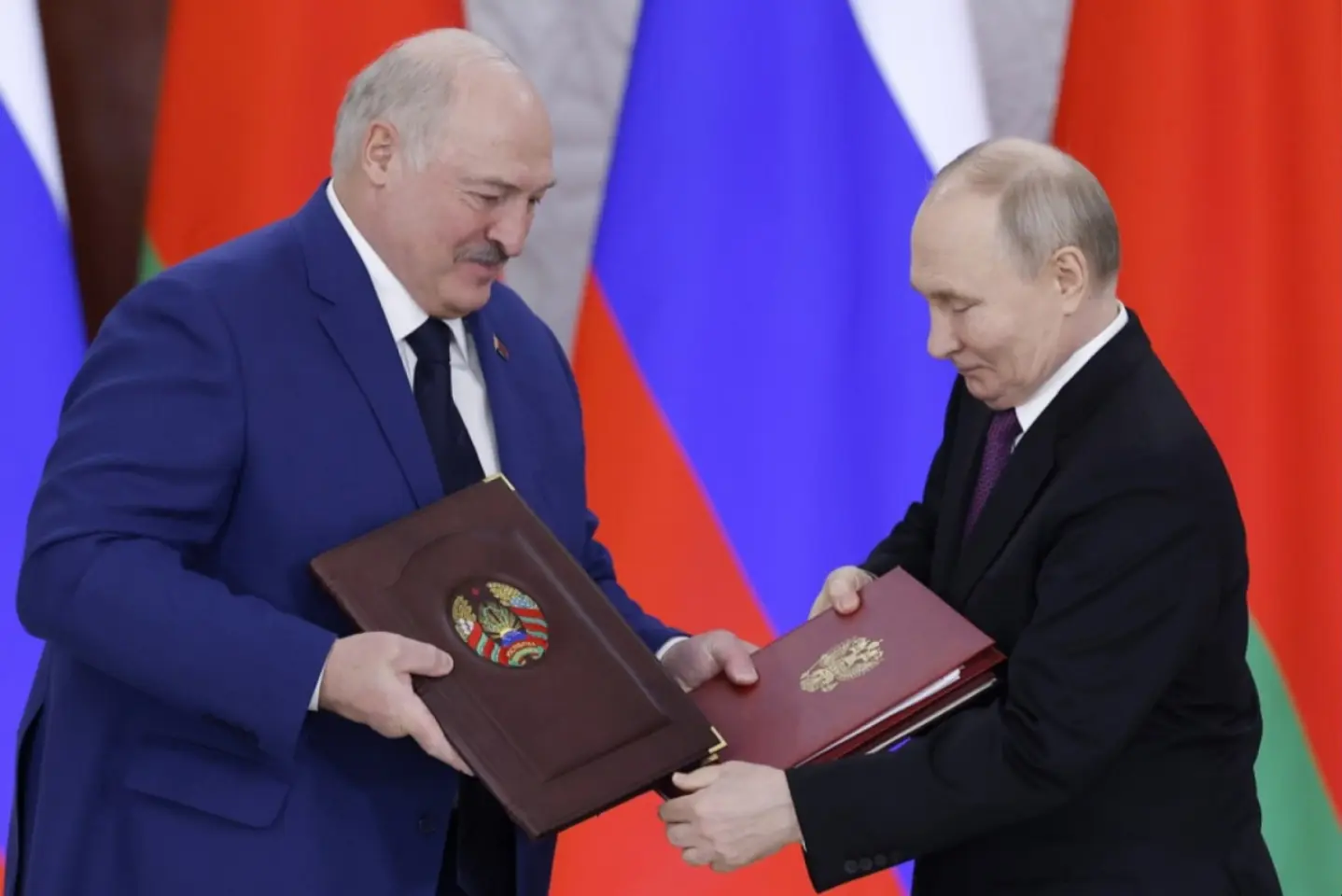
Hundreds of Belarusian companies support Russia's war effort, supplying it with, among other things, shells, drones, chassis for military vehicles, and components imported from the West.
“There’s a war going on, and our ally is fighting”
“The West, Ukrainians reproach us: “You’re helping Russia”. And why shouldn’t we? We [Lukashenko and Russian propagandist Olga Skabeeva] went to a factory where ammunition is produced, and she saw the ammunition and missiles that we supply to Russia. We’re not hiding anything. There’s a war going on, and our ally is fighting” – Lukashenko said in an interview to “Russia 1” TV channel on August 18, 2024.
Close cooperation with Russia in military industry is the thing the dictator in Minsk is proud of, which he constantly underlines in his speeches. After the start of full-scale Russian invasion in Ukraine with the use of Belarusian territory, the Lukashenko regime along Russia got under severe sanctions from the Western states. In this situation, instead of seeking de-escalation in the internal and foreign policy, the dictator in Minsk made a bet on increasing cooperation with Moscow and entering the largest market in Russia at the moment – everything connected with the war against Ukraine. While the Kremlin is getting stuck into positional war and is literally step by step occupying Ukrainian territory, Belarusian enterprises are providing more and more goods to fulfill the demand of the invaders’ military machine.
If during the first months of war Russia took only fuel and ammunition from the stocks of the Armed Forces of the Republic of Belarus, the continuation of what was planned by the Kremlin as “3-days triumph campaign” opened a big window of opportunities for Belarusian companies. At the moment, according to BELPOL information, more than 500 entities are supplying goods used by Russia in its war against Ukraine.
Ammunition, spare parts, Western components subject to sanctions
Belarus is assisting Russia fight its war in several ways. For instance, as EU and US sanctions against Belarus are not as severe as those against Russia, Minsk can still get its hands on certain goods and technologies, which are then re-exported to its ally. For example, German heavy machinery or microchips produced with the use of European materials are supplied to Russian military industry companies by Belarusian colleagues, who are still able to maintain access to the Western markets.
The representatives of the opposition Belarusian Coordination Council have called for harmonization of the sanctions against Moscow and Minsk, but that has not happened yet. However, this may change: on October 9, 2025 the European Parliament passed a resolution which called to “maintain and extend its sanctions policy against Russia, and to apply a similar sanctions policy to all enabling states, including Belarus, Iran and North Korea”. This could be the serious step to close this essential backdoor in the European and American sanctions for the Kremlin.
Belarus is also suppling ever increasing quantities of weapons to Russia. Although the statistics on this field isn’t openly published since 2020, the head of Belarusian State Military Industrial Committee Dmitry Pantus acknowledged that in 2024, Belarusian military-industrial complex achieved record production volumes and record exports of goods and services.
The military industry is working at full steam. Minsk Wheel Tractor Plant is the crucial supplier of wheeled chassis for Russian ballistic missile systems “Iskander” and “Yars”, while Precise Electro Mechanics Plant is producing the range of artillery shells, most notable of which are 122-mm ones for MLRS “Grad”. Design Bureau “Unmanned Helicopters” is the leader of the Belarusian UAV industry, which is developing unprecedentedly fast in order to keep up with the demands of the Russian military in reconnaissance and combat drones. JSC “Integral” supplies a wide range of electronics, while OJSC “Planar” – optics: both are essential for the production of precision weapons by Russia. These are only the most famous examples of Belarusian enterprises on the EU sanction list.
Several companies even changed their profile in order to produce ammunition for Putin’s army: just like OJST Legmash (previously produced variety of machinery for light industry like sewing machines) or Orsha tools plant (before 2023 specialised in tools for metalworking machines) which started manufacturing parts for 152-mm and 122-mm artillery shells. Immediately these state-owned enterprises turned from unprofitable ones into prospective and high-margin companies. Even BelAZ, being very successful in producing and selling heavy trucks, is manufacturing parts for 122-mm artillery shells used by “Grad” multiple launch rocket systems. Or take Amkador, together with excavators and tractors producing various UAVs.
Even companies that didn’t need to switch to arms and ammunition production are gaining from the war: the Belarusian branch of BTK Group in Brest is producing uniforms for Putin’s soldiers, while Belshina is supplying various tires for the wide range of military vehicles to the Russian Ministry of Defence.
According to independent media, even the Belarusian prisoners are working for Kremlin’s military machine. For example in penal colony #9 in Horki, the forced labor of prisoners is used to produce tank panoramic sights. The prisoners in other colonies are forced to manufacture uniform elements.
A new gold mine for the dictator
This policy is imposed and controlled personally by Lukashenko, whose family is benefitting from the militarization of the Belarusian economy, as the export of state-owned companies is controlled by his clan. The dictator set the goal to increase cooperation with Moscow and get more orders from the Russian Defense Ministry, as its demand is constantly growing. He also personally holds negotiations on expanding such cooperation – his meetings with the heads of Russian regions are a good ground for that.
For example, on October 20, 2025, Lukashenko met with the head of the Republic of Mordovia of the Russian Federation Artem Zdunov. As usual for this kind of events, the parties paid most attention to economic and industrial cooperation. Lukashenko once again urged to deepen cooperation and told that there are already some success stories: “One of the examples – work of the Mordovian company “Lider-Compound”, which produces insulating goods from raw materials supplied by the Belarusian Naftan”. It is worth noting that “Lider-Compound” is a critical supplier for the Russian military industry, providing a wide range of cables for various enterprises.
On October 2, 2025, Lukashenko approved draft amendments to the agreement on the development of military-technical cooperation with the Russian Federation. He previously held a closed meeting with the top management of the State Military Industry Committee of Belarus, where “the work of the Belarusian military-industrial complex, including key joint projects with foreign partners, was discussed”. The meeting focused on promising areas and the scientific and technical potential of the Belarusian defense industry – reports Lukashenko’s website.
Against this background, the independent media and the Community of Belarusian Railway Workers report about constant increase in military goods supply. So it is not surprising that according to the official data, in 2024, the turnover of goods and services between Belarus and Russia reached a record $57.6 billion, having shown an increase of 7.4% compared to the previous year. Looks like the dictator in Minsk found a solution to at least some economic issues of the recent years.