It began quietly, as such things often do. Around two in the morning on September 10, 2025, residents of several towns in eastern Poland reported the same low, mechanical hum. A coordinated swarm of Russian drones had entered Polish airspace.
By dawn, a dozen had been shot down over the Lubelskie and Podkarpackie regions. Others turned back before impact. The Polish Air Force scrambled interceptors, NATO liaison channels lit up, and the government in Warsaw announced a temporary closure of airspace in the southeast. It was, officially, a “border incident.” But no one doubted the symbolism.
Poland, a front-line NATO state and the logistical heart of Western support for Ukraine, had been hit – again, not by rockets or tanks, but by something subtler: an intrusion, a test.
“Nothing was destroyed, no one was hurt”, a senior defense official told reporters the next morning. “But we treat it as an act of hybrid aggression.”
Outside the Defense Ministry, the world’s attention briefly flared. By midday, the first theories, memes, and denials had already begun to circulate online. Within twenty-four hours, it was no longer only a military story. It was also a story of perception, rumor, and doubt.
To make people stop believing in anything - that’s the Russian main goal
Warsaw’s sky had barely cleared when the second wave began – not of drones, but of posts.
Telegram channels linked to Russian networks, anonymous X accounts with Polish-language slogans, and fringe portals all launched the same battery of narratives: the drones were Ukrainian; NATO knew in advance; the government is hiding civilian casualties.
The claims multiplied faster than fact-checkers could keep up. Screenshots of supposed “leaked” documents appeared, alongside grainy videos allegedly showing fragments of Western-made drones. Each image was shared thousands of times before corrections could catch up.
Disinformation researchers at NASK (Research and Academic Computer Network is a government research & development organization and data networks operator) and Res Futura Analytical Collective later mapped the pattern: a coordinated “burst” within hours of the incursion, designed not to convince, but to confuse.
“It’s not about making you believe one version,” says an analyst involved in the monitoring effort. “It’s about making you believe nothing.”
In the following days, familiar slogans resurfaced. “Poland as NATO’s cannon fodder”. “The government leading us to war”. “The Ukrainian state as the real aggressor”. Each of these fit neatly into existing social resentments – anti-establishment, anti-Western, or simply weary of the war next door.
When official agencies issued clarifications, the tone on social media shifted: If they’re denying so fast, they must be hiding something. The speed of the information cycle became the weapon itself.
And yet, in quieter corners of the country, the reaction was different. There was fear, yes, but also a calm resilience – local mayors reassuring residents, soldiers on routine patrols. Poland had been tested before. What was new was the simultaneity of the physical and digital attacks, like two hands playing different melodies that together formed a dissonant chord.
Late-night visits to the archives, cash payments in envelopes – Cold War methods are still in the game
Two weeks later, the military zone near Tomaszów Lubelski was still cordoned off. Investigators combed through wreckage, collecting fragments of what officials later described as modified Russian Orlan drones, adapted for low-altitude reconnaissance.
But by that time, public attention had shifted to another kind of story: alleged spy arrests. The Internal Security Agency (ABW) announced several detentions related to “foreign intelligence activities.” Among them, one case stood out – not for its violence, but for its intimacy.
Tomasz L., a mid-level clerk at Warsaw City Hall, had been quietly collecting and copying archival documents: old ID applications, birth records, death certificates. Over months, he passed them on to Russian handlers, helping to create false identities for “illegals” – deep-cover agents operating in Western Europe under fabricated Polish or EU identities.
When the story broke, it sounded like a Cold War footnote. But in 2025, amid a digitalized bureaucracy and renewed Russian infiltration, it felt eerily current.
The details, as disclosed by prosecutors, were chilling in their banality: USB drives filled with scans, late-night visits to the archives, cash payments in envelopes. Tomasz L. wasn’t a spy in the cinematic sense. He was, as one official put it, “a small cog in a very old machine that still turns.”
The revelation shook Warsaw’s City Hall, but also raised broader questions. If Russian intelligence could burrow into local administration, how many other seams were left unguarded? And how many Tomasz L.s were out there, unnoticed amid the noise?
Meanwhile, the disinformation echo continued. Anonymous profiles began to suggest that the clerk’s arrest was “political diversion” or “a setup to justify new repressive laws.” The aim was simple: neutralize the shock, blur accountability, return the public to its habitual skepticism.
Russia’s action is easy - it just amplifies what’s already fragile
By early October, the emotional temperature in Poland had cooled, there was no new attack. Instead, a quiet exhaustion spread – a sense that “something is happening” yet remains deliberately opaque.
Sociologists call it “cognitive fatigue”: when the flood of contradictory claims leads to withdrawal rather than engagement. That fatigue is fertile ground for propaganda.
In that silence, new voices began to rise. Less known political actors had begun to organize press conferences, livestreams, and small rallies under the banner of “peace” and “national sovereignity”.
Among them were figures already known from earlier far-right or anti-system circles, now united by a shared skepticism toward NATO and the government’s pro-Ukrainian stance.
Their message was simple: Enough. Stop arming Kyiv. Focus on Poland.
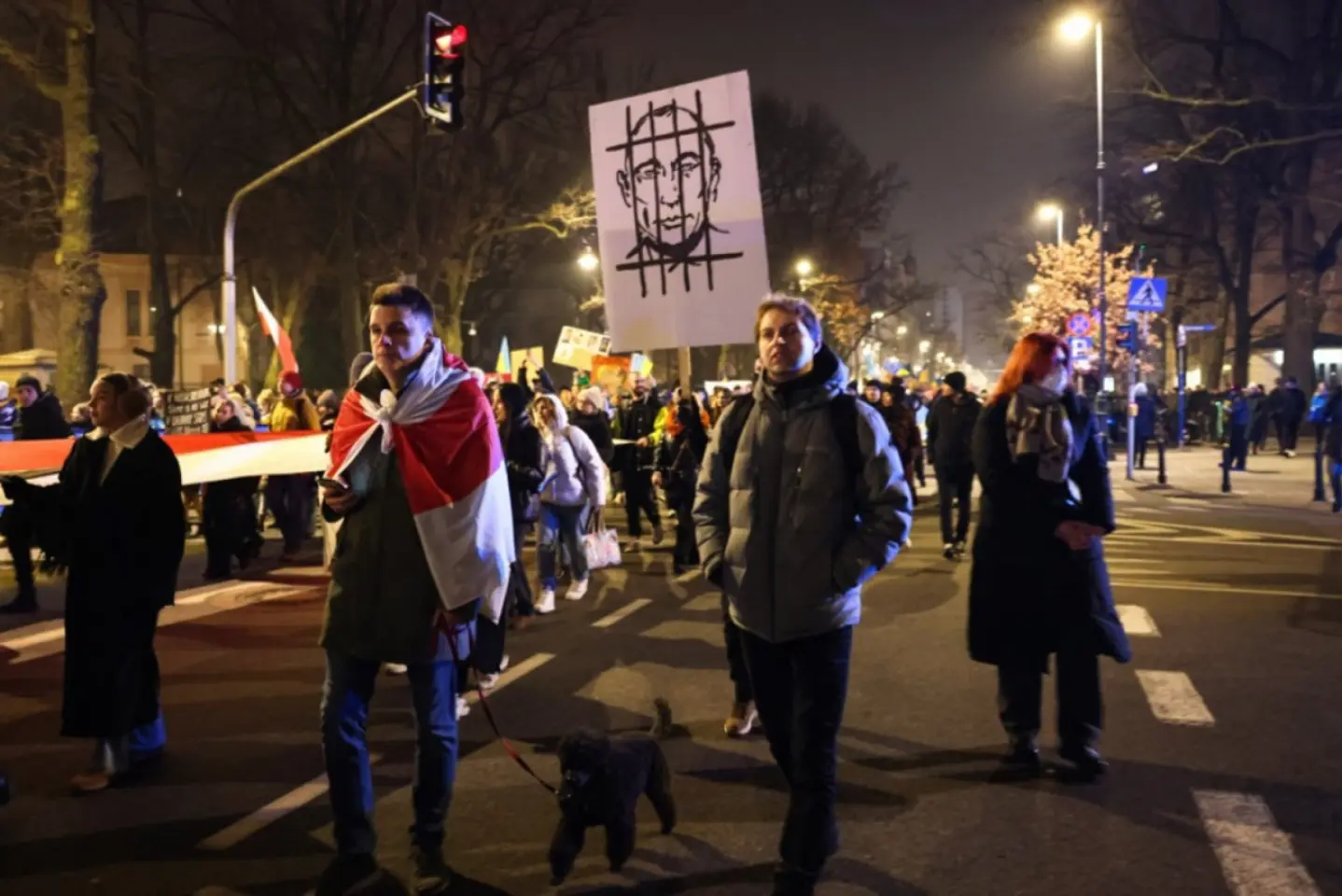
In another era, these slogans might have remained marginal. But after the drone attack, they found a slightly larger echo. Not because most Poles agree with them – polls still show overwhelming support for NATO – but because many feel an undercurrent of fatigue.
The messages were tailored to local frustrations – high food prices, rising defense spending, migration tensions. “Russia doesn’t need to build new agents, it just amplifies what’s already fragile,” says Dr. Michał Kuś, a media scholar at Jagiellonian University in Kraków, who studies the political uses of disinformation in Central Europe.
The latest news is that National Federation of Non-Partisan Local Governments (Bezpartyjni Samorządowcy), led by Marek Woch, a former presidential candidate, will merge with the Camp of Great Poland (Obóz Wielkiej Polski), an organization whose members openly support Russia. The new group aims to enter the Parliament in 2027.
Moscow’s symphony of confusion strikes back
When, in mid-September, Polish authorities confirmed the detention of a Ukrainian citizen wanted by Germany in connection with the 2022 Nord Stream pipeline sabotage, the story seemed at first to belong to another timeline. Yet within hours, it was woven into the same tapestry: the drones, the spy in Warsaw, and now “the Ukrainian saboteur sheltered by Poland.” The insinuation was clear: Kyiv, not Moscow, is the true source of chaos.
In fact, the legal case is part of a years-long German investigation into the Nord Stream sabotage. The detained suspect is Volodymyr Z., a trained diver. German prosecutors allege that he was a member of a cell that rented a sailing yacht from Germany and planted explosive devices on the Nord Stream 1 and 2 pipelines near the Danish island of Bornholm in September 2022.
Volodymyr Z. had apparently been under a European arrest warrant since 2024, and had evaded capture by crossing into Ukraine before re-entering Poland.
His lawyer Tymoteusz Paprocki has argued that his client will plead not guilty – one key line of defense advanced is that no Ukrainian should be held criminally responsible for attacking the pipelines, because the Nord Stream gas infrastructure is partly Russian-owned and functioned to finance Moscow’s war effort.
In the viral churn, that distinction – that this is a German procedural case, not connected to the drone attacks over Poland – vanishes. Memes proliferated with new strength but the same message: “NATO bombing its own allies”. The story’s power lies not in its truth or compatibility with facts, but in its emotional coherence: that Poland’s security is betrayed by its alliances, that “Western justice” is selective, that Ukraine is the destructive actor behind the scenes.
Thus, an arrest in a procedural European case becomes another instrument in Moscow’s symphony of confusion.
Russia’s strategy: to make noise not to be heard, but to drown out others
A month after the drones, Warsaw feels normal again. Politicians are fighting as viciously as before, the news cycle has moved on. Yet something in the public mood has shifted – a low, persistent awareness that Poland is being watched, probed, and measured.
Russia’s strategy, if it can be called that, seems almost paradoxical: to make noise not to be heard, but to drown out others.
The story of a low-key spy Tomasz L. – the quiet bureaucrat feeding Moscow’s machine – embodies that ambiguity. His work was invisible precisely because it was ordinary. The same can be said of the digital battlefield: millions of tiny actions, shares, comments, omissions.
Poland’s response so far has been pragmatic, even stoic. The military performed well, the institutions held, the media largely resisted hysteria. But the deeper test is ongoing: whether citizens can maintain discernment in an age when every crisis comes wrapped in competing truths.
Democracies, unlike autocracies, cannot command belief. They must earn it, again and again.
Since the drone attack European partners have provided radar upgrades and new detection systems. Yet, as one diplomat dryly noted, “The hardware is the easy part. The hard part is keeping people patient, informed, and trusting.” Because the real war, increasingly, is not fought on front lines, but in the fragile web of attention, belief, and fatigue.
As one my friends who is an analyst at the Centre for Eastern Studies told me: “Russia doesn’t need us to believe her version of events. She just needs us to doubt our own.” That may be the truest sentence of this autumn.
And perhaps the quietest form of resilience is simply refusing to let that doubt harden into indifference.