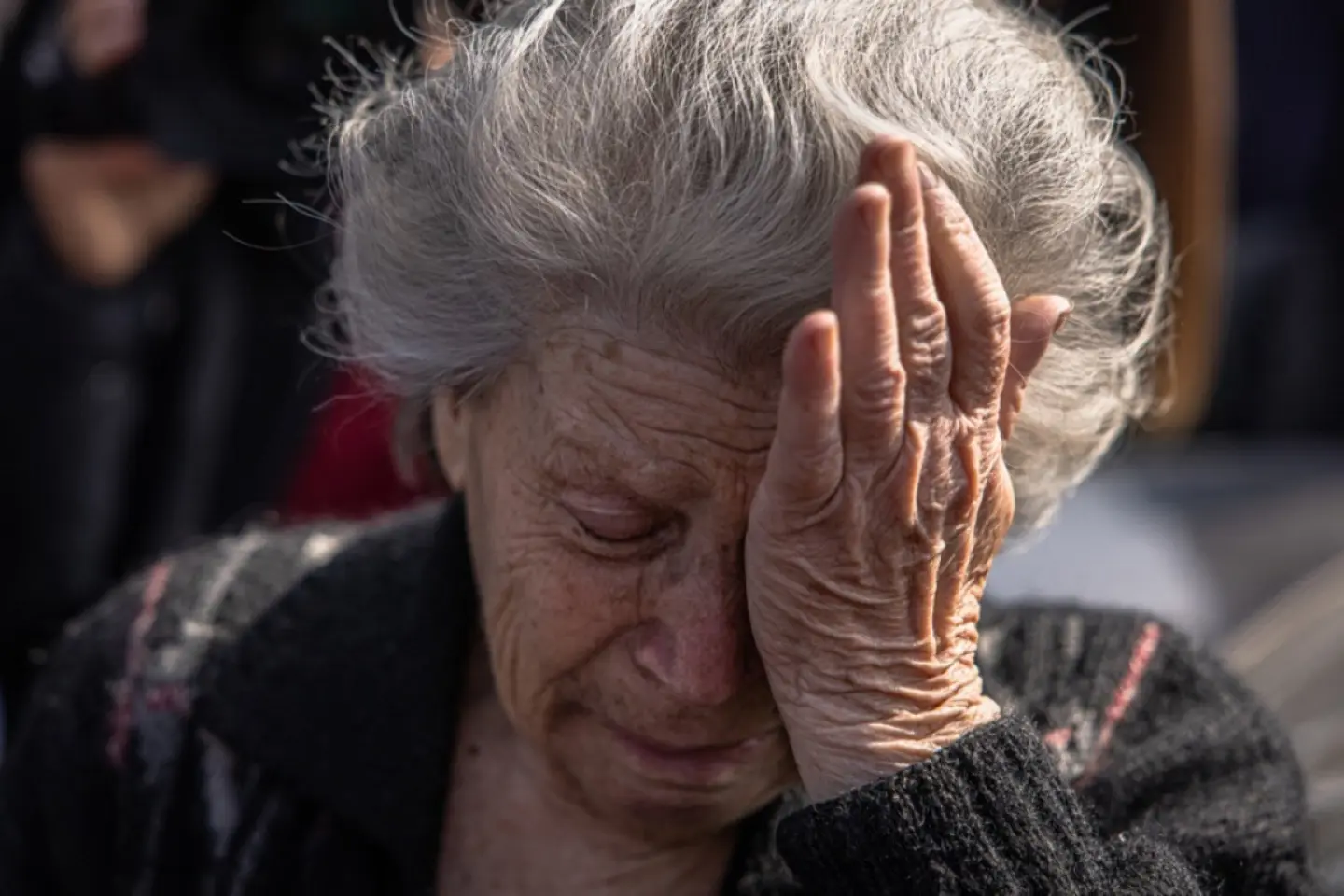
The stress, deprivations, and trauma suffered by Ukrainian civilians living in frontline, and occupied towns and cities, have been having a lasting impact on their health, with a yet unknown number meeting an untimely death, according to Inna Kubai, a Researcher at the Reckoning Project.
Ukrainian government agencies and international organizations regularly update the statistics on civilian casualties caused by Russian shelling and combat. But those figures do not include a father from Mariupol who survived the siege of the city and a brutal beating by occupying forces, only to die several months after escaping occupation. Nor do they include his wife, who suffered a heart attack in a basement packed with people sheltering from relentless shelling and survived her husband by only two and a half years.
Since 2022, The Reckoning Project – a global team of journalists and lawyers documenting, publicizing, and helping build cases of atrocity crimes – has collected more than 800 testimonies. Many of them describe a dramatic deterioration in survivors' health following occupation and the deaths of loved ones after they managed to escape. The two stories from Mariupol presented here illustrate how war kills not only instantly – with bullets or missiles – but also months or years later, after depriving people of medicine, adequate nutrition, and basic medical care while subjecting their bodies and minds to extreme and prolonged trauma. All names of witnesses and their family members have been changed for security reasons.
"My mother's heart stopped twice in the basement"
On the evening of February 23, 2022, 17-year-old Yaroslava went to bed thinking about her chemistry test and the dress she would wear to dance the waltz at her graduation ceremony. She lived with her parents, Andrii and Yuliia, and her younger sister, Nina, in Mariupol's Prymorskyi district.
The next morning, the war began.

Local people cary water near destroyed apartment buildings in Mariupol, Ukraine, 12 April 2022 @EPA/SERGEI ILNITSKY
In early March, heavy fighting reached their neighborhood. Their apartment building lost electricity, heating, and running water. Several shells struck the building, nearly burying the family beneath the rubble. They moved into the basement, which was packed with people. The youngest child there was only three months old. According to Yaroslava, the dust and suffocating air caused people to bleed black from their noses. They cooked over open fires between shelling, melted snow for drinking water, and struggled to survive.
Her mother suffered from chronic kidney disease, which had previously been controlled with regular medication. But her medicine quickly ran out, and her condition steadily worsened.
"It was impossible to get to a hospital or find any medicine," Yaroslava recalled.
Her mother began losing consciousness.
"Twice, when her heart stopped and my father tried to save her... I remember my mother's skin turning gray, and her hand was cold," she said.
"They told me I was a filthy Ukrainian woman, like all Ukrainian women"
In mid-March, with almost no food left, the family decided to drive toward the village of Melekine. Near the village, they were stopped by soldiers of the self-proclaimed Donetsk People`s Republic. After learning the family was from Mariupol, the soldiers pointed their weapons at Andrii and ordered them to undergo filtration in Mangush.
According to Yaroslava, they waited there for two days before being processed. Russian soldiers forbade people from leaving their cars, repeatedly searched and humiliated them, and pulled out and beat those they found suspicious. Russian television crews occasionally arrived to film propaganda reports.
When it was finally their turn, Yaroslava's mother – whose legs had become paralyzed while in the basement – and her younger sister remained in the car while Yaroslava and her father were taken away for questioning.
They were separated into different rooms. Soldiers searched their phones and documents, questioned them about their contacts and their views on what the Russians called the "special military operation."
After about half an hour, Yaroslava was ordered to strip down to her underwear. She was menstruating at the time but had no access to hygiene products, clean clothes, or a shower. She remembers bloodstains on her trousers.
"They told me, in very crude language, that I was a filthy Ukrainian woman, just like all Ukrainian women, and that my legs were crooked," she recalled.
After the interrogation, she returned to the car. Her father arrived about an hour later. Russian soldiers dragged him back. He was covered in bruises, with blood on his face and nose.
Before leaving Mariupol, Andrii had wiped his phone clean, believing it would make him safer. Instead, it made the occupiers suspect he was a spy. During the interrogation, they beat him to force a confession. His calm demeanor only seemed to anger them further.
"He stayed very calm and composed, and that composure infuriated them. They beat him severely, pointed guns at him as if they were about to shoot him, and every time he fell or cried out, they beat him again," Yaroslava said.
Despite his injuries, Andrii got behind the wheel and drove toward Berdiansk. Along the way, his condition deteriorated rapidly. He began vomiting, developed severe headaches, and started losing his eyesight. In that state, he drove his family through more than twenty Russian checkpoints, where they were searched over and over again as though none of the previous inspections had taken place.
In early April, the family reached Zaporizhzhia but immediately continued to Dnipro because they could not find a doctor in the city overflown with other refugees. In Dnipro, doctors diagnosed Andrii with damage to his optic nerve caused by the beating.
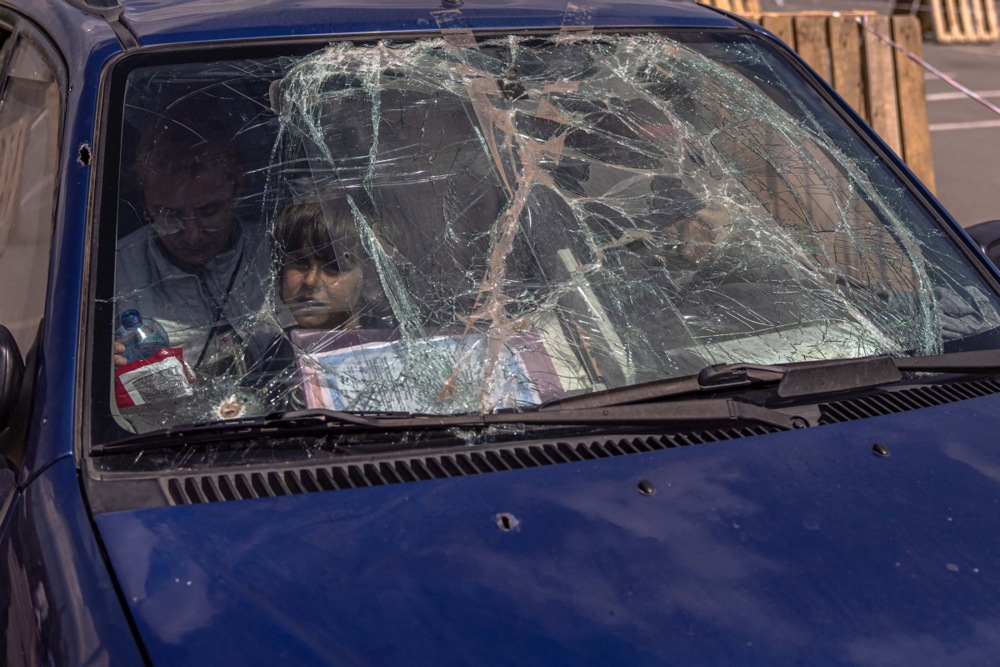
A family from Mariupol arrive in a car at the evacuation point in Zaporizhzhia, Ukraine, 02 May 2022. @EPA/ROMAN PILIPEY
After leaving Mariupol, Yaroslava spoke publicly about her experiences. Her account was distorted by pro-Russian media, leading to hostile online attacks against her.
During the occupation, Yaroslava lost 10 kilograms. The trauma she endured triggered diabetes. Her younger sister, Nina, began suffering epileptic seizures.
After sending his daughters abroad, Andrii died in Ukraine in January, 2023. His wife, Yuliia, died in June, 2025.
Neither of Yaroslava's parents was killed by shrapnel or a bullet. Their deaths resulted from illnesses, injuries, and trauma that would never have occurred had Russia not launched its full-scale invasion and laid siege to Mariupol.
"Blood on the ground looked like spilled borscht"
When Russia launched its full-scale invasion, 25-year-old Mariia lived with her mother, Hanna, in the same Prymorskyi district of Mariupol. Hanna had suffered a stroke several years earlier and struggled with high blood pressure. Mariia's nephew, Hlib, had been hospitalized with asthma. On February 24, all patients were discharged, and with the family's last money, Mariia bought medicine for her relatives.
When heavy fighting began, they also took shelter in the basement of an apartment building. Mariia watched as cars carrying people who had tried – and failed – to evacuate returned riddled with bullets. She saw the bodies of civilians lying in the streets.
"Blood on the ground doesn't look like blood. It looks like spilled borscht. People tried to bury the dead, of course, but if they didn't know the person, they often didn't want to deal with it. They would simply cover the bodies," Mariia said.
At the end of March, Mariia traded a canister of gasoline for a bicycle. Packing what little they had left into bundles, four people – three women and a teenage boy – set out on foot, walking more than 30 kilometers before reaching the occupied village of Bilosaraiska Kosa, where they stayed for a month and a half.
Unable to afford transportation to Ukrainian-controlled territory, the family was eventually forced to return to the ruins of Mariupol. Their apartment had been completely destroyed. They moved into a relative's empty apartment that had been awaiting renovation.
When they were once again running out of food, they reluctantly agreed to join an evacuation organized by the Russian authorities. Escorted by Russian soldiers, they were taken to Novoazovsk for filtration.
Deported to Russia
After passing filtration, the family was deported to a temporary accommodation center for refugees in Taganrog, Russia.
"People who didn't have relatives in Russia had no choice but to stay there and wait for trains that would take them deep into Russia," Mariia said.

Temporary accommodation center for refugees from Mariupol and self-proclaimed Donetsk People's Republic (DPR) in the sports school in Taganrog, Rostov region, Russia, 22 April 2022. @EPA/ARKADY BUDNITSKY
Later, while helping other refugees, she heard stories of people whose passports had been confiscated before they were transported to Makhachkala and other economically depressed regions from which it was extremely difficult to leave.
Fortunately, Mariia's family had relatives in Russia's Rostov region, allowing them to avoid being sent farther into the country. In early July 2022, with the help of volunteers, they crossed the Russian-Estonian border at Ivangorod. They initially settled in Estonia, where Mariia worked for a volunteer organization, before later moving to Finland.
In Finland, Hanna was diagnosed with cancer.
"There has never been a history of breast or gynecological cancer in our family. But doctors here say they are seeing breast cancer in many Ukrainian women. They believe it may be linked to the war, to chronic stress, and to living under occupation, where your body is pushed beyond its limits," Mariia said.
Residents who remain in Mariupol and other occupied territories are effectively unable to access health care without Russian citizenship. But even those who obtain Russian passports, Mariia says – remaining in contact with friends who stayed behind in Mariupol – still struggle because of severe shortages of doctors and medicine.
"My mother has friends who had to move to Russia because their son has diabetes and they couldn't get proper insulin in Mariupol," she said.
When victims are no longer counted
People living under occupation die not only from weapons, but also from a lack of medicine, the absence of adequate – or sometimes any – medical care, and the worsening of chronic illnesses caused by constant stress and war, says oncologist Oleh Chornyi.
"Stress aggravates every chronic illness – cardiovascular diseases, neurological disorders, and, of course, cancer. Many cancer cases begin with conditions that were never treated in time because of the circumstances," he explained.
When people escape occupied territories, they face additional obstacles. Their medical records may have been left behind or destroyed. Doctors often have no information about the stage of their illness. As a result, patients must begin the diagnostic process all over again, losing precious time, Chornyi said.
As of the end of May 2026, the UN Human Rights Office had verified 62,716 civilian casualties in Ukraine since February 24, 2022. The Office has repeatedly stressed, however, that these figures include only civilian deaths and injuries that it has been able to verify directly as resulting from hostilities, and that the actual number of victims is significantly higher, particularly in occupied territories.
According to the World Health Organization, in findings released in February 2026, more than two-thirds of Ukrainians reported that their health had deteriorated since the start of Russia's full-scale invasion; around 10 million people are affected by mental health problems, and 4.1 million require health assistance. A separate WHO Health Tracker survey found that 59 percent of respondents in the regions most affected by the war rated their health as poor or very poor.
The WHO also notes that displacement interrupts medical treatment, complicates access to physicians, and increases mortality among people with serious illnesses. Meanwhile, Ukraine's health care system continues to operate under enormous strain due to repeated attacks, power outages, and shortages of medical personnel.
Official Ukrainian and international statistics count those whom war kills immediately. But for many families affected by Russia's actions, the war does not end with a missile strike or with forced displacement. Their losses unfold months or even years later. These deaths are far more difficult to quantify than the casualties from any single attack, yet without counting them, it is impossible to answer one fundamental question:
How many Ukrainian lives has Russia's war truly claimed?