Serbia’s longtime leader, Aleksandar Vučić, seems determined to extend his 12 years rule by borrowing from a playbook used by Russia’s Vladimir Putin, and some leaders from the Balkans: running for the Prime Minister office (again), as his second presidential term nears its end. There’s a strong chance the gamble will pay off but then again, it may turn against Vučić.
The Constitutional Squeeze: Vučić can’t run for a third presidential term, but there are no such limits for the Prime Minister’s office
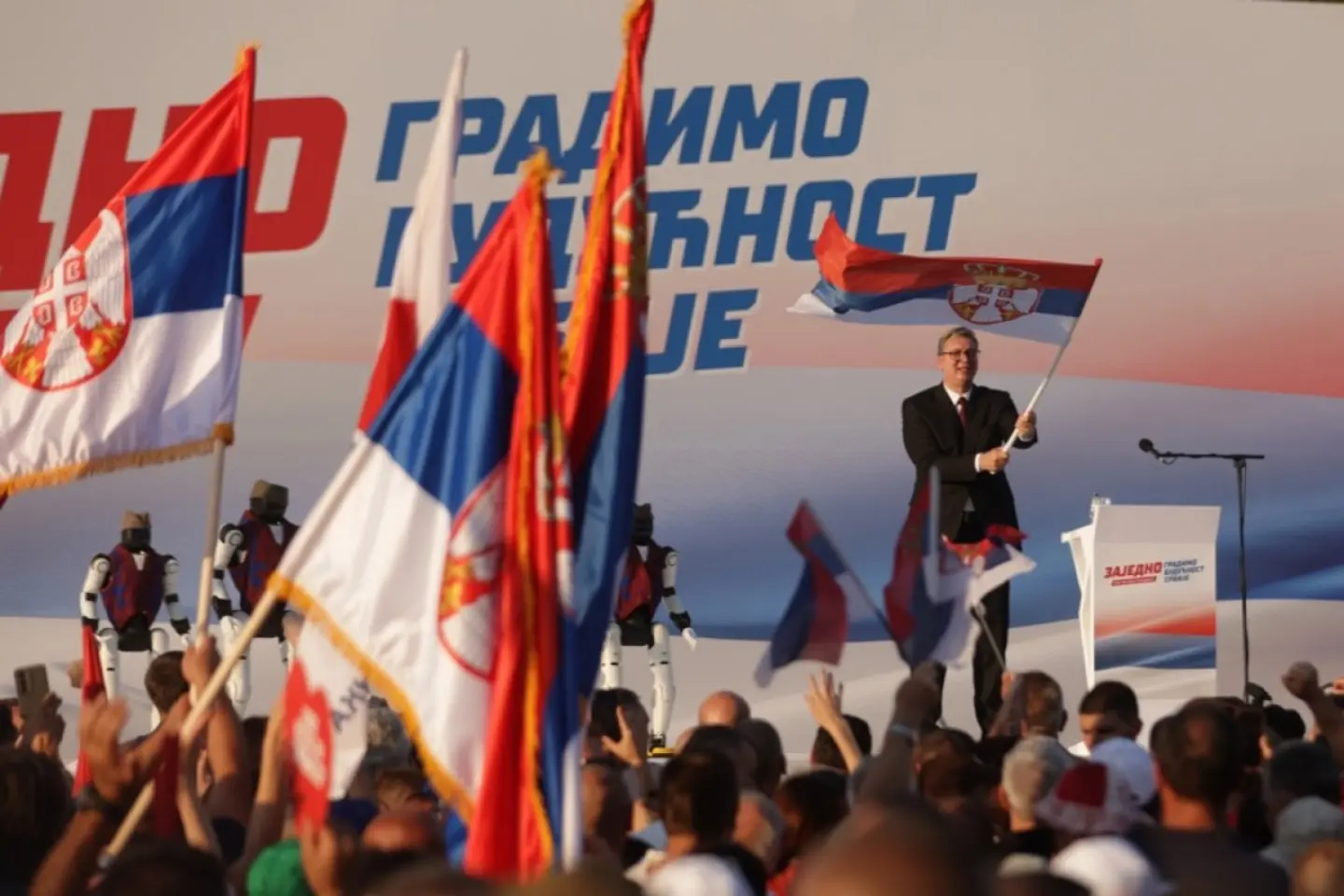
On June 27, Aleksandar Vučić told thousands of his own supporters bused to a square in central Belgrade that he would resign as President of Serbia within a few weeks. He said he would remain in office "for just several weeks. Then I'll resign," and offered to help the ruling Serbian Progressive Party campaign in the elections that follow if the party asked him to. He proposed the SNS electoral list be renamed United Serbia, a name that echoes Vladimir Putin's United Russia. The rally fell close to Vidovdan, the Serbian Orthodox feast day marking the 1389 Battle of Kosovo, one of the most charged dates on the national calendar.
Almost nothing about this can be interpreted as a genuine step back in good faith. In reality, the move represents nothing more than a calculated trade, which entails giving up a title that has become term-limited for one that carries the actual levers of executive power, while keeping indirect, but not very well hidden, control of the party, the state apparatus, and the security services intact throughout the transition. The resignation functions as a mechanism for extending twelve years of personal rule under a new title, timed to outpace the very protest movement that forced the concession in the first place.
The mechanics are rather straightforward. Vučić's second and final presidential term expires on May 31, 2027, and the constitution bars a third. The presidency itself is a largely ceremonial post, while Serbia's parliamentary system vests real executive authority in the prime minister and cabinet, a structure Vučić has personally overridden since 2012 regardless of which office he formally held. Returning to the premiership, the post he occupied from 2014 to 2017 before shifting the center of power to the presidency, would let him keep governing once the office he currently holds is constitutionally closed to him. He hinted at this path himself earlier this year, saying "I will not run away from responsibility" if circumstances required his return.
The plan carries one structural risk and that is political cohabitation. If Vučić becomes prime minister, Serbia needs a new president, the highest official directly elected by voters and therefore the only one holding independent political legitimacy. Should that office go to a genuine opposition figure rather than a loyalist, the new president could use that legitimacy to actually oppose Vučić, who appears to be struggling to settle on a presidential candidate capable of winning in the first round. However, a loss in that race is one Vučić could likely tolerate simply by ignoring an opposition-aligned head of state once he holds the premiership himself.
A Familiar Playbook in Eastern Europe
The reverse office swap has clear precedent in the region. Vladimir Putin rotated into the Russian premiership between 2008 and 2012 specifically to sidestep presidential term limits before returning to the Kremlin.
One regional parallel sits even closer to home. Namely, Milorad Dodik, longtime president of Republika Srpska, handed his post last winter, under an international arrest warrant and mounting pressure, to his ideologically aligned associate Siniša Karan. Bulgaria's Rumen Radev gave up the presidency and went on to establish a party, win the elections and become prime-minister .
Serbia's political system remains more competitive than Russia's, which is precisely why the succession step, not the resignation, is where the plan could still unravel. Elections can actually make a difference in Serbia, as they did in Hungary this year.
Engineering the Electoral Calendar
Timing is itself part of the instrument, a crucial one even. Serbia has been shaken since November 2024, when the collapse of a renovated canopy at the Novi Sad railway station killed sixteen people and set off a protest movement that drew an estimated 180,000 people onto the streets of Belgrade last month alone, according to the independent Archive of Public Gatherings. Students, who have deliberately kept their distance from the traditional opposition, have demanded early elections for close to a year. Calling the vote himself lets Vučić choose the ground that suits him, rather than drift under mounting pressure. For example, elections held at the height of Serbia's summer would fall when many citizens are away on holiday, and the constitution's forty five to sixty day window between dissolution and voting favors the SNS, which retains by far the largest logistical capacity of any political force in the country to mobilize supporters and transport voters to the polls. A similar result can be achieved by organizing elections during the Christmas or spring holidays.
Turnout, more than persuasion, is likely to dictate the result. SNS members make up roughly one in four voters, meaning that if each brings a single relative to the polls, the party's support already approaches half the electorate without shifting a single undecided voter. A recent Faktor Plus poll put the SNS at around 47 percent against just under 31 percent for the student movement, though the agency is widely regarded by students and opposition figures as close to the regime. Even so, a 30 percent showing would mark the strongest opposition result Serbia has seen in years.
Vučić will likely try to push a loyalist to the President’s Office
The SNS has no shortage of names for the presidential race but no obvious frontrunner. Party leader Miloš Vučević has already said the natural choice is for Vučić to become prime minister, and parliament speaker Ana Brnabić has echoed the appeal. Speculation inside the party has floated Interior Minister and Socialist Party leader Ivica Dačić, whose health has reportedly declined, former president and SNS co-founder Tomislav Nikolić, and non-partisan loyalists such as Constitutional Court president Vladan Petrov and historian Čedomir Antić.
None of these potential candidates has the makings of a political leader in his own right. On the opposition side, University of Belgrade rector Vladan Đokić and former basketball star Dejan Bodiroga have circulated as possible candidates, though no single figure has yet consolidated support in that camp either. The SNS itself functions as an inverted pyramid, every level deriving its authority from Vučić personally, with no figure resembling a genuine deputy, let alone a successor he would tolerate as an independent equal.
The Campaign and a Wary West
Vučić's own account of his rally speech stayed almost entirely domestic. References to foreign policy were limited to preserving Serbia's ties with China, while EU accession, effectively stalled for five years, received no real priority. Of the chapters opened since talks began in 2014, only two have been provisionally closed, and fewer than a half of Serbians now say they would vote for EU membership in a referendum, with many believing the country will never join. Trust in Russia, at 58 percent, and China, at 56 percent, both outpace trust in the EU, which sits at 40 percent, according to the European Commission's own mid-2026 survey. The regime has continuously spread anti-European propaganda, together with touting the autocratic Eurasian giants, while being itself responsible for Serbia not making headway in the process of Euro integration.
In a certain sense, Washington has been considerably less patient than Brussels. American pressure forced Belgrade to give up Russia's stake in NIS, the national oil company, with Gazprom Neft's exit to Hungary's MOL now in its final stages, and in June 2026 US Customs and Border Protection blocked imports from the Chinese-owned Zijin Copper operation in Serbia over forced labor concerns, following a similar order against a Chinese-owned tire plant the previous December. The EU has kept its own pressure largely rhetorical, although Brussels did hold back roughly 1.5 billion euros in Growth Plan funding over judicial reforms and media freedom, while at the same time avoiding direct confrontation, out of concern that isolating Vučić further would only push Serbia harder toward Moscow and Beijing.
What the Presidential Vote Will Test
A SNS win is far from guaranteed. The party is betting that legal procedure, unmatched media reach, and a compressed election calendar will convert a tactical rotation into a renewed mandate. The mass protest movement it faces, at times equal in populism to the regime itself, has already outlasted a year and a half of predictions of its own collapse, yet it has still not settled on a single candidate capable of turning protest numbers into a parliamentary majority. Until it does, Vučić's calculation, that he can trade one office for another and keep the substance of power intact regardless of who occupies either chair, remains the safer bet.
In the end, sequencing of the two elections will matter the most. If presidential elections are held ahead of the parliamentary vote, chances that the regime loses the first national battle rise considerably, as opposed to running both elections simultaneously. Holding presidential elections alone would most definitely force a referendum atmosphere, one thing the regime has been trying to avoid. However, Vučić might have already calculated that the presidency is worth sacrificing, if it means postponing the parliamentary elections even further, all the while hoping that the protest movement will eventually run out of steam.