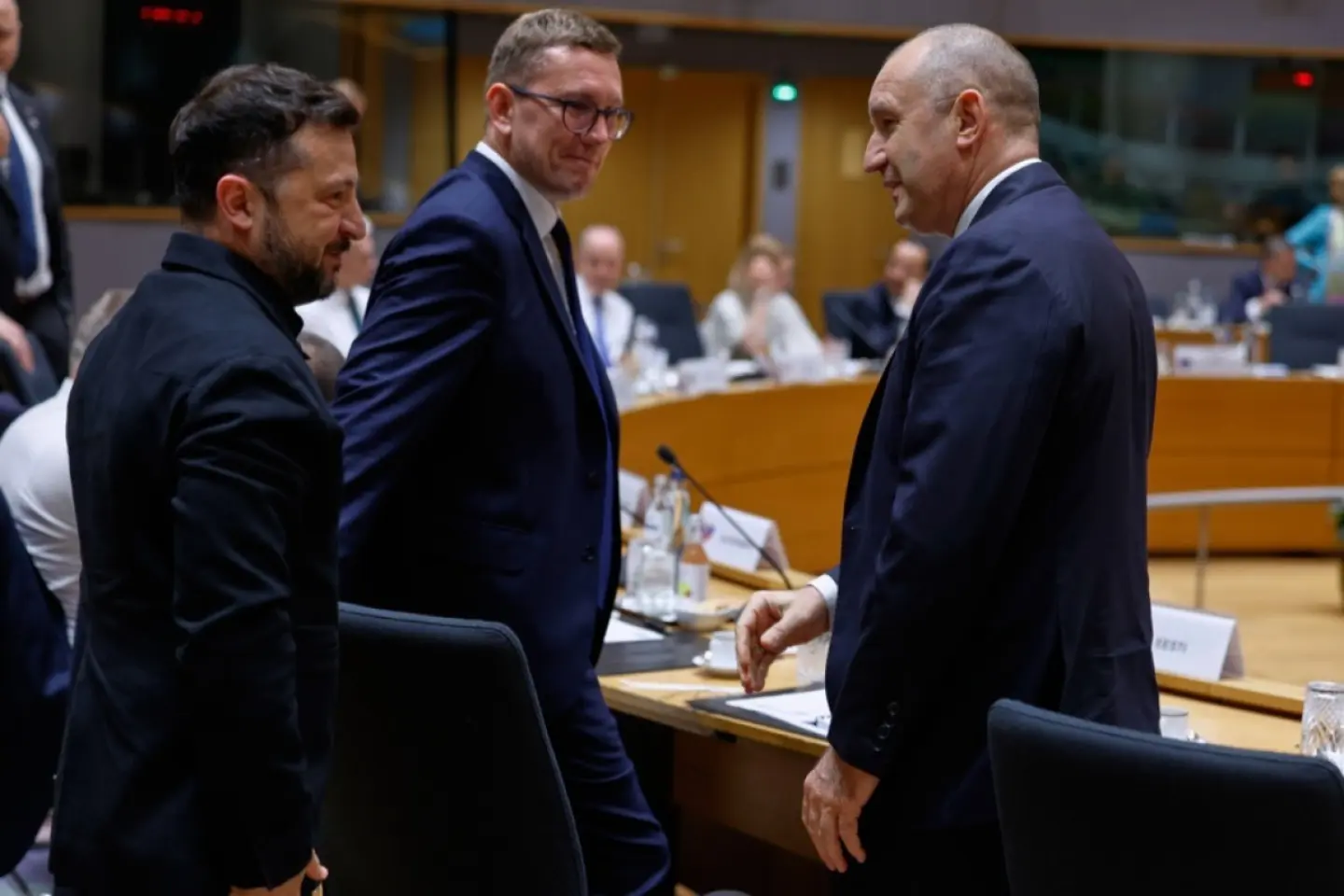
Since it was sworn in, Rumen Radev’s government ceased Sofia’s aid for Ukraine, and distanced itself from plans to beef up Bulgaria’s defense industry. It also took steps to shield former collaborators of the Communist era secret police, embraced pro-family narratives, and expressed support for Russia’s Orthodox Church.
Rumen Radev resigned from the Presidency in January and assembled a party with unclear political leanings called Progressive Bulgaria, its lack of positioning on the left-right spectrum also part of its allure. Radev promised reform and had a campaign empathetic to the common man’s struggles with price hikes and uncertainty, showcasing a new vision to eradicate corruption, even though he was shy from explaining how. Saying one thing, while hinting another, appearing as skeptic about a certain topic, yet never stating outright his position became Radev’s trademark.
His choice of words and dry attitude, self-branded as simply pragmatic, is representative for the shaky politics of his cabinet, ever since his Progressive Bulgaria party took office on May – a result of his landslide victory in April, supposedly ending Bulgaria’s election spiral and paving the way for a new era in local politics. The question that arises is what kind of political era?
Cutting the aid to Ukraine and putting on hold Bulgaria’s drive to modernize its army
"Previous governments made a firm long-term commitment to financial support for Ukraine with fixed annual contributions [...] I told our allies that Bulgaria will provide support according to its capabilities. This year there is no such capability”, said Bulgaria’s President-turned-Prime Minister Rumen Radev to local media on July 9.
There has never been a “fixed annual contribution” from the side of Bulgaria. Despite being a major seller of firearms to Ukraine, Bulgaria has made modest aids since 2022, with some decisions ending in red tape amid the country’s short-lived cabinets in recent years. It remains unclear what did Radev intend by saying that Bulgaria has no capability to provide support, except willingly positioning his country as weak.
One of Radev's most commented political maneuverings came on July 14, when the Prime Minister clarified why Bulgaria did not join the Coalition of Willing summit in Paris, despite being in the French capital attending Bastille Day and after a personal invitation by Emmanuel Macron. Radev said that he doesn't see Bulgaria's place at a summit that "insists on continuing financial and military aid to Ukraine". "For the first time, Bulgaria openly declares its national interest when it comes to imposing sanctions on Russia. As we see, there is nothing dramatic about a country defending its interests in a collective format", stated Radev. His call for a diplomatic-only, neutral approach won him a positive coverage on Russian media, while in Bulgaria local media experts were left guessing on whether this is part of a bigger strategy on Radev's part.
It’s not only about Ukraine. Last October, major German defense contractor Rheinmetall sealed plans to build a new arms plant in the town of Sopot – which has a tradition of arms manufacturing – with the promise of “next-generation technology” and the creation of more than 1,000 jobs. At the time, Bulgaria said that it would finance its participation through a loan of more than 400 million euros under the EU’s SAFE mechanism, which was set up to boost defense industrial production in Europe. Progressive Bulgaria is now backing away from the deal. On July 9, Economy Minister Alexander Pulev said that there are currently no funds available to build the project and questioned how favorable the terms are for Bulgaria. Opposition parties were quick to criticize the cabinet for sabotaging the deal and in essence, the opportunity for Bulgaria’s defense to be modernized.
Shielding Communism era secret service collaborators while embracing the “traditional family”, and the Russian Orthodox Church
Radev’s cabinet has also targeted the treatment of the country's Communist past. On June 25, Finance Minister Galab Donev, a close long-time ally to Radev, said that COMDOS – the commission for uncovering former security service collaborators – will cease to exist by the end of the year, and its activities will be transferred to the State Archives Agency. Deputy PM Ivo Hristov added that the organization – founded in 2007 as a step towards lustration by disclosing collaborators of the totalitarian communist services – has "exhausted its role” and is consuming an overblown state budget. This quickly saw vocal criticisms by researchers, experts and opposition voices, seeing this move as an attempt to hide the full scale of repression from the Communist regime and block the files’ availability by possibly changing rules of access. The future of the Commission will be decided by September 15.
In June, Radev’s party made another controversial move, declaring its support for the ‘March of the Family’, a counter-protest to Sofia’s annual LGBTQ+ Pride, which brands itself as saving the traditional values of the Christian family.
“At a time of moral disorientation, social fragmentation and profound demographic crisis, safeguarding the traditional family is not simply a matter of personal choice; it is a cornerstone of our national security, identity, and future,” Progressive Bulgaria MP Slavi Vassilev, formerly a political analyst often supporting the politics of Radev, said in a statement read to parliament on June 12.
Bulgaria’s Orthodox Church leader, Patriarch Daniil, attended the March and later met with Radev to discuss the idea of classes on “Goodwill and Christianity” in the country’s curriculum – an idea which has been promoted before but has remained highly unpopular amongst scholars because of insufficient specialists in the field, lack of strategy and possibility of conservative propaganda.
Several days later, on June 18, Radev threatened to veto a planned 21st package of sanctions against Russia over its war in Ukraine, which includes measures against the Russian Orthodox Church and its head, Patriarch Kirill. “I am not interested in the Russian Patriarch as an individual,” Radev told reporters. “I am interested in the fact that he is the head of the Russian Orthodox Church, which is Eastern Orthodox, just like our church. I am concerned about the millions of people who belong to that church.”
Testing the ground for future moves?
Rumen Radev eventually backed away from vetoing the package of sanctions as a whole. However, Sofia’s threat to do so did work: Patriarch Kirill’s name, and that of Lukoil’s boss, Vagit Alekperov, were removed from the list.
A pattern seems to emerge regarding moves and narratives pushed by Radev and his team. Someone says something that is quickly taken over by the media, triggering crossfires between politicians and generating alarmist headlines, only to fade away – Vassilev and Pulev did not follow-up too much on their comments after they’ve caused an outcry, Radev somehow softened his tone regarding the sanctions.
It’s almost like the cabinet is testing the grounds about which narratives can be instilled easily, which will see societal outrage (even if small-scaled, two anti-government protests already happened in Sofia in early July) and whether any of the political novices will gain a more particular traction.
This strategy is however running its course: on June 26, Market Links agency published a survey according to which Radev’s rating is already dropping with five percent – still, it has a high 53 per cent of approval from the society which means a wider discontent is unlikely to be experienced in the forthcoming months. This also begs the question on when and on what occasion the true face of the current office will show and how long these testing of the water will continue.