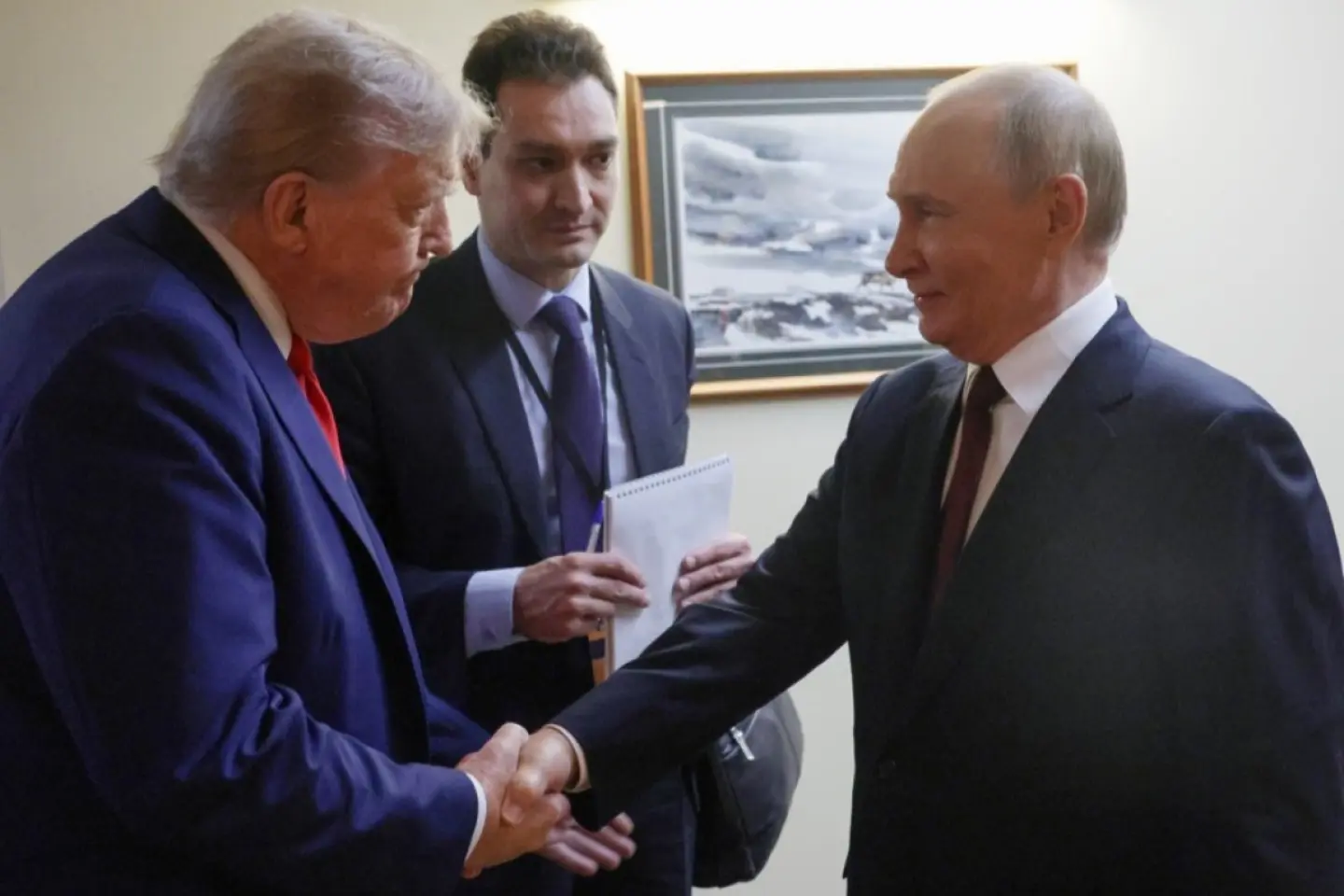
The war in Ukraine would have ended in 2025 had the US not abandoned, under pressure from Europe, the agreements reached by Vladimir Putin and Donald Trump in Anchorage, according to a false narrative promoted by Russian Foreign Minister Sergei Lavrov.
NEWS: The conflict between Russia and Ukraine could have ended a year ago if the US and Europe had honoured the agreements reached at the summit in Anchorage, Alaska, Russian Foreign Minister Sergei Lavrov said. According to Lavrov, the US decision to abandon those agreements under pressure from European countries prevented peace from being established. The minister also spoke of undisclosed attempts by some European countries to establish contacts through back channels, but said these talks had produced no new results [...]
The summit in Anchorage, Alaska, held on 15 August 2025 between Vladimir Putin and Donald Trump, focused on exploring ways to bring the Russian-Ukrainian conflict to an end. According to the Russian account, the two sides discussed a compromise plan that would recognise Donbas and Crimea as Russian territory and bring the “special military operation” to an end. The US and Ukraine subsequently denied, however, that any legally binding agreements had been reached.
Moscow’s demands remain unchanged: recognition of the new regions within their administrative borders and non-aligned status for Ukraine. Sergei Lavrov stressed separately that Russia remains open to dialogue, but that the “special military operation” would not be suspended during any potential negotiations [...] The minister added: “The US may say that the territorial issue needs to be resolved, but for Russia, what matters most is the people.”
NARRATIVES: 1. The US and Russia reached an understanding in Anchorage that could have ended the war, but Washington abandoned it under pressure from Europe. 2. Russia is ready for peace, but Ukraine and the West refuse to accept it. 3. Russia is fighting to protect people, while the US and its allies are primarily concerned with territory.
PURPOSE: To shift responsibility for the continuation of the war from the state that invaded Ukraine to the West; to retrospectively recast the Anchorage summit as a peace agreement sabotaged by the West; to legitimise the annexation of Ukrainian territories, including areas that Russia does not control; and to fuel divisions between Washington and European capitals.
Reality: No peace agreement, or even a ceasefire agreement, was reached in Anchorage.
WHY THE NARRATIVES ARE FALSE: The Trump-Putin summit on 15 August 2025 ended without an agreement on bringing the war to an end. The two leaders failed to reach an understanding on ending the armed conflict in Ukraine, although the US president described the talks as productive.
The issue resurfaced in June 2026. After Russian officials began accusing Washington, for the first time, of failing to honour the “spirit of Anchorage,” US Secretary of State Marco Rubio stated that “there was no agreement in Alaska”.
Lavrov is therefore presenting proposals discussed during negotiations as an agreement that had already been reached, and then using this premise to construct a narrative of a “peace” subsequently derailed by the West. No peace treaty was signed in Anchorage, nor was there a ceasefire agreement or any document requiring Ukraine to cede territory to Russia. Moreover, on 2 September 2025, less than three weeks after the summit, Donald Trump said he was “very disappointed” with Vladimir Putin.
Ceding territory does not guarantee an end to the war
Moscow is demanding that the Donetsk, Luhansk, Zaporizhzhia and Kherson regions be recognised in their entirety as Russian territory, even though it has been unable to capture them in full. According to the Institute for the Study of War (ISW), Russia controls approximately 79.9% of the Donetsk region, 99.8% of Luhansk, 75% of Zaporizhzhia and around 71% of Kherson. Since 2022, Putin has set at least 15 deadlines for the complete capture of the Donetsk region, none of which have been met.
Moscow is therefore demanding that Ukraine relinquish territory that the Russian army has not captured, while asking the international community to recognise these territorial claims as legitimate. In effect, Ukraine is being asked to voluntarily withdraw from territories that the Russian army has failed to capture since 2014 and then recognise Russian sovereignty over them.
Vladimir Putin has repeatedly made a ceasefire conditional on major territorial and political concessions. On 14 June 2024, he said Russia would cease fire and begin negotiations if Ukraine completely withdrew from the Donetsk, Luhansk, Kherson and Zaporizhzhia regions and abandoned its bid to join NATO. This was not, however, an offer to end the war. Putin also maintained his demands for Ukrainian neutrality, “demilitarisation” and “denazification,” as well as the lifting of Western sanctions.
In December 2025, Kremlin adviser Yuri Ushakov said that a ceasefire would be possible only after Ukrainian troops withdrew from the entire Donbas. There is therefore no commitment from Moscow that the “special military operation” would end if Ukraine ceded these territories, as Lavrov now implies. Statements by Russian officials refer to a possible ceasefire and the continuation of negotiations, not to a guaranteed peace. In other words, the victim is being asked to surrender territory first, while the aggressor reserves the right to decide later whether to end the war and on what terms.
Russia claims territory, but says it is fighting for people
Lavrov’s claim that the US is focused on territory while, for Russia, “what matters most is the people” turns the origins of the dispute on their head. Donald Trump’s special envoy, Jared Kushner, has recently said that Vladimir Putin had specified the territorial line Russia was demanding and that, if Ukraine withdrew to that line, “the rest of the deal” would largely be in place. The territorial issue therefore exists precisely because Russia itself has made territorial demands.
Lavrov’s claim is also contradicted by the consequences of the invasion. Mariupol, Bakhmut, Avdiivka and Lysychansk, cities in Ukraine’s predominantly Russian-speaking east, were devastated during Russian offensives. In the occupied territories, the UN has documented arbitrary detention, enforced disappearances, and the systematic use of torture and ill-treatment against civilians.
Moreover, in the same statement, Lavrov says that the “special military operation” will continue during any future negotiations. Moscow thus claims that its primary concern is people, while refusing to cease fire during negotiations: drone, missile and other attacks continue, and people continue to be killed and injured as a result.
The human cost of the war continues to rise. By the end of July 2026, the UN had verified at least 16,874 civilian deaths and 51,273 injuries in Ukraine since the start of the full-scale invasion, while noting that the actual figures are higher. Lavrov’s attempt to portray the West as concerned with territory and Russia as concerned with people therefore obscures the fact that the territorial demands come from Moscow, while the population the Kremlin claims to be protecting is directly bearing the consequences of the war it launched.
CONTEXT: The Trump-Putin summit in Anchorage in August 2025 ended without an agreement. The Trump administration subsequently continued negotiations through repeated contacts and visits by its envoys to Moscow and Kyiv. After Anchorage, Washington shifted its pressure towards Kyiv to accept territorial compromises, while several European leaders accompanied Volodymyr Zelenskyy to Washington, stressing the need for security guarantees and insisting that Ukraine must decide the future of its own territory. European leaders also called for transatlantic unity to be maintained and reaffirmed that borders must not be changed by force and that decisions concerning territory are for Ukraine to make. Lavrov is now portraying this position as European interference that prevented peace.
Check sources: